




Tadhib A'lam Al-Mawqi'een
44.85ر.س
Product description
Picked and refined by Abad Al-Thabit for the Imam Ibn Al-Qayyim
Introduction
Praise be to Allah, Lord of the worlds, and blessings and peace be upon the Messenger sent as mercy to the worlds, our Prophet Muhammad, and upon his family, companions, and followers who follow them with goodness until the Day of Judgment, and abundant peace and blessings.
To proceed:
Indeed, among the gems of the books of Muslims and especially the Ahl al-Sunnah, which has not been surpassed by any book over time nor equaled by any other, is the book "Telling the Messengers about the Lord of the Worlds" authored by Imam Abu Abdullah Muhammad ibn Abi Bakr Al-Zur’ei Al-Dimashqi, known as Ibn Qayyim Al-Jawziyyah, which he wrote for the select of those engaged in Islamic knowledge, for scholars, muftis, judges, and included in it the methodology of Ahl al-Sunnah wal-Jama’ah in dealing with the texts of Sharia, using analogy, and other valid indications that are among their distinctive approach.
The book "Telling the Messengers" is a lengthy work, divinely written in detail to establish its principles, comprehensive in providing examples and explaining issues. It is truly a book unparalleled in its time and in subsequent eras until our present day.
Since the zeal of students of knowledge has been limited in reading it, let alone grasping its benefits, I saw fit to refine it to make it more accessible to many students of knowledge. This refinement serves as an introduction to the original and an initial step before it, not a substitute.
This is the purpose of this book.
In this refinement, I followed the following methodology:
- I relied on the edition of Dar Al-Jil, and benefited from the edition of Dar Ibn Al-Jawzi, edited by Mashhoor Hassan.
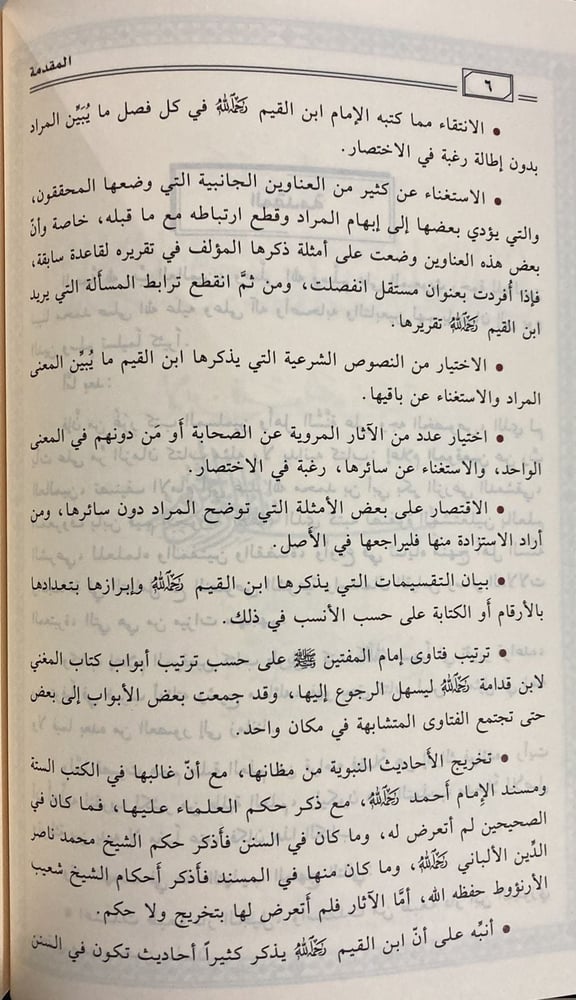
- I selected from what Imam Ibn Al-Qayyim wrote in each chapter what clarifies the intended meaning without lengthy elaboration, aiming for conciseness.
- I omitted many side headings placed by the editors, some of which lead to ambiguity and disconnect the relation with what precedes, especially since some of these headings were placed on examples mentioned by the author to illustrate the previous rule. If these are given as separate titles, they become disconnected, and the connection of the issue with Ibn Al-Qayyim’s clarification is lost.
- I selected from the texts of Islamic law that Ibn Al-Qayyim mentions what clarifies the intended meaning, and I omitted the rest.
- I chose a number of narrations reported from the companions or others that convey the same meaning, and I omitted the rest for the sake of brevity.
- I limited myself to some examples that clarify the meaning without including all; for those wishing to increase, they may refer to the original.
- I arranged the divisions mentioned by Ibn Al-Qayyim, may Allah have mercy on him, and highlighted them by numbering or writing as appropriate.
- I organized the fatwas of the Imam, the Mufti of Allah, according to the order of the chapters in Ibn Qudamah’s "Al-Mughni," and combined some chapters to gather similar fatwas in one place for ease of reference.
- I traced the prophetic hadiths from their sources, most of which are in the books of Sunnah and Musnad Imam Ahmad, with mention of scholars’ judgments on them. What is in the two Sahihs I did not address, and what is in the Sunan I mention the ruling of Sheikh Al-Dhahabi, and what is in the Musnad I mention the rulings of Sheikh Shuaib Al-Arna’ut, may Allah preserve him. As for the narrations, I did not undertake their tracing or judgment.
- I note that Ibn Al-Qayyim often mentions hadiths found in the Sunan and Musnad, choosing the wording from Musnad. Therefore, I place them in the Musnad. If the hadith is in the Sunan or some of them, I usually attribute it to one of them, especially if the wording matches that of one of the narrators without the others.
The agreed upon (authentic) hadiths are, at times, mentioned by Ibn Al-Qayyim with one of its wordings, which involves a question to the Prophet (peace be upon him). For example, in Sahih Muslim, and its meaning is also in Sahih Bukhari. In such cases, I attribute it to Sahih Muslim and do not treat it as a separate hadith like the narration of Imran ibn Husayn, where he said: The Prophet (peace be upon him) said: “One thousand and seventy from my Ummah will enter Paradise without reckoning.” They asked: “Who are they, O Messenger of Allah?” He said: “They are those who burn (with fire) and do not seek Ruqyah, and they rely upon their Lord.” Then ‘Ukasha stood up and said: “Pray to Allah to make me one of them.” He said: “You are one of them.” Then a man stood up and said: “O Prophet of Allah, pray to Allah to make me one of them.” He said: “‘Ukasha preceded you.”
If the hadith is repeated, I refer to it as “its tracing has preceded.”
In this refinement, I included only those hadiths that scholars have accepted as authentic or good.
In my tracing of the hadiths and their sources, I used the following numbering:
1 - Sahih Al-Bukhari, according to Fath Al-Bari.
2 - Sahih Muslim.
3 - Jami’ At-Tirmidhi, according to Ahmad Shakir.
4 - Sunan Abi Dawood, according to Muhyi Al-Din Abdul Hamid.
5 - Sunan An-Nasa’i, according to ‘Abd Al-Fattah Abu Ghuda.
6 - Sunan Ibn Majah, according to Muhammad Fawad Abdul Baqi.
7 - Musnad Imam Ahmad, according to Ihyaa’ Al-Turath.

From Dammam