Product description
Abdulrahman Al-Dahim Introduction
Praise be to Allah, and prayers and peace and blessings be upon the Messenger of Allah, and upon his family and companions, and those who follow his guidance. To proceed:
Indeed, one of the great blessings and kindness of peace and gentleness to all creatures is what Allah created for them from the domesticated cattle; so that they may thank Him constantly.
Have they not seen that We have created for them from what Our hands have made, animals that are beneficial, so they are their owners, and We have subdued them for them? From them, they ride, and from them, they eat, and in them, there is benefit, and drinks. Will they not be grateful? [Yasin: 71-73].
And the animals were created for you; in them, there is warmth and benefit, and from them, you eat. And indeed, in the animals, there is a lesson for you; We give you to drink from what is in their bellies, and in them, there is much benefit, and from them, you eat. [Al-Mu'minun: 21].
And Allah has bestowed favor upon the people of the cities by sharing with their pilgrims some of their rites and rituals. For the pilgrims, there are gifts, and for the people of the towns, there are blessings.
And indeed, one of the greatest acts of devotion that draws closer to Allah and His Lord on the Day of Sacrifice and the days of Tashreeq is the slaughtering of the sacrifice. It is among the most noble acts of worship and the greatest acts of closeness, and it is paired with prayer in the Book of Allah. Allah, the Most High, said: "So pray to your Lord and sacrifice" [Al-Kawthar: 12].
Ibn Kathir said: "The correct opinion is that the intended meaning of 'sacrifice' is the slaughter of the pilgrimage rites; hence, the Messenger of Allah, peace be upon him, used to pray Eid and then slaughter his sacrifice." (2)
Qatadah said: "Pray to your Lord on the Day of Sacrifice, and slaughter your sacrifice." (3)
Ibn al-Jawzi said: "And it was said by Ata and Mujahid and the majority." (4)
And Sheikh Islam Ibn Taymiyyah, may Allah have mercy on him, said: "The greatest of the financial acts of worship is the sacrifice, and the greatest of the physical acts of worship is prayer. What the servant gathers in prayer cannot be gathered in other acts of worship, as understood by the people of the living hearts and high ambitions. And what is gathered in his sacrifice from preferring Allah, good opinion of Him, strong faith, and trust in what Allah has is an amazing matter, if it is accompanied by faith and sincerity." (2)
And in the hadith: "No human being performs an act on the Day of Sacrifice that is more beloved to Allah than shedding blood. Indeed, it will come on the Day of Resurrection with its horns, hair, and hooves, and indeed, the blood is accepted by Allah before it falls to the ground. So, be pleased with it, and it will be pleased with you." narrated by Tirmidhi, and he said: "Hasan Gharib."
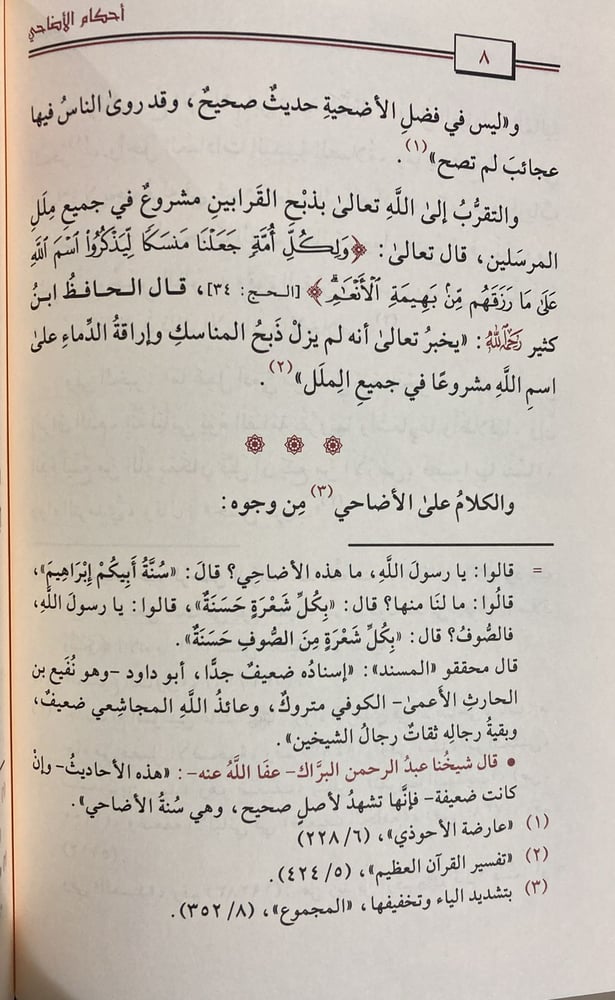
And the virtue of the sacrifice is a sound hadith, and people have narrated wonders about it that are not authentic. And drawing closer to Allah the Most High by sacrificing close relatives is permissible in all the religions of the messengers. Allah, the Most High, said: "And for every nation We have appointed a ritual that they may mention the name of Allah over what He has provided for them of livestock" [Al-Hajj: 34]. Al-Hafiz Ibn al-Jawzi said: "Allah informs that slaughtering the rites and shedding blood in the name of Allah has always been prescribed in all religions." (2)
And the discussion about sacrifices has several aspects: