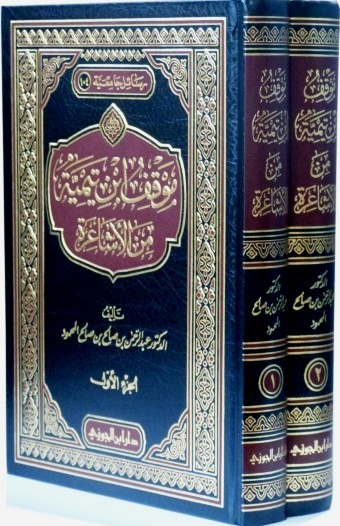
The stance of Ibn Taymiyyah regarding the Ash'aris 1/2
98.90ر.س
Product description
Abdul Rahman Saleh Saleh Al-Mahmoudi
This book addresses Ibn Taymiyah's stance towards the Ash'arites in its third part, where it presents his detailed responses to the Ash'arites on various issues of creed. And that Sheikh Al-Islam, when responding to opponents, transmits their statements verbatim — and this is one of the foundations of his methodology and scientific honesty, which has been previously clarified. Then he responds to them, and this approach is very beneficial for detailed discussions with the Ash'arites from their own books; because responses must be based on the statements of the Ash'arites from their books; because responses must be based on statements that have been accurately attributed to their author, understood correctly as intended by their authors, and not subject to distortion.
This book includes many topics, including:
First chapter: Ibn Taymiyah and the Ash'arites
It contains sections:
Section One: The life of Ibn Taymiyah.
Section Two: Ibn Taymiyah's methodology in establishing the creed of the Salaf and in responding to opponents.
Section Three: Abu al-Hasan Al-Ash'ari.
Section Four: The emergence of Ash'arism and their creed.
Section Five: The development of the Ash'ari school and their most famous scholars until the era of Ibn Taymiyah.
Second chapter: Ibn Taymiyah's stance towards the Ash'arites
It contains sections:
Section One: His general methodology in responding to the Ash'arites.
Section Two: His general approach in responding to the Ash'arites.
Section Three: His detailed stance regarding responding to them.
This book addresses Ibn Taymiyah's stance towards the Ash'arites in its second part. It discusses the Kullabites — their scholars — and before discussing the emergence of the Ash'ari school, it is necessary to mention the rise of a famous school that coincided with the Ash'ari school, and that is the Maturidi school, which is Hanafi in doctrine, along with its scholars and the scholars of their scholars who studied under the followers of Abu Hanifa. The Maturidi school is not far from Abu al-Hasan Al-Ash'ari; he is a fierce opponent of the Mu'tazila. They disagreed on issues they are known for opposing the Ahl al-Sunnah in, such as issues of attributes, creating the Qur'an, denying vision, power, and the eternal punishment of major sinners in hell, intercession, and others. They have written independent books on these topics; however, the Maturidi school did not respond to them from the perspective of the methodology of the Salaf — may Allah have mercy on them — but was influenced by the methods of the people of kalam, and thus agreed with them on some theological principles and adhered to their implications, which led to some statements that do not align with the doctrine of the Salaf, and in some ways, they are close to the Ash'ari school.
The Maturidi school is distinguished by several issues, including: the obligation of reasoning and the invalidation of blind imitation in issues of creed; sources of knowledge for them are the objects (sense perception), news, and reasoning; and the proof of the Creator's existence based on the occurrence of bodies built on the non-existence of attributes.
This book addresses Ibn Taymiyah's stance towards the Ash'arites in its first part, where the divisions and sects appeared at the end of the era of the Companions, continuing into the era of the Tabi‘un and those after them. After the Ash'ari school spread in the Islamic world and underwent developments that brought it closer to the Mu'tazila, philosophers, and Sufis, Sheikh Al-Islam Ibn Taymiyah was among the most prominent scholars who strongly opposed the Ash'ari school.
This book includes many topics, including:
First chapter: Ibn Taymiyah and the Ash'arites
It contains sections:
Section One: It discusses the life of Ibn Taymiyah, including:
- The first discussion: The era of Ibn Taymiyah and some issues and events that characterized this era.
- The second discussion: The biography of Sheikh Al-Islam Ibn Taymiyah and clarifying the well-known aspects in biographies.
Section Two: Ibn Taymiyah's methodology in establishing the creed of the Salaf and responding to its opponents.
Section Three: About the life of Abu al-Hasan Al-Ash'ari and his creed.
Section Four: The emergence of Ash'arism and their creed.
Section Five: The development of the Ash'ari school and their most famous scholars.