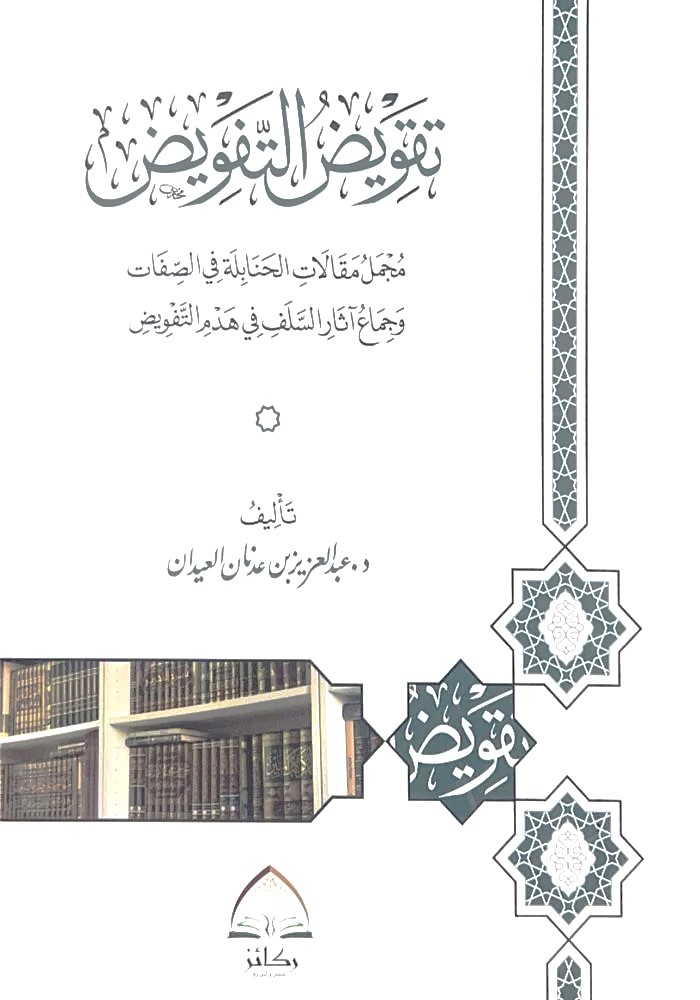
Undermining the delegation: the overall articles of the Hanbalis on attributes
20.70ر.س
Out of Stock
Product description
Author's name: Abdul Aziz Adnan Al Eid
Publisher: Rukaz for Publishing and Distribution - Kuwait
Book format: Fine binding with suede paper
Publication date: 1444-2022 AH
Book size: 17×24 cm
Number of pages: 246
The book "Taqweed at-Tafweed" is a collection of the Hanbali scholars' articles on the attributes of Allah.
In an era where waves of thought clash and methodologies multiply, the book "Taqweed at-Tafweed" serves as a guiding lighthouse illuminating the path for seekers of truth in the sea of Islamic creed.
This work is not just a treatise on jurisprudence, but a journey into the depths of correct understanding of divine attributes, steering the ship of thought toward the shores of certainty and monotheism.
Description of the book "Taqweed at-Tafweed"
Author: Abdul Aziz Adnan Al Eid
Source: Dar Rukaz for Publishing and Distribution, Kuwait
Print: Fine binding with suede paper
Release date: 1444 AH / 2022 AD
Dimensions: 17 cm × 24 cm
Pages: 246
The book "Taqweed at-Tafweed" is a study and analysis of the Hanbali scholars' stance on the issue of tafweed (delegation) regarding divine attributes.
The aim of the book is to clarify and correct the understanding of divine attributes according to the Hanbali methodology, based on sacred texts and the sayings of scholars.
Features of the book:
Deep scholarly approach: The book features an in-depth treatment of the issue of tafweed, providing precise analysis of texts and opinions.
Methodology: It follows a rigorous scientific approach in research and reasoning.
Comprehensiveness: The book covers various aspects of the topic, offering a comprehensive view of the Hanbali scholars' articles on the attributes.
Importance of the book:
The book gains significance as it addresses a central issue in Islamic creed—the understanding of divine attributes and how to deal with related texts.
It seeks to present a balanced understanding that prevents the reader from misinterpretation or ignorance, emphasizing the Salafi approach in dealing with these matters.
For those wishing to explore this subject deeply and gain a more accurate understanding of the Hanbali stance on tafweed, this book is a valuable reference.
The pages of this book serve as a bridge leading to a deeper understanding of creed issues, so make this book part of your library and get your copy now.

Questions you might have