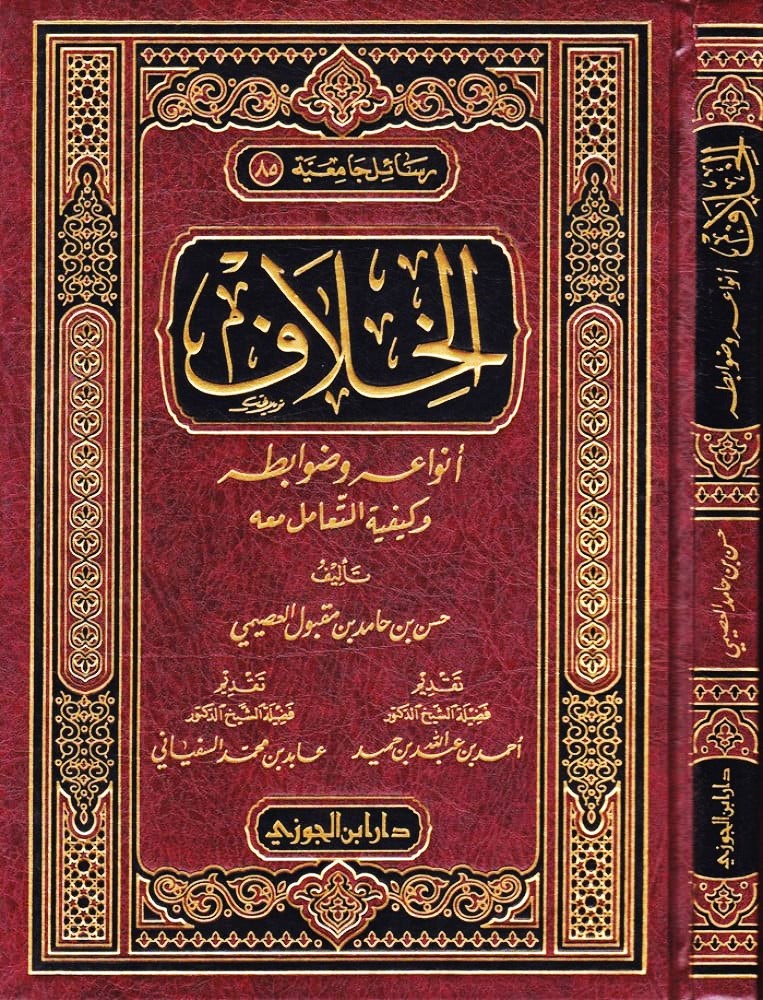
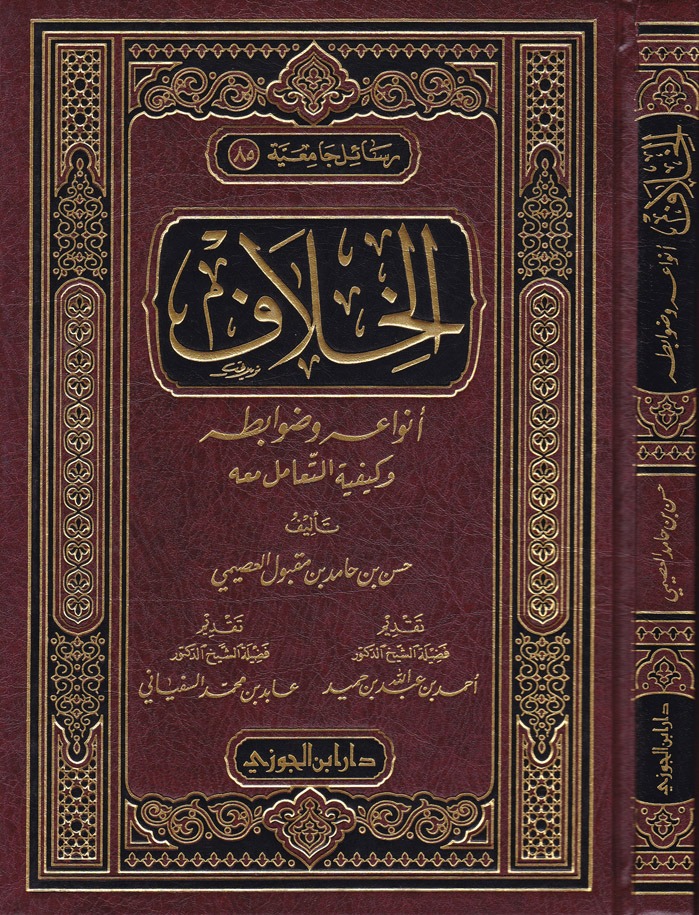
The disagreement types and its controls
29.90ر.س
Product description
Hamed Al-Asimi
Book Title: The Disagreement: Its Types, Rules, and How to Deal with It (Graduate Thesis)
Author: Hassan bin Hamed Al-Asimi
Presentation: Dr. Ahmed bin Abdullah bin Humaid, and Dr. Abed bin Mohammed Al-Sufiani
Edition: First, 1430 AH
Number of Parts: 1
Number of Pages: 229
Publisher: Dar Ibn Al-Jawzi
Book Technical Information:
Book Title: The Disagreement: Its Types, Rules, and How to Deal with It
Author Name: Hassan bin Hamed bin Maqbool Al-Asimi
Printing House: Dar Ibn Al-Jawzi
Edition Number: Second edition, 1436 AH
Book Size: Volume in (272 pages)
Introduction to the Book:
The book is originally a scientific thesis submitted by the researcher to obtain a master's degree from Umm Al-Qura University, and it was approved with excellent grade.
The author begins the book with an introduction and preamble.
In the introduction, he mentions: the importance of ijtihad, and that one of the conditions of the mujtahid is to be insightful about the places of consensus and the points of disagreement. Then he mentions the reasons for choosing the topic, and studies that discussed:
- Causes of juristic disagreement
- Theological disagreement
- The issue of considering disagreement
- The effects of disagreement among jurists
- The ruling on denying in issues of disagreement
In the preamble, he discusses: the reality of ijtihad, its importance, the conditions of the mujtahid, and the reasons for the differences among jurists.
In the first chapter: the author clarifies the intended meaning of disagreement and its types in two sections.
First section: Definition of disagreement
The author clarifies that the meaning of disagreement in linguistic and terminological sense is the same; as disagreement in Arabic means lack of agreement, and each person goes against what the other has gone.
He also favors the opinion that there is no distinction between the terms disagreement and difference, as there is no difference between them in Arabic, and they are frequently used by scholars without differentiation.
Second section: Types of disagreement
The author divides disagreement into two types based on acceptance and rejection:
First type: Blameworthy disagreement
This includes:
1- Disagreement among disbelievers
2- Disagreement among those with deviant sects and innovations
3- Disagreement in issues where there is no room for ijtihad
4- Disagreement in issues where there is scope for ijtihad but accompanied by injustice, desire, or tribalism
Second type: Permissible disagreement
It is the difference among mujtahids in issues where there is no definitive proof, known as juristic issues.
Chapter Two: Permissible disagreement
First section: Definition of permissible disagreement
The author refers to two definitions, one from As-Shawani and the other from Al-Shatibi, concluding that permissible disagreement is: statements issued from an authorized ijtihad legally.
Then he mentions the rules for permissible disagreement, which are as follows:
First rule: The person examining the issue is a mujtahid.
Second rule: The mujtahid exerts effort in examining the issue.
Third rule: The issue is one where ijtihad is possible, such as new cases lacking specific texts, or where evidence exists but the indication is ambiguous or there is conflicting evidence in known ways of conflict and preference.
Fourth rule: The motive for ijtihad is to follow the truth and seek correctness.
Fifth rule: The ijtihad is not a cause of enmity or hatred among the differing parties.
Second section: Evidence for the permissibility of permissible disagreement
The author includes evidence from the Quran, Sunnah, and scholars' sayings.
Third section: Rules of permissible disagreement and practical examples
The author divides the rules into two categories:
First: Rules related to the person examining or arguing for the issue, including:
1- The examiner should be a person of absolute or partial ijtihad.
2- The mujtahid should exert effort in examining the issue.
3- The intention should be to reach the truth, not follow personal desires.
Second: Rules related to the issue itself, including:
1- Absence of explicit, specific evidence, or evidence exists but its indication is non-definitive.
2- No resulting injustice, division, or conflict.
The author then provides examples related to permissible disagreement in doctrinal and practical jurisprudential issues.
Fourth section: How to deal with permissible disagreement
The author sees that dealing with permissible disagreement involves two levels:
First: How to deal with the statement or action that contradicts, as follows:
1- It is not a prerequisite for permissible disagreement that the disagreement be used as a basis for permissibility of the act or abstention.
2- There is no blame in juristic issues.
3- Discussions should be objective and fair to reach the truth, and not just dismiss the issue as merely differing.
4- The person examining the issue has the right to weaken the opposing statement, provided it is supported by evidence and proof.
5- It is recommended to avoid permissible disagreement.
Second: How to deal with the one who makes the opposing statement, as follows:
1- If the speaker is a scholar, this is considered a slip from him.
2- If the speaker is from the people of desires and innovations, dealing with him should be: advising him, clarifying the falsehood of his statement, using wisdom, good admonition, and gentle debate.
3- Avoid harming him and causing harm to others; this includes imposing disciplinary sanctions, considering the interests and harms involved.
Fifth section: The objectives of Sharia in regard to prohibiting permissible disagreement
The author mentions two objectives:
First: Preserving religion from alteration, change, and the creation of new sayings that imitate the lawful way.
Second: The Sharia came to achieve unity among Muslims and their consensus on truth, while blameworthy disagreement divides the nation and disperses their groupings.
Chapter Three: The blameworthy mistake of scholars
First section: Definition of the mistake of scholars
The author defines it as: statements issued from an unpermitted or unauthorized ijtihad.
He states that it has five cases:
1- The person examining the issue is not qualified for ijtihad.
2- The person is a mujtahid but fell short in his ijtihad on that specific issue.
3- His ijtihad and disagreement are on a matter with definitive evidence.
4- The motive for disagreement is following desires.
5- The issue causes enmity and hatred among the differing parties.
Second section: Evidence for prohibition of blameworthy disagreement
The author includes evidence from the Quran, Sunnah, and scholars’ sayings, indicating that most Quranic verses and prophetic hadiths on disagreement condemn it, either by criticizing all parties or one group and praising the other.
Third section: Rules of blameworthy disagreement
The author states that the rule for blameworthy disagreement is: that one of the rules of permissible disagreement is absent.
It has five cases: three related to the person, and two related to the issue.
Cases related to the person and the evidence for the disagreement:
First case: The person is not qualified for absolute or partial ijtihad.
Second case: The person is a mujtahid but fell short in his ijtihad.
Third case: The motive is desire and tribalism.
Cases related to the issue:
1- The evidence is definitive and conclusive.
2- The disagreement results in division, conflict, enmity, and hatred among Muslims.
Fourth section: How to deal with blameworthy disagreement
The author believes that dealing with blameworthy disagreement involves two levels:
First: How to deal with the statement or action without regard to the speaker, as follows:
1- Verify the authenticity of the news.
2- Not to spread or narrate this mistake among people.
3- It is not permissible to follow the scholar in this mistake, but it is obligatory to warn against it and clarify its error.
4- The ruling based on this mistaken statement should be invalidated.
Second: How to deal with the scholar who erred, as follows:
1- Advising the scholar and clarifying the error in his statement.
2- Not criticizing or condemning him because of that mistake, nor diminishing his status.
3- Benefiting from his other correct issues and beneficial sciences.
Fifth section: The objectives of Sharia in prohibiting blameworthy disagreement
The author mentions two objectives:
First: Protecting religion from alteration and the creation of false sayings that imitate the lawful way.
Second: The Sharia aims to maintain unity among Muslims and their collective adherence to the truth, while blameworthy disagreement disperses their unity and divides their community.
Chapter Four: The slip of the scholar
First section: Definition of the slip of the scholar
The author states that the term “slip of the scholar” refers to two meanings: one is his failure in ijtihad on a specific issue, and the other is his committing a sin openly before people.
Synonyms include: misguidance of the wise, stumbling of the scholar, and rare occurrences among scholars.
He favors the view that there is no authentic hadith from the Prophet (peace be upon him) warning against the slip of the scholar, but there are reports from some companions such as Omar ibn Al-Khattab, Muadh ibn Jabal, and Abdullah ibn Abbas, may Allah be pleased with them all.
Second section: How to deal with the slip of the scholar
The author believes that dealing with the slip of the scholar involves two levels:
First: How to deal with the slip without regard to the speaker, as follows:
1- Verify the accuracy of the news.
2- Not to spread or narrate this slip among people.
3- It is not permissible to follow the scholar in this slip, but it is obligatory to warn against it and clarify its error.
4- The ruling based on this slip is invalid.
Second: How to deal with the scholar who slipped, as follows:
1- Advising the scholar and clarifying the mistake in his statement.
2- Not criticizing or condemning him because of that slip, nor diminishing his status.
3- Benefiting from his other correct issues and beneficial sciences.

From Dammam