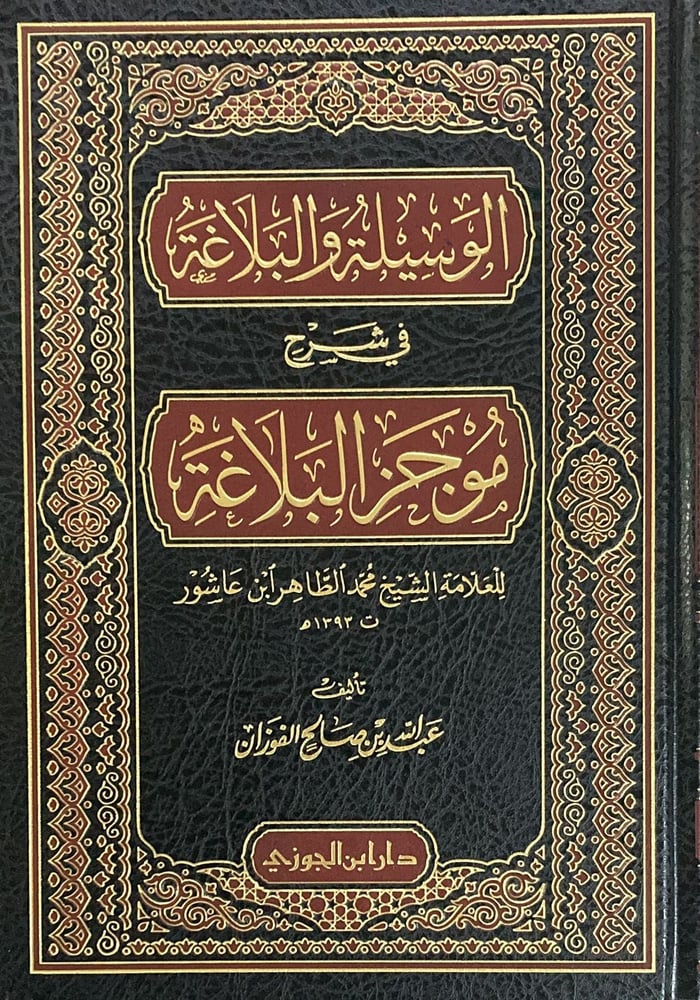
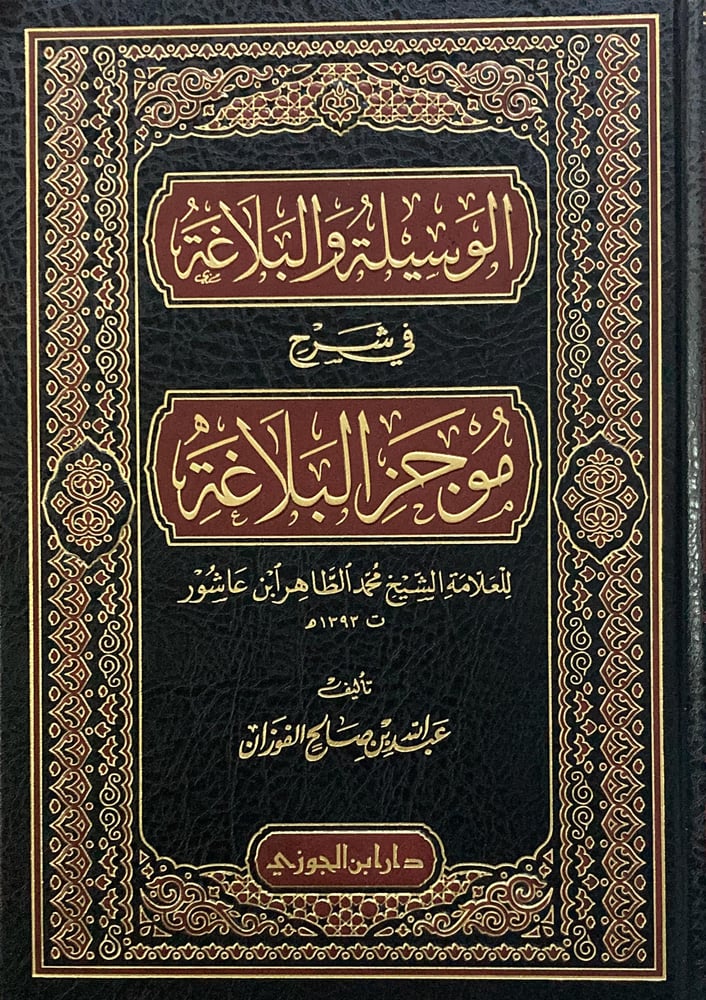


The means and eloquence in the concise explanation of rhetoric
60.50ر.س
Product description
For the scholar Sheikh Muhammad Tahir ibn Ashour
Authored by Abdullah bin Saleh Al-Fawzan
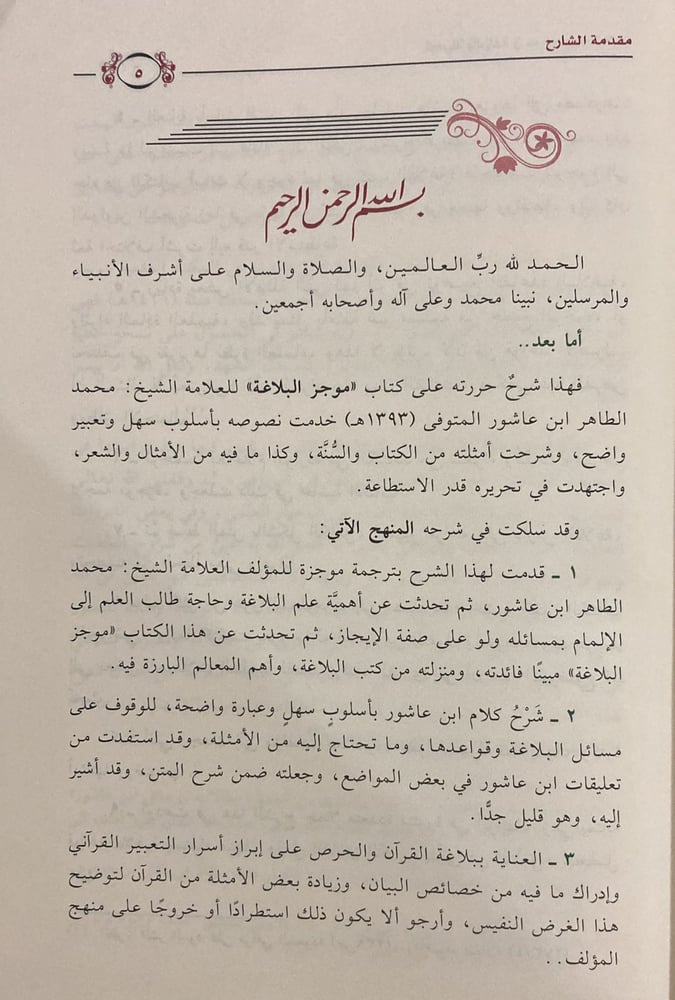
Introduction of the sharh
In the name of Allah, the Most Merciful, the Most Compassionate
Praise be to Allah, Lord of the worlds, and peace and blessings be upon the noblest of prophets and messengers, our Prophet Muhammad, and upon his family and all his companions.
As for what follows..
This is a detailed explanation I prepared on the concise book "Al-Balagha" by the scholar Sheikh Muhammad Tahir ibn Ashour, who passed away in 1393 AH. I have served his texts in an easy style, with expressions from the Book and the Sunnah, as well as examples and poetry, clearly. I explained his examples and endeavored to clarify it as much as I could.
In my explanation, I followed this approach:
1 - I began this explanation with a brief translation of the author, the scholar Sheikh Muhammad Tahir ibn Ashour. Then I discussed the importance of the science of Balaghah (Rhetoric) and the need for the student of knowledge to familiarize themselves with its issues, even briefly. Then I talked about this book "Al-Balagha Al-Mujaz" (The Concise Rhetoric), explaining its benefit, its rank among books of Balaghah, and its prominent features.
2 - I explained Ibn Ashour's words in a simple style with clear wording, to clarify issues of Balaghah, its rules, and what examples it needs. I benefited from Ibn Ashour's comments in some places, incorporating them into the explanation of the text, with references to him, though very few.
3 - I paid attention to the eloquence of the Qur'an, striving to highlight the secrets of the Qur'anic expression and to understand its characteristics of eloquence, adding some examples from the Qur'an to clarify this precious purpose. I hope this is not an unnecessary digression or deviation from the author's methodology.
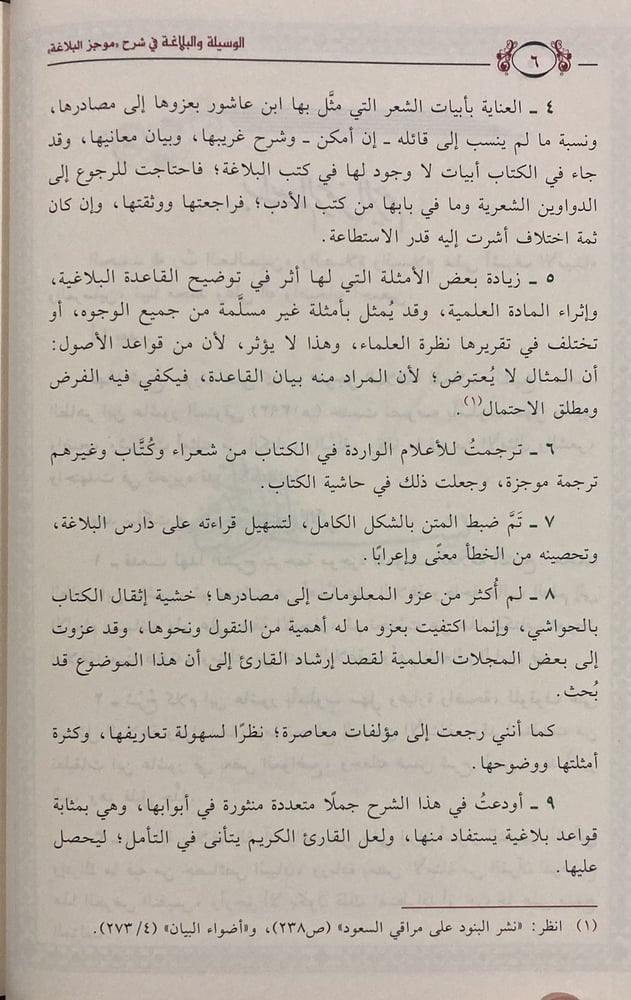
4 - I paid attention to the poetry verses that Ibn Ashour cited, attributing them to their sources, and if any were not attributed to their poets, I explained their unfamiliar words and their meanings. Some verses in the book do not exist in the books of Balaghah, so I revisited the poetry collections and related books, verified them, and pointed out any differences as much as I could.
5 - I added some examples that have an impact on clarifying the rhetorical rule and enriching the scientific material. Sometimes, examples may be from sources that are not accepted in all aspects or may differ in their presentation among scholars. This does not affect, because one of the principles of the fundamentals is that the example should not be challenged; its purpose is to illustrate the rule, and a hypothesis or general possibility suffices.
6 - I translated the notable figures mentioned in the book, including poets, writers, and others, briefly, and I placed this in the footnotes of the book.
7 - I fully vocalized the text to facilitate reading for students of Balaghah and to protect it from errors in meaning and grammar.
8 - I did not heavily attribute information to its sources to avoid burdening the footnotes, but I only attributed what is important, such as quotations and similar matters. I also referred to some scientific journals to guide the reader that this topic has been researched. I also referred to contemporary writings because of their easy definitions, numerous examples, and clarity.
9 - I included in this explanation many scattered sentences in their respective chapters, which serve as rhetorical rules from which benefits can be derived. I hope the dear reader will take time to reflect to grasp them.
10 - I do not claim perfection or near it in this explanation. I may have misunderstood Ibn Ashour's words in some places or misinterpreted his intent. But it is enough that I exerted effort in preparing it. Therefore, I ask the esteemed reader—especially the specialists—to kindly point out what they see as remarks.
11 - I relied on the old edition printed by the Scientific Library in Tunis in 1351 AH, which was photographed by Dar Adwa' Al-Salaf in 1426 AH. In my opinion, it is the best edition for this book, as is my custom in explaining texts—after exerting effort. I hope Allah makes it successful, though I was unable to obtain a handwritten copy.
This is, and my relationship with Balaghah (Rhetoric) began and my desire for it appeared during my studies at the Scientific Institute, then at the College of Sharia in Riyadh. Allah granted me success to teach it from 1394 AH for several years at the Scientific Institute and in some scientific courses. I also benefited from it in some of the explanations of Hadith that Allah blessed me with. I do not consider myself among its scholars or specialists who Allah has blessed with extensive knowledge, eloquence, and beautiful style, due to my limitations and my modest knowledge. But I wanted to contribute my part in this field, participating with researchers by explaining this "Concise" book, and striving to make it easier for students and to foster their love for it. I named it: "The Means and Rhetoric in the Explanation of the Concise Rhetoric" (Al-Wasila wal-Balagha fi Sharh Muwajaz al-Balagha).
If you, dear reader, see any weakness in the style of this explanation, or flaws in applying the rule, or misunderstandings, I admit my shortcomings and errors. I do not claim my words are free from mistakes or flaws.
I ask Allah to benefit from this effort; He is Hearing, Near, and Responding.
Written by Abdullah bin Saleh Al-Fawzan
On the last two nights of Dhu al-Hijjah, the concluding days of the year 1399 AH
Qassim / Buraidah
Alfozan.net@gmail.com

From Dammam