



Product description
Authored by Sheikh Mohammed Al-Fayez
Book of Tafsir (Overview) and Analysis - Translation - Features – Disadvantages - Best Edition
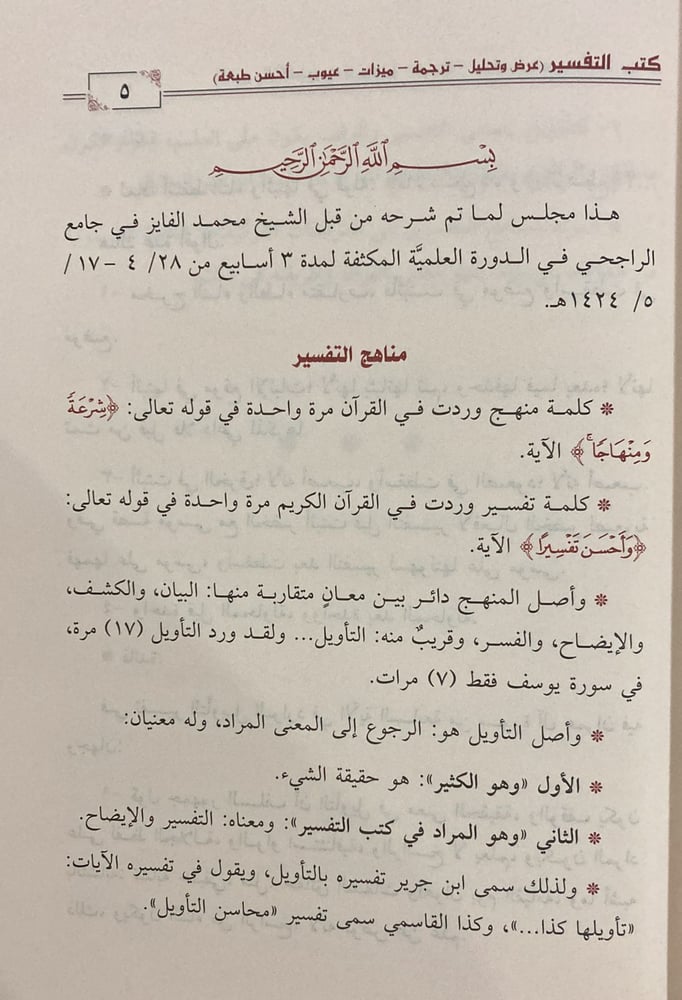
In the name of Allah, the Most Merciful, the Most Compassionate
This is a session based on what Sheikh Mohammed Al-Fayez explained at Al-Rajhi Mosque during the intensive scientific course for three weeks from 28/4 to 17/5/1424 AH.
Methods of Tafsir
The word "Method" (منهج) appeared once in the Quran in the verse:
﴿Shira'ah and Minhaj﴾ (a way or method).
The word "Tafsir" (تفسير) appeared once in the Holy Quran in the verse:
“And the best of explanations” (وَأَحْسَنَ تَفْسِيرًا).
The root of "Method" (منهج) revolves around similar meanings: clarification, revelation, elucidation, interpretation, and close to it: ta'wil (تأويل).
Ta'wil (تأويل) appeared 17 times in the Quran, only in Surah Yusuf (Joseph), 7 times.
The original meaning of "Ta'wil" is: returning to the intended meaning, and it has two meanings:
First, "which is often the true essence of something."
Second, in the context of tafsir books, it means: explanation and clarification.
Therefore, Ibn Jareer named his tafsir "Tafsir al-Ta'wil," and he says in his interpretation of the verses: "Its ta'wil (interpretation) is such and such..."
Similarly, Al-Qasimi named his tafsir "Masaaneh al-Ta'wil" (The Beauties of Ta'wil).
Benefit:
Book of Tafsir (Overview) and Analysis - Translation - Features – Disadvantages - Best Edition
Why was the letter "tā'" omitted and then confirmed in the phrase: "ما لم تستطع" and "ما لم تسطِع"?
There are several opinions:
1- The exit points of Tā' and Ṭā' are close, so it was confirmed in one place and omitted in another.
2- It was confirmed in the position of affirmation because, with its presence, the sentence is complete, and it was omitted afterward because it was already present, so there is no need to mention it.
3- It was confirmed in the "kharq" (break or difficulty) because it is more difficult, and omitted in "sudud" (ascension or rising) because it is also more difficult.
In the story of Moses with Al-Khidr, it was confirmed before the interpretation of Al-Khidr's actions due to their difficulty to understand for Moses, and it was omitted after the interpretation because they became easier for Moses—one before the attempt and one after the attempt.
Benefit:
In the interpretation of "Ta'wil" mentioned in the seventh verse of Surah Al-Imran, there are two opinions:
1- The majority of the Salaf (early Muslims) say that "Ta'wil" means the true reality, and the pause (waqf) is on the name of Allah (Allah), with the "waw" (and) being a continuation, and the firm scholars do not know the true meaning. The intended meaning of "tashabuh" (resemblance) is a real resemblance, such as the realities of attributes and the horrors of the Day of Judgment, and similar matters. The praise is from the firm scholars because it is delegated from knowledge.
2- "Ta'wil" in the sense of explanation, and the pause is on knowledge, with the "waw" being a conjunction, and the firm scholars know, and "mushabbah" (resemblance) refers to the non-real resemblance.
The meaning of "Method" (manhaj) in Quranic studies is the author’s explanation of understanding the meanings of the Quran and his approach in doing so.


