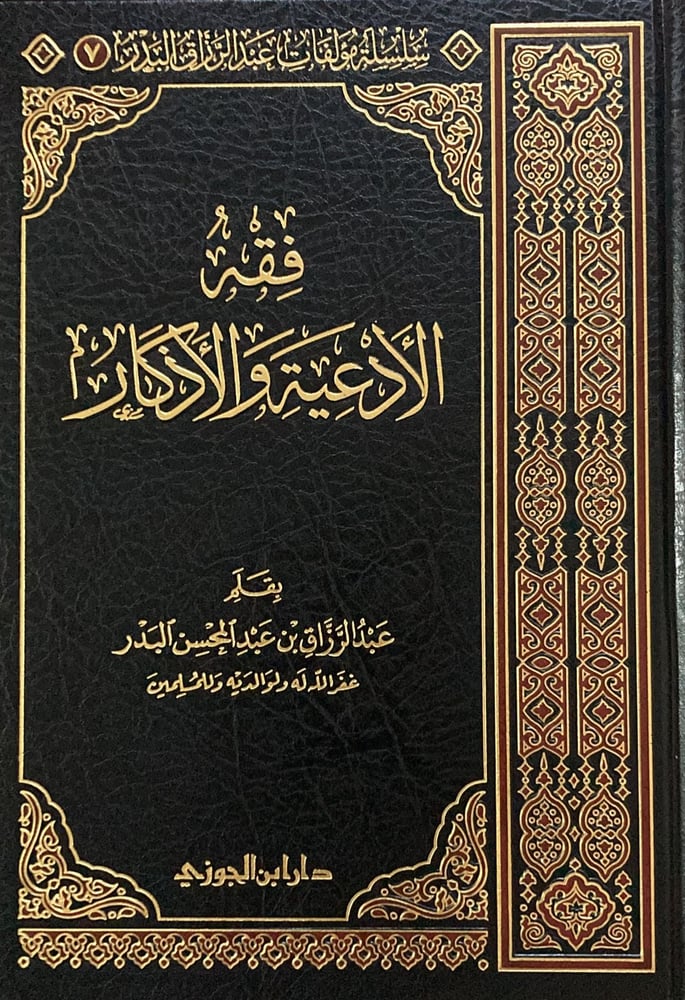


Jurisprudence of supplications and remembrances
63.25ر.س
Product description
By Abdulrazzaq bin Abdulmohsin Al-Badr
Introduction
In the name of Allah, the Most Gracious, the Most Merciful
All praise is due to Allah, we praise Him, seek His help, and ask for His forgiveness. We seek refuge in Allah from the evil of ourselves and from our bad deeds. Whomever Allah guides, there is no misleader for him, and whomever He misguides, there is no guide for him. I bear witness that there is no deity but Allah alone, with no partner, and I bear witness that Muhammad is His servant and Messenger.
O you who have believed, fear Allah as He should be feared, and do not die except as Muslims. [Al-Imran: 102].
O mankind, fear your Lord who created you from a single soul and created from it its mate, and dispersed from both many men and women. And fear Allah, through whom you ask one another, and the wombs. Indeed, Allah is ever Watchful over you. [An-Nisa: 1].
O you who have believed, fear Allah and speak words of appropriate justice. (70) He will amend for you your deeds and forgive you your sins. And whoever obeys Allah and His Messenger has certainly attained a great victory. [Al-Ahzab: 70-71].
After that:
There is no doubt that I have spent my time in what is better for the soul and more beneficial, which is the remembrance of Allah and His supplication. It is the best means by which a servant draws closer to his Lord, and it is the key to all goodness that a servant attains in this world and the Hereafter.
When Allah grants the servant this key, He intends to keep him astray, so the door of goodness remains open before him. (1). Thus, his heart remains restless, his heart is diseased, his thoughts are scattered, he is often anxious, weak in resolve and willpower. But if he preserves the remembrance of Allah, supplication, and frequent turning to Him, his heart will be tranquil through His remembrance (Indeed, in the remembrance of Allah do hearts find peace). [Ar-Ra'd: 28]. He will gain from the benefits, virtues, and fruitful blessings, both in this world and the Hereafter, beyond what can be counted except by Allah the Most High.
The remembrance of the Lord of the Throne, secretly and openly, removes misery and worry from you, and brings goodness in this world and the Hereafter. Even if Satan whispers to you one day, he will be dispersed. The chosen one (the Prophet) once told his companions that many who remember Allah often are distinguished in the race. (2).
Mu'adh was advised to seek Allah’s help in remembering Him and thanking Him with good deeds, worshiping Him. He was also advised to give advice to someone who came seeking counsel, and who was struggling with the burden of religious obligations, to keep his tongue moist with remembrance, as it helps in all matters and brings happiness.
He also said that the remembrance is a messenger for his people in the Gardens of Eden and the dwellings. Allah mentions that He remembers His servant and is with him in all matters. The remembrance remains in Paradise, and the obligation (Taqdeer) ceases when they are eternally rewarded.
Even if the remembrance is only a means to love Allah and to be guided, it is essential. The young man is forbidden from backbiting, gossiping, and all speech that corrupts the religion.
It would be a great fortune for us to have a strong desire to remember Allah abundantly. Yes, the blessed remembrance is good, but from our ignorance, our remembrance is scarce, just as our worship of Allah is limited. (3).
Therefore, the prescribed Islamic remembrances and supplications are of high status in religion, and hold a special place in the hearts of Muslims. Books of remembrance, in their various forms, are highly regarded and carefully attended to among them. It is impossible to count what scholars have written, both past and present, about remembrance and supplication, due to the vast amount of writings on this topic. Some narrate the hadiths with chains of narration, some are detailed and extensive, others are concise, moderate, and refined, with differences in collecting texts, presenting evidence, organizing, and classifying them, and explaining and clarifying them, among other matters.
Not to mention that the people of falsehood have many writings in this field, which contain deviation, distortion, and distance from the truth, due to their lack of adherence to the Sunnah and their neglect of the authentic traditions.
The Book and the Sunnah, along with the sayings of the Salaf, have indicated the types of permissible and recommended remembrance of Allah and supplication, as with other acts of worship. The Prophet (peace be upon him) explained to his nation what they should say in the morning and evening, during prayers and after, upon entering the mosque, when sleeping, waking, in times of fear, when eating and after, when riding, traveling, seeing what they like or dislike, during calamities, in times of distress and sadness, or other circumstances and times of the Muslim.
He also clarified the levels, types, conditions, and etiquettes of remembrances and supplications, in the most complete manner. He left his nation on a clear, straight path in this matter and all other aspects of religion. No one deviates from it after him except the doomed.
Undoubtedly, remembrances and supplications are among the best acts of worship, which are based on strict regulation and following, not on personal desires or innovation. The prophetic supplications and remembrances are the best that a seeker can pursue, and following them is a safe way, with benefits and results beyond what words can express, and other remembrances may be forbidden, disliked, or contain shirk, which most people do not realize. This is a lengthy topic with many details.
The obligation for a Muslim is to remember Allah according to what He has legislated, and to supplicate using the authentic supplications. Allah has forbidden excessiveness in supplication; therefore, we should follow what is legislated and established, just as we do with other acts of worship, and not deviate from it to other ways.
Among the most blameworthy are those who adopt sects not based on the Prophet’s teachings, even if they are associated with some scholars, and abandon the prophetic supplications that the Master of mankind, the leader of creation, and Allah’s proof over His servants, used to say. (2).
All goodness lies in following him, guiding by his guidance, and emulating his example. He is the best example and role model, peace and blessings be upon him. He was the most complete in remembering Allah and the best in supplicating to Him.
Therefore, when a servant gathers in this matter to adhere to the prophetic remembrances and supplications, understanding their meanings and intentions, and with a heart present during remembrance, he has achieved his share of goodness.
Ibn Al-Qayyim said: The best and most beneficial remembrance is that which the tongue witnesses with the heart, and it is among the prophetic remembrances. The one who remembers should understand its meanings and purposes. (3).
Introduction
Since this matter holds such high status and importance, I was motivated to prepare and present — despite my acknowledged incapacity and unworthiness — a study on the prophetic remembrances and supplications, explaining their jurisprudence, their great meanings, significant implications, profound lessons, impactful lessons, wise judgments. I have strived to compile the words of scholars on this topic, and I have gained many benefits, subtle insights, and precise warnings from the words of the verified scholars, especially the two great Imams, Shaykh al-Islam Ibn Taymiyyah and his student Ibn Al-Qayyim, may Allah have mercy on them both.
Then I organized what I had collected into a coherent work, titled: “The Jurisprudence of Supplications and Remembrances.” A large part of it was broadcast in episodes via the blessed radio station, the Holy Quran Radio in the Kingdom of Saudi Arabia — may Allah protect it — and its presentation continues to this day.
Many of my teachers and brothers have expressed their desire for me to publish it in print, so that its benefit may be multiplied and its usefulness increased. I made slight modifications to its style to make it suitable for publication, and I assigned a specific title for each episode indicating its content and guiding to its subject.
It will be published, God willing, in appropriately sized and themed collections. This is the first part of it. I pray to Allah, the Generous, that He accepts this work from me and from all my deeds, and that He blesses it, making it beneficial for His servants, the Muslims. He is the All-Hearing, the Responsive.
I cannot omit in this context my sincere gratitude to the esteemed Sheikh Abdul-Aziz bin Abdullah bin Baz, may Allah be pleased with him, who kindly read and commented on this book (1), and introduced it despite his many works. I ask Allah to place that among his good deeds, reward him abundantly for us and for the Muslims. He is the All-Hearing, the Responding.
And I have written, may Allah have mercy on him, Abdulrazzaq Al-Badr, and forgive him, and have mercy on him and his parents and all Muslims.

From Dammam