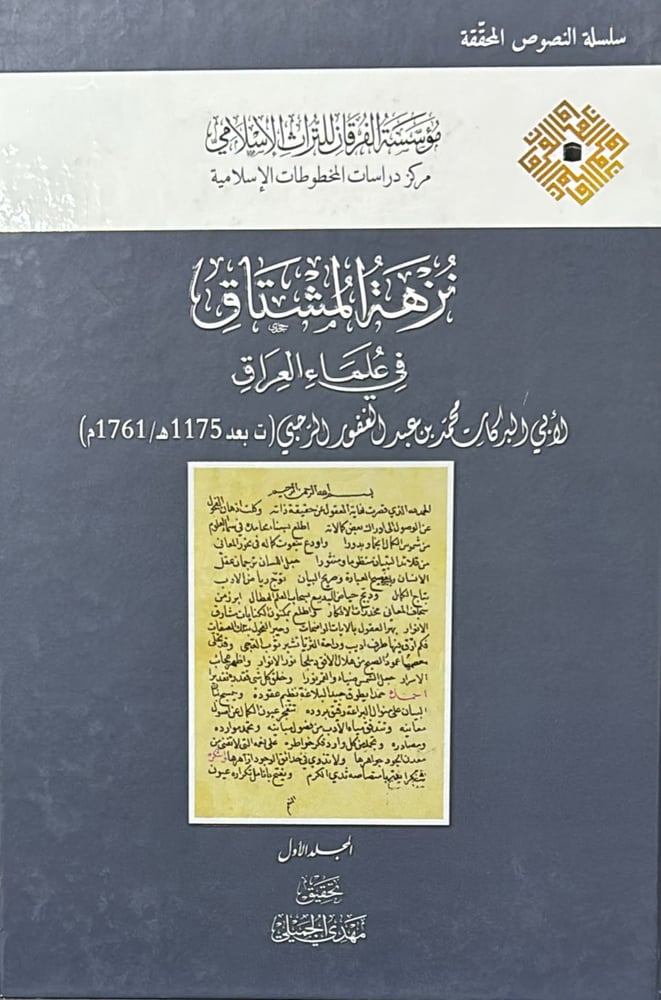
The Wanderer’s Excursion in the Scholars of Iraq 1-2
92ر.س
Product description
The Delight of the Seeker in the Scholars of Iraq 1-2 by Abu al-Barakat Muhammad bin Abdul Ghafoor al-Rahbi, Mahdi al-Jumaili
Summary
The Delight of the Seeker in the Scholars of Iraq
Abu al-Barakat Muhammad bin Abdul Ghafoor al-Rahbi (died after 1175 AH)
Edited by: Mahdi al-Jumaili
The book sheds light on an important stage of scientific life in Iraq, and it translates for a group of its most prominent scholars during that period, whom no one else had previously translated except al-Rahbi in this book.
The value and importance of the biographies come from the closeness of the compiler to the biographees, and his personal knowledge of them, as he translates some from the class of his teachers, others are peers, and some are from his family members, who are considered among the most prominent scholarly families in Iraq during that period.
The content of the book provides a picture of the scientific and literary level of the noble scholarly families that the author translated for their members, such as the Al-Haidari, Al-Suwaydi, Al-Omari, Al-Jubouri, Al-Khayri, and Al-Rahbi families, among others.
The time period around which the book revolves is considered one of the important phases in the history of the scientific movement in Iraq, which has not been adequately highlighted, and there is still a pressing need for more books documenting it, its scholarly activities, and its scholars.
The book is classified in a unique way in the art of authorship, as it essentially represents three books: the first in biographies, which includes biographies of the most prominent scholars of Iraq in his era; the second in maqamat, consisting of thirty-two maqamat modeled after the maqamat of Badi' al-Zaman al-Hamadani and Al-Hariri. The author competed with the aforementioned in beautiful expressions and exquisite style; and the third is a book of thirty-three chapters on literature and other topics, each dedicated to a separate subject, such as a chapter on knowledge and its people, a chapter on literature, a chapter on love and related matters, a chapter on the beloved and his conditions, a chapter on the Nasiib (poetic praise), and so on. The author demonstrated great skill in composition and citing evidence.
His arrangement is wonderfully crafted, mixing the three types together: biographies come first, then the chapter, and then a maqama, and so on until the end of the book.
Additionally, the book contains valuable scholarly letters, some of which have no copies other than in this book, most of them for the biographees, to demonstrate their scholarly prowess and firm foundation. Some letters may have been written in the style of the biographees, or letters from non-biographees to enrich and adorn his "Nuzha" (recreation).
The book was verified based on the original copy written in the author's handwriting, which he gifted to the Grand Vizier Muhammad Pasha Raghib. It is stored in his library in Istanbul to this day. Other copies of the book were considered, but the copy in the author's handwriting was deemed most important.
This book is considered a precious gem, a noble jewel, and a unique literary masterpiece in its content, due to the exquisite style of the author in composition, prose, and poetry, and the inclusion of literary and poetic evidence, representing some of the finest works written by Arab poets and writers across various eras.

Questions you might have