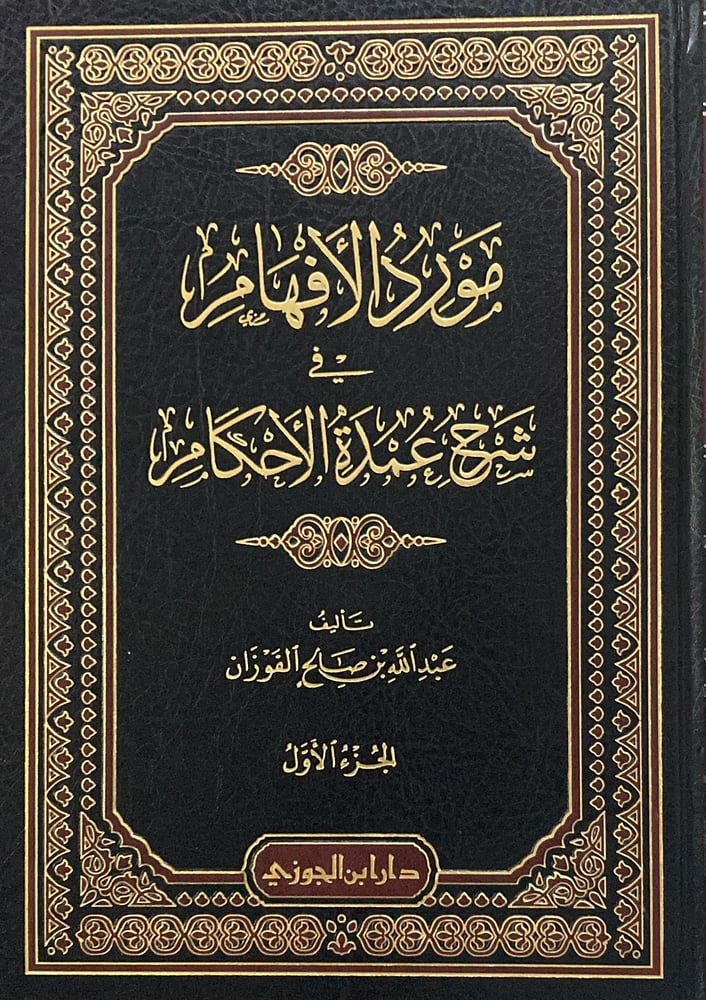


Mawarid Al-Ifhām Explanation of 'Umdat Al-Ahkam 1/4
190.90ر.س
Out of Stock
Product description
Sheikh Abdullah Al-Fozan
Introduction of Al-Sharh
Introduction of Al-Sharh
== Praise be to Allah, Lord of the worlds, and prayers and peace be upon the most honorable of prophets and messengers, our Prophet Muhammad, and upon his family and companions all together, and upon those who follow them with goodness until the Day of Judgment.
After that, this is an intermediate explanation I wrote on 'Umdat al-Ahkam' by Hafiz Abdullah bin Abdul Wahid Al-Maqdisi (d. 600 AH), to be suitable - God willing - for those engaged with 'Al-Umdat from memorizers and teachers, who seek help from it, and it is indispensable for the aspiring and the advanced.
In my explanation, I followed the following approach:
First: I made the discussion of the hadith in four main aspects:
- The first aspect: in the translation of the narrator. This is at the first mention of him, and I do not refer to his translation location in the book if it is repeated again, for the sake of brevity, unless the narrator's name appears in the text of a hadith, then I do not translate him within the explanation of the text, but I refer to his translation location in the explanation of his hadith that he narrated; to keep the topic consistent. The translation is not limited to the companion but I also translate the Tabi’i if the author of 'Al-Umdat' mentions him, whether he mentions him before the companion or separately.
- The second aspect: in the authentication of the hadith. This is by referring to the location of the hadith in Sahih al-Bukhari by mentioning the book, chapter, and number, and in Sahih Muslim, along with the chain of narration, relying on the numbering of the Salafi edition of 'Fath al-Bari' and the numbering of Muhammad Fawad Abdul Baqi for 'Sahih Muslim,' indicating whether the wording mentioned in 'Al-Umdat' is from Bukhari or Muslim after referring to the 'Sahihain.' If so, it means their wording is the same. If there is a benefit related to the grading, I usually mention it.
- The third aspect: in explaining the words of the hadith, including the translation of those mentioned in the text if they have no narration, and this explanation is simple and concise, unless the context requires clarification that necessitates mentioning the linguistic derivation, then I mention it. I also make sure to mention the grammatical analysis if it is important.
- The fourth aspect: in discussing what is derived from the hadith, by mentioning the benefits extracted from it in a concise manner, unless the context requires clarifying some of them or elaborating on them.
Second: I have endeavored to accurately record the wording of the hadith with full diacritics, and what in the wording has more than one meaning—linguistically or grammatically—I have not mentioned it, only indicating it in the explanation.
Third: I discussed the titles of books such as: the Book of Prayer, the Book of Fasting, with independent speech, while I included the chapter titles within the explanation of the words, for the sake of brevity.
Fourth: I limit myself to the jurisprudential issues or educational lessons that can be derived from the hadith, without going into other issues, seeking brevity, and because the aim is to clarify the jurisprudence of the hadith and to alert students that true jurisprudence is what is derived from the legislative evidence.
Fifth: If the hadith has a reason, or contains a problem, or a type of apparent contradiction, I mention that, limited to what I see as the most likely.
Sixth: I did not expand on mentioning differences of opinion in most issues, but I stick to the most likely opinion supported by evidence—at least in my view—unless the context calls for mentioning the disagreement, especially in issues not previously discussed in my previous explanations. Sometimes, presenting some issues may involve some length, which is rare. I also referred to 'Minhat al-‘Alam' in some disputed issues that needed to be briefly addressed.
Seventh: I was careful not to excessively quote texts from scholars’ speech to avoid lengthening the explanation of the hadith and increasing its size.
Eighth: I did not usually attribute the explanation of words or the benefits derived from the hadith to their sources, to avoid burdening the book with footnotes, only indicating—when necessary—some sources, unless the context requires citing sources.
Ninth: I tried to keep the structure of the book consistent, but some details or discussions on certain hadiths may be lengthy because the context demands that.
This material was mostly gathered from two sources:
The first: information taken from my two books: 'Minhat al-‘Alam' in explaining 'Bulugh al-Maram' and 'Al-Rawdah al-Afham' in explaining the additions of the Mahrir on 'Bulugh al-Maram,' with necessary modifications, because the texts in 'Al-Umdat' differ from those in 'Bulugh' and 'Al-Mahrir' by addition or omission. This required time and effort.
The second: information derived from other sources, including: printed explanations of 'Al-Umdat' such as: 'Ihkam al-Ahkam' by Ibn Daqiq al-‘Id (d. 702 AH), 'Al-‘Idah fi Sharh al-‘Umdat' by Ibn al-‘Attar (d. 724 AH), 'Riyad al-Afham' by al-Fakihani (d. 734 AH), 'Al-‘Idah' which is the marginal note of al-San’ani (1182 AH) on 'Ihkam al-Ahkam,' 'Kashf al-Litham' by al-Safarini (1188 AH), 'Sharh ‘Umdat al-Ahkam' by Sheikh Abdul Rahman al-Sa’di (d. 1376 AH), 'Al-Ilmam' by Sheikh Ismail al-Ansari (d. 1417 AH), 'Tanbih al-Afham' by Sheikh Muhammad al-‘Uthaymin (d. 1421 AH), up to the end of the book 'Hajj,' 'Tashil al-‘Alam' by Sheikh Abdullah al-Bassam (d. 1423 AH). May Allah have mercy on all.
We relied on the 'Umdat al-Ahkam' edition edited by Mahmoud al-‘Arnawut—may Allah preserve him—and then applied it with text and grading based on the edition edited by Nadhir Muhammad al-Faraybi—may Allah preserve him—because it is the best edition (according to my knowledge). I added what I reviewed of some words and corrected some printing errors. I also included the approval of the narrator companion of the hadith throughout the entire book, to keep the chapter consistent, because differentiation in such matters is human work, subject to errors, faults, and mistakes, just as the one who offers guidance in such observations—whether from misunderstanding, misattribution, or printing errors—may be benefited from that, God willing, in an upcoming edition.
I named this explanation 'Mawarid al-Afham' in the explanation of 'Umdat al-Ahkam.' I ask Allah to make my work sincere and purely for His face, beneficial for His servants.
He is the Hearing, the Near.
Written by Abdullah bin Saleh Al-Fuzan
AlFuzan.net@gmail.com
In the year 1438 AH

Questions you might have