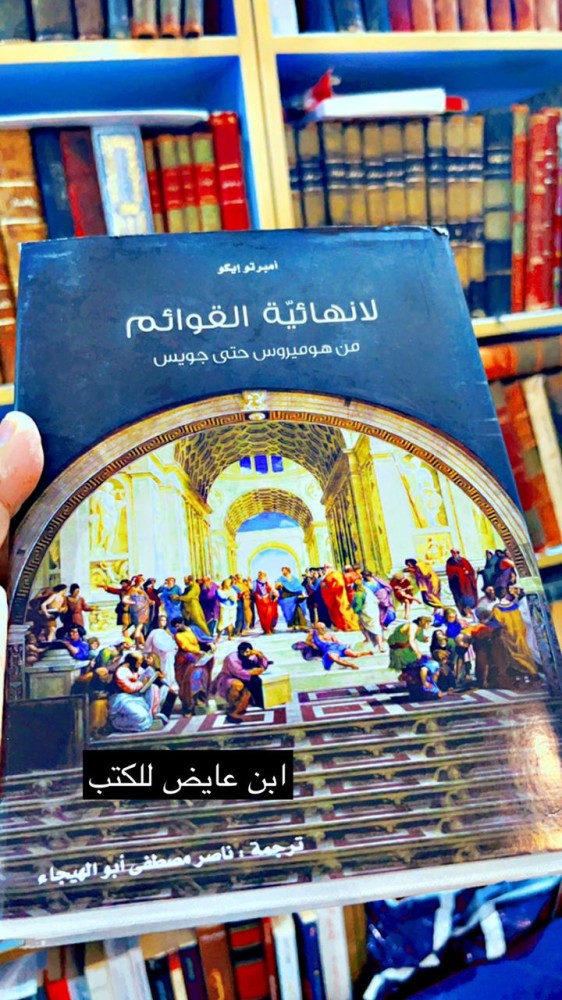
Product description
In this book, Umberto Eco chronicles the list, taking from the ship catalog in Homer's Iliad as the starting point, and passing through medieval literature, ending with modern and postmodern works. He examines in this book the phenomenon of collection, and the creation of lists, and the compilation of encyclopedias, and classification, across past eras, going so far as to suggest that this tendency in approaching things throughout Western cultural history as a whole, or rather, that there is an eternal return to the theme of the list and obsession with it that characterizes that history. Thus, Eco engages in a critical historical effort, observing Western endeavors to tame multiplicity and possess it within lists of things, places, wonders, collections, and treasures. This is fundamentally a critical effort, because Eco — as he mentioned — did not intend to undertake an unlimited historical survey, but rather to specify types of lists, and then, with his profound knowledge, to provide many examples of them, ranging from visual to verbal. These examples reach a level of abundance that evokes in the reader’s mind the internet, which Eco describes as: providing us with a catalog of information that makes us feel wealthy and unlimited capacity. The book, which came as a result of an invitation from the Louvre Museum, takes the reader on an enjoyable labyrinthine journey filled with pictorial images of battle scenes, lush gardens, angels, demons, treasures, and art collections, culminating in one aspect with an image of Campbell’s soup cans; taken from the Museum of Modern Art in New York. Eco speaks about the reason that prompted him to write this book, saying: "When the management of the Louvre invited me to organize, throughout October 2009, a series of conferences, exhibitions, reading sessions for the public, musical performances, film screenings, and other similar events, all related to a topic I chose myself, I did not hesitate for a moment, and immediately proposed the topic of (the list). If someone were to read my novels, they would find them teeming with lists, and the roots of this obsession stem from two subjects I studied as a young man: medieval texts and the works of James Joyce." Umberto Eco, an Italian philosopher, literary critic, novelist, and medieval scholar, whom he employed in his famous novel: "The Name of the Rose." Eco studied philosophy in the Italian city of Turin, worked in media and publishing, before becoming in 1971 a university professor of semiotics. He stopped teaching in 2007 after receiving more than 30 honorary doctorates. He is one of the most prominent semiotics scholars in the contemporary global culture, and has written on various topics, ranging between philosophy, literature, literary criticism, linguistics, and history. Among his books are: "Interpretation between Semiotics and Deconstruction," "The Sign: Analysis of the Concept and Its History," "The Reader in the Tale," "On Beauty," "On Ugliness," "Foucault’s Pendulum," and "Baudolino."
