Product description
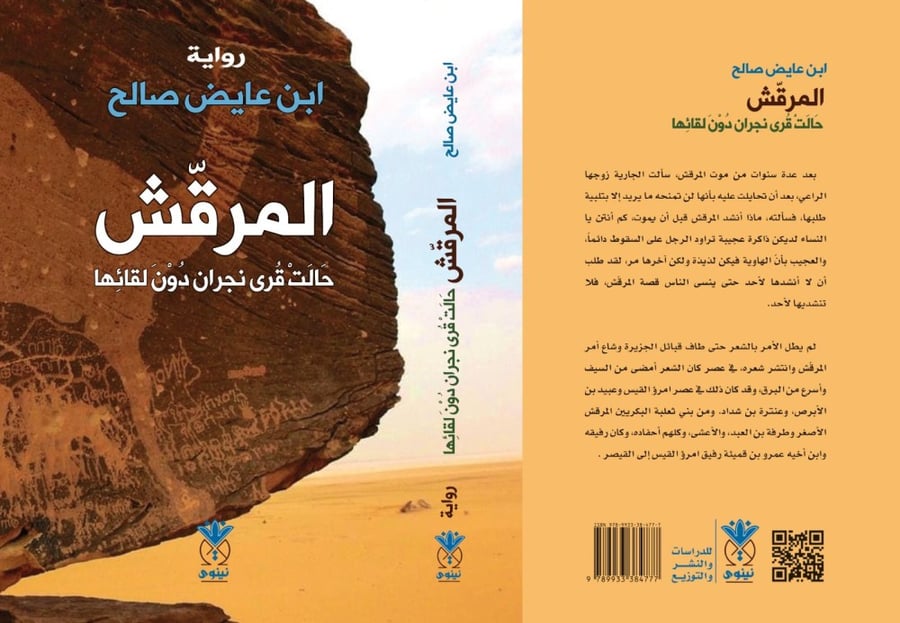
The novel "Al-Murqash" by Saudi Saleh Al-Yami employs artificial intelligence tours in the gardens of "Julliq" and the orchards of "Al-Yamama" and a love story in "Nineveh". Riyadh: Badr Al-Kharif, Al-Sharq Al-Awsat newspaper. The Saudi researcher and novelist Saleh bin Ayedh Al-Yami succeeded in employing one of the greatest stories of love and passionate love with its tragic ending and its chapters filled with drama, sadness, and self-mourning, in a novelistic way, with the re-employment of AI algorithms to form the closest image of the truth through the biography of "Al-Murqash," one of the most prominent poets of the Jahiliyyah and one of the heroes of the Banu Abs war. The novel was titled "Al-Murqash" and was published a few days ago by Dar "Nineveh" for Studies and Publishing. This is Al-Yami's eighth novel, preceded by: "The Engineer's Widow," "Shabeeb," "Al-Ghyaaf," "Kefana Huznan," "Leadership of Ideas Teaches Leadership," "The Hordaa Dance," and "The Doctrine of Hope 2022." It is known that the biography of "Al-Murqash" mixed heroism, love, and poetry after his uncle Awf deprived him of his beloved Asma and married her to a man from Murad (the horn of the gazelle) in his absence, claiming she had died. After discovering the truth, he traveled to Najran, as his grandson Tarafa bin Al-Abed says:
When he saw that there was no settlement for him
And that his love for Asma must kill him
He traveled from the land of Iraq, Murqash, on a joyful tune, rushing swiftly,
To the land of Sarw, driven by love,
And he did not know that death was lurking in Sarw.
His end came through the betrayal of his companions, and before death overtook him, he asked to send his ring in a vessel of milk with the shepherd to his beloved Asma. She recognized that he was Al-Murqash, who died a victim of love and loyalty, immortalizing an era forever.
The story of "Al-Murqash" enriches imagination with the intersection of many characters from that era. Al-Murqash was captured by Al-Muhalhil, his nephew Amr bin Qami'a, as well as Amr bin Saad Al-Murqash Al-Asghar, the owner of Bint Al-Mundhir, as well as Tarafa bin Al-Abed, and Imru' Al-Qais, who took Amr bin Qami'a on his journey to Byzantium.
Saleh Al-Yami narrated history in "Al-Murqash" by employing AI algorithms, as mentioned, to reach the closest image of the truth in the pre-Islamic era, and to attempt to correct the biographies and their chronological connections in that time. It is a novel that narrates history from a comprehensive, integrative perspective, as if it says that facts are incomplete unless they are dismantled and reconstructed with objectivity. The truth cannot argue with falsehood, and there is no shared dialectic between them. Love is an extended bridge that no one can demolish, but it is based on great sacrifice.
The novel includes several characters, including "Mas'ad," who is led by curiosity to fall into the pit of history, plunging into its depths to the point of drunkenness, as if "struck on his ears," and he did not wake from his sleep despite all attempts by the hospital, doctors, and his brother's crying for months. He was in a state of passionate love. Al-Murqash intoxicated him with his love for Asma while searching for the secret of his love for the city of Najran, discovering that others had preceded him ("I loved the love of good"), which made "Saeed" take it upon himself to find a solution, with the help of his friend "Salem," who specializes in reading the human brain with MRI technology, under the guidance of the wise and knowledgeable "Abu Saleh."
They built a machine supported by AI that re-narrates historical events and wars, preparing and utilizing all the information on the internet to inspire the past and reconstruct it. The main character was "Al-Murqash," Amr bin Saad Al-Bakri, who was the subject of Mas'ad's research before his coma, and the goal was to find out the reason behind Mas'ad's coma and his unwillingness to wake up.
Based on Abu Saleh's advice, if the machine detects the idea he is thinking of, communication with him might be possible.
The era of Al-Murqash was a hotplate in the Arab world: Qabadh and the Mandaic, Al-Mundhir bin Maa' Al-Sama', his wars with the Ghasasina, and his pursuit of the kings of Kinda, the peak of Christian disputes and disagreements over the nature of Christ, the Nestorians and the Jacobites, the consensus of Shimon Al-Arshami and Al-Murqash in Al-Mundhir's council when the Himiar King Dhu Nuwas' delegation arrived to tell them about the Najrān massacre and the story of Al-Hadid, the controversy and those behind it, poetry and its leadership of thought, and the role of the Jews of Tiberias in inciting seditions, controlling poetry recitation in taverns, and spreading it to sow discord and ignite strife, as well as their role in the Najrān massacre and the Al-Hadid incident, and the eternal dialogue between Dhu Nuwas and Saint Harith bin Ka'b.
He only woke up after hearing Al-Murqash's words echoing in Najran, recited by his brother Saeed, who kept repeating poetry unconsciously, and it was the most affecting to himself, flowing naturally and close to his soul:
"I struggle with the stubborn heart, longing,
Or is it you who is victorious over Asma, or is it you who is victorious?
He is wandering and not aware of Asma's heart,
Such is love’s passage and its consequences."
And the story continues with these touching excerpts:
"The millstone emitted a hoarse, sad sound, as if a mother was groaning over her children’s hunger and their death one after the other, helpless but patient, not bowing or hesitating before the horrors of this world.
The smell of crushed wheat on the rocks emanates, spreading a fragrant mixture of desire and life.
Do you know, Asma, to what high place I elevate her?
The flowers breathe her in, her whispers hidden in the shepherds' chants.
My longing for her manifests as a phantom in the air, and cool breezes blow on the thirsty face, as if she was created to adorn the universe, while I suffer, hoping the stone will pity me and inspire those around it to recite a poem healing its wounds, so that glory may emerge from its soul.
The suffering one is the mother of all glory for words; the more patience and resilience, the stronger the pull toward eternity.
Even if I am a lover, life is broader than a being
We can only see it through it,
But sight is not everything.
The image sprouts in the abundant soul,
To give birth to a universe,
And life’s mercy is boundless.
But I have become accustomed to lighting my fire with Asma’s name,
And over time, I believed in her as a goddess of fire.
This novel is the eighth among Saleh Al-Yami's works, preceded by: "The Engineer's Widow," "Shabeeb," "Al-Ghyaaf," "Kefana Huznan," "Leadership of Ideas Teaches Leadership," "The Hordaa Dance," and "The Doctrine of Hope 2022."
