

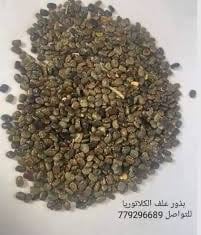




Clitoria seeds (blue tea)
30ر.س
Product description
Kleeja seeds or what is called blue tea
The package contains (200) grams of refined seeds suitable for planting
Benefits of blue tea:
This is "the smartest strategic decision" that livestock breeders can make, and it is scientifically called intercropping.
Integrating Kleeja (legumes/protein) with Bounikam or Roods (grasses/energy and fibers) creates what we call "the magic mixture" in the field before reaching the feedlot.
Here is why this combination is considered a genius idea, and how to implement it successfully:
1. Why the combination? (Benefits)
* Complete meal (Burger & Bun Concept): Bounikam provides "energy, fibers, and quantity," and Kleeja provides "protein." When you plant the field, you get a "ready mixed green forage" (natural TMR), so the animal does not need to add external protein concentrates.
* Saving chemical urea fertilizer: Kleeja is a natural nitrogen factory; it fixes atmospheric nitrogen into the soil, and Bounikam is "greedy" for nitrogen. Kleeja feeds Bounikam for free, greatly reducing your need to buy urea.
* Natural supports: Kleeja is a "climbing" plant that needs something to wrap around to produce abundantly and not rot on the ground. The strong stems of Bounikam act as columns (supports) for Kleeja to climb, exposing it to sunlight and increasing its production.
2. Which is better for intercropping: Bounikam or Roods?
Bounikam (Mombasa/Tanzania) is better for intercropping with Kleeja for the following reasons:
* Height: Bounikam grows upright, suitable for Kleeja's climbing nature.
* Compatible growth speed: Both need to be harvested every 25-30 days in the hot Jazan climate, so you do not have to sacrifice one crop to wait for the other.
3. The best planting method (practical application)
Do not scatter the seeds randomly (broadcast sowing) because Bounikam may dominate and choke Kleeja initially. The best system is the row method:
* Option one (row by row - 1:1): one row of Bounikam next to one row of Kleeja. This gives an excellent balance (50% energy - 50% protein).
* Option two (two rows Bounikam against one row Kleeja - 2:1): two rows of Bounikam opposite one row of Kleeja. This is more suitable if you want a larger quantity (tons) with a moderate protein ratio (about 16-18% for the mixed crop).
4. Golden tip for harvesting
When harvesting, you will find the forage is a homogeneous and very palatable mixture. But pay attention:
* Cutting height: ensure to cut at 10-15 cm above ground level.
* Reason: this height protects the "stump" (growth point) of Bounikam and protects the lower buds of Kleeja to resume growth rapidly.
Expected result:
You will get a very dense green field, high productivity, and nutritional value that will save you from buying "blocks" or imported soy.
Is your land currently equipped with an irrigation network? And is it drip irrigation or sprinklers? (Because the method of line distribution differs slightly).

From Alqumraa Wafarms Uha