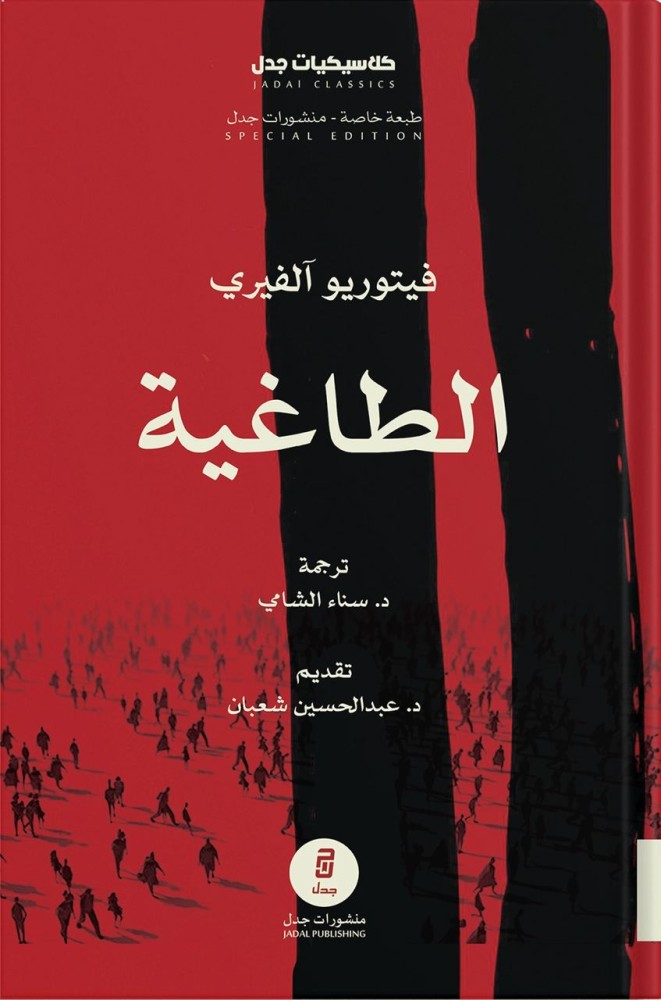
The tyrant, by: Vittorio Alfieri
46ر.س
Product description
Both democracy and dictatorship are two sides of the same coin, which is power. Just as Plato rejected the idea of democracy from its inception, considering democratic rule as corrupt, and placing it in a low rank among corrupt regimes, ranking it just before tyranny in the hierarchy of decline after the rule of tyranny, as mentioned in his book "The Republic." In the same degraded position, Aristotle classified democracy in his sixfold classification of forms of government, which he presented in his book "Politics," where he considered democracy among distorted and corrupt forms of government that do not seek to achieve the public benefit. The critique and opposition to the idea of democracy continued even during the Roman Empire. In the darkness of the Middle Ages, no one remembered or discussed the idea of democracy, at a time when Islam illuminated the world with civilizational concepts based on justice and humane goals and means.
After nearly two thousand years, the young Alifiri came to expose the concept of tyranny/despotism wherever it exists, whether it disguises itself as monarchy or republic, as if Alifiri lives among us today and perceives all the tricks of ruling, the surrounding plans, and the opportunistic personalities, and how the faces of authority resemble each other even if their colors differ. Alifiri analyzes the concept of tyranny/despotism with microscopic detail, just as a biologist studies beneficial and harmful microbes to reach a conclusion that has not changed and will not change throughout history: power that renews itself at the expense of everyone, including kings and presidents, and burns anyone who obstructs its perpetuity. Today, this is clear to all the peoples of the earth, and they have no choice but to unite under the umbrella of humanity and return to divine legislation to save their safety from the claws of tyranny. This will not happen unless they overcome their narcissistic ambitions, from which tyranny derives its existence.
Number of pages: 160

Questions you might have