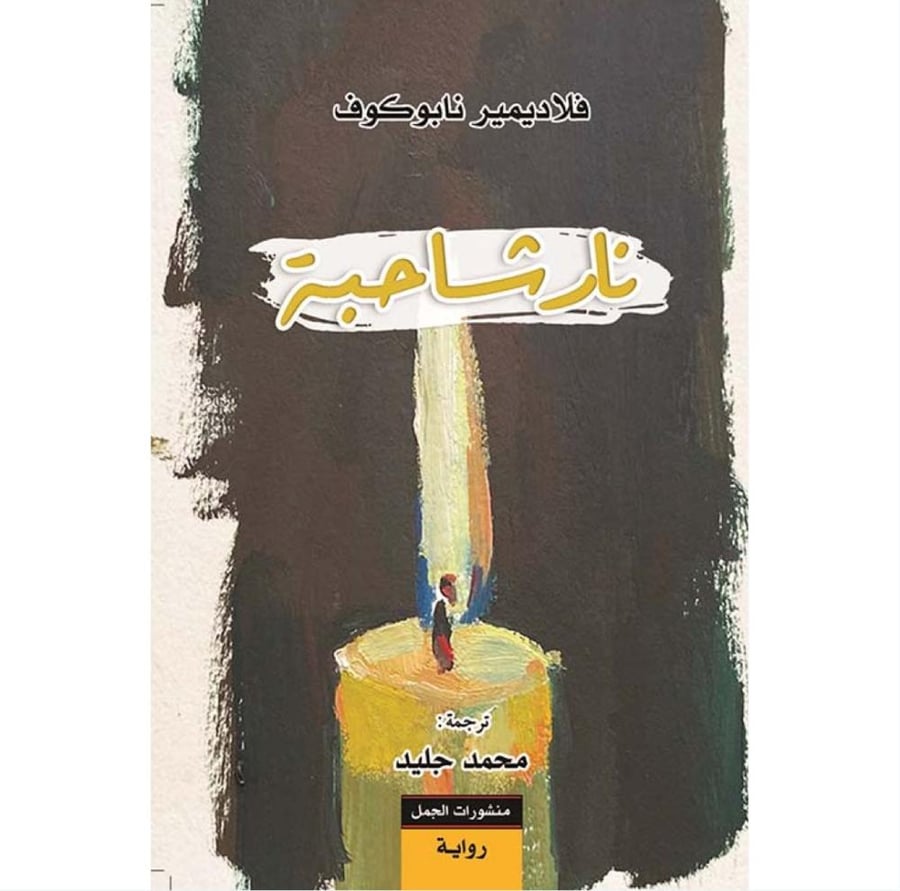
Pale fire
45ر.س
Product description
A pale fire, a poem with dual epic sections, consisting of nine hundred and nine and ninety-nine lines, divided into four parts, authored by John Francis Shaid (who was born on July 5, 1898, and died on July 21, 1959) during the last twenty days of his life, at his house in New Way, in Appalachia, United States of America. The manuscript, mostly a revised copy faithfully transcribed from which this text was taken, consists of eighty medium-sized indexed sheets, which Shaid kept at the top of each with pink superscript to record some notes (section number, date), and used fourteen light blue lines to write his poem, with a sharp pen, thin, elegant, and notably clear handwriting, leaving a blank line to show a double space between the lines, always using a new sheet to start a new section. The short first section (166 lines), with all its amazing birds and false suns, occupies thirteen sheets. The second section, dear to you, and the third, which indicates skill and brilliance with its striking impact, are similar in length (334 lines), each covering twenty-seven sheets. The fourth section leads back to the first, adopting its length, again occupying thirteen sheets, with the last four sheets containing a corrected version used on the day of his death instead of an error-free copy. John Shaid, a methodical man, used to copy his daily quota of complete lines at midnight, but even if he copied them again later, I suspect he sometimes did so, as he marked his sheets or sheets, not with the date of his final edits, but with the date of the corrected draft or the first correct version. I mean he kept the date of the actual creation rather than the date of second or third ideas. There is a noisy amusement park directly in front of my current house. We finally have a complete calendar of his work. The first section began in the early hours of July 2 and was finished on the 4th. He started the next section on his birthday and completed it on July 11. He dedicated another week to the third section. The fourth section began on July 19, and the corrected version, as previously mentioned, provides us with the last third of its text (lines 949-999). This third part, in appearance, seems quite unrefined, filled with erased marks and grossly filled-in areas, and does not strictly follow the pattern of the lines as in the revised copy. In fact, it appears that it is beautifully accurate once you delve into it and force yourself to open your eyes to the transparent depths beneath its turbulent surface. It contains no line with a flaw or obscure reading. This fact alone suffices to show that the accusations (dated July 24, 1959) in a newspaper interview with one of Shaid's claimants — who confirmed without having seen the manuscript that it "consists of drafts, none of which lead to a complete text" — are malicious fabrications by those who do not hope much to denounce the state in which death halted the work of a great poet, but rather to cast doubt on the competence of his current investigator and commentator, and perhaps on his integrity.
