


Melody and its transformations
13ر.س
Out of Stock
Product description
Introduction: The construction of the musical work is based on the two pillars: the musical instrument and the musical melody. In the case of a vocal work, lyrics and vocal sound are added, all integrated together, shaping the form and level of the vocal performance, where this general concept is consistent with the framework of the cultural identity within which the musical or vocal work is created. For this reason, musical and vocal outputs vary from culture to another, with the acknowledgment of the universality of arts in general, including music specifically, as a common human language that does not require knowledge of the sub-languages of cultures.
On the other hand, musical and vocal arts are considered a criterion for the cultural and social history of peoples and civilizations. Based on them, the levels of general mood and the overall intellectual framework in which these artistic works are produced are outlined.
For example, in the Arab context, Iraqi art stands out with its sorrowful tone, which manifests in poets’ poems, song lyrics, and musical melodies, contrasted with the joyful state of the Egyptian people; art, humor, satire, and a general way of life.
More precisely, in the context of musical and vocal melody, stages of the rhythm of life prevailing between one stage and another are highlighted. For instance, musical and vocal works used to feature calm and slow melodies, unlike today’s works enveloped in a fast, lively, and rapid rhythm. In my view, this can be interpreted within the framework of the daily rhythm of individuals and societies of previous stages compared to current ones, as speed has become the hallmark of contemporary life and the quick, accelerating reality.
Regardless of the foundation and interpretation through the standard of musical and vocal melodies from a general cultural and cognitive perspective, many questions remain about the system of melody, music, and singing—whether led by artists, audiences, or prevailing culture; or whether the lines of economic production are among the active players in this system; or whether all of these together, along with other influencers and creators.
This is what we have sought in your magazine (The Arab Magazine) to clarify and discuss.
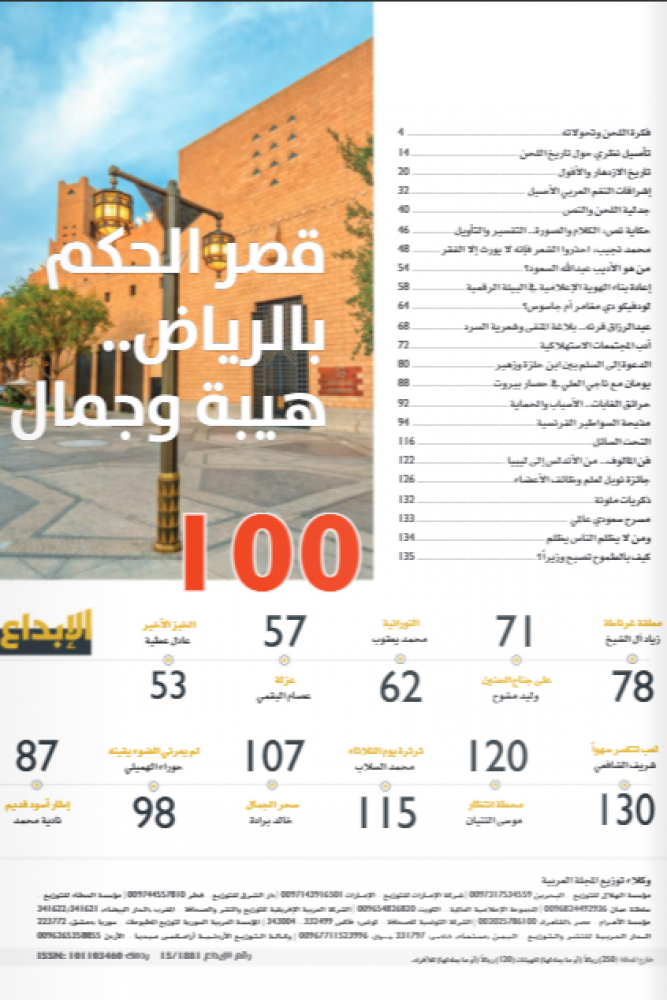
In this issue, you will read about:
Melody and their transformations
Who is the writer Abdullah Al-Saud?
Rebuilding the national identity
Nobel literature from Zanzibar

From Al Qatif