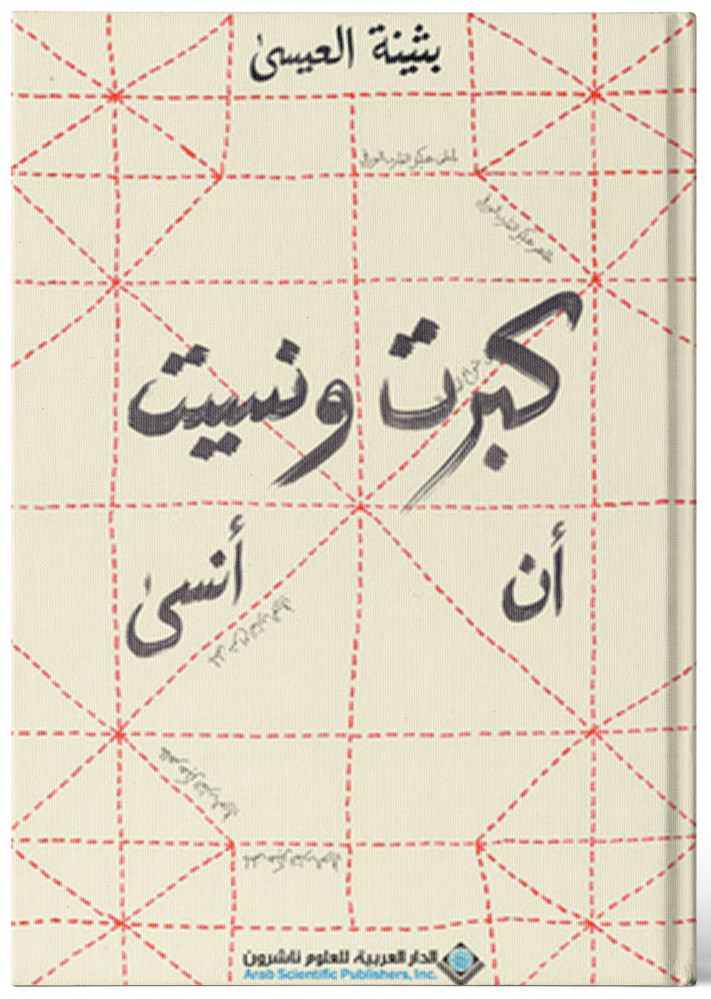
I grew up and forgot to forget - Buthaina Al Essa
45ر.س
Out of Stock
Product description
"She grows up and forgets," a phrase often said by an elder to a child when they are hurt or exposed to any form of harm. From this phrase, the story of Fatima unfolds, the story of the girl who grew up trying to forget, and... Fatima represents the children of what was known as the Awakening generation, the generation of religious movements that swept the region in the eighties and nineties of the last century. It is a movement that left deep scars in the Kuwaiti home, especially and the Gulf in general, from the banning of satellite channels, criminalizing music, poetry, drawing, and all forms of arts, to the repression of women and the confiscation of their right to make their own decisions—about education, work, and finally marriage. Fatima loses her parents in a car accident, and her older half-brother takes on the task of raising her, embracing this sacred duty with all possible enthusiasm, trying to "save what can be saved of her after 13 years of 'unsound' upbringing" that does not align with what he believes to be divine law. Fatima is subjected to various forms of domestic violence (verbal, physical, psychological) under the guise of religion, which her older brother skillfully uses to discipline her. When he almost succeeds in killing her morally under the pretext of reform, he gets rid of her by marrying her off to (Faris), who is an extension of the same patriarchal mentality, but without any reliance on the sacred. Fatima tries to forget her inner truth, the voice of the poetess emerging from within her, to keep up with what society expects from her, embodied in her husband and brother. But she does not forget... she only remembers. The novel is a journey of Fatima, from attempts to forget to confrontations with memory, and all her struggles to preserve her small and harmless rights in this barren life they decided for her. Her battle with the guardian who speaks in the name of religion at times, and tradition at other times, in an attempt to break through the matrix of alienation and achieve a small victory by writing poetry. In the end, Fatima realizes that the true hero of her story (and of our story) is poetry itself, which saves the lives of thousands of people every day, rescuing their souls from mutation and decay under the weight of spiritual and aesthetic dryness that totalitarian, patriarchal, and materialistic societies systematically and skillfully impose. In short, what the novel says is that our attachment to beauty, and our insistence on it, is an act of resistance." They told me always: you grow up and forget. When I fell and my eyebrow was cut, when my math teacher forced me to stand facing the wall because I forgot that 7 × 6 = 42, when my bicycle broke and they didn’t buy me another so I wouldn’t break it, when my soul’s bottle broke, when my parents died, when I didn’t die, when the world was too much and I was alone, when my sister cut my doll’s head because "Barbie" is forbidden, and when they shut down "Spacetoon" because "Pokemon" is forbidden. When they removed pictures of my mother and father from the frame and buried them in the broken drawer so that the angels wouldn’t cast them out... When the cracks in the walls filled with demons, when I was forced to enter the girls' college to preserve my chastity, when I was presented to a friend for marriage to preserve my chastity, when I tore the covers of my books to protect them from burning, when I wrote my first poem under a box of Kleenex trembling with fear, when my brother finally slapped me, they all told me: you grow up and forget. The problem is that I grew up and did not forget, I grew up and forgot to forget.
Type of cover: normal paper
Size: 21×14

From Al Qatif