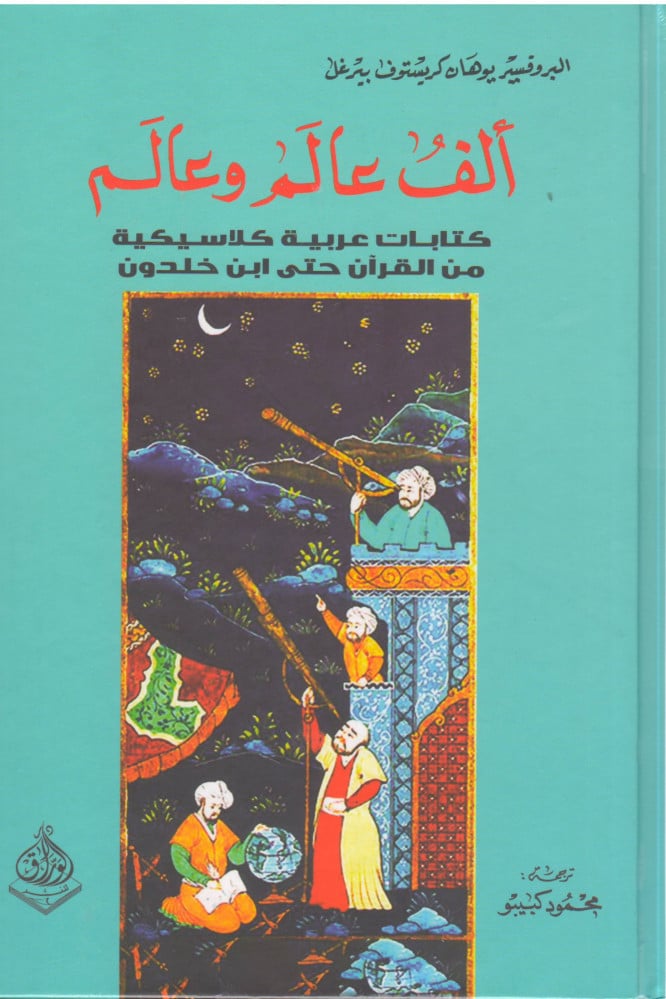
A thousand worlds and worlds - Johann Christoph Burgl
138ر.س
Product description
Type of cover: cardboard
Number of pages: 463
The Quran is according to Islamic belief the eternal word of God revealed by God to the Prophet Muhammad for the Arabs and all Muslims in the Arabic language — "Quran in Arabic" as repeatedly mentioned in the Bible. A book considered a guide for newcomers and a wonderful literary model for everyone who writes in Arabic in the future, as well as a reminder of what was in past ages. A book presenting the sacred history of the Jews and others from previous religions and civilizations, as in a bright-colored window. And this is not surprising because the Arabian Peninsula was not a barren desert without culture during Muhammad’s time, but a crossing and meeting point for great religions and cultures deeply rooted in antiquity: the Persians and Byzantines left their marks there, as well as ancient Arab kingdoms with significant cultural importance that had arisen there. When Muhammad began his call in Mecca, the two great neighboring empires were Persia and Byzantium. They still exist along with their subordinate states, the Lakhmids under Persia with their capital at Hira in Iraq, and the Ghassanids under Byzantium with their capital at Jabiya in Syria, 80 kilometers south of Damascus. No one at that time expected that these two empires would fall as a result of the call of that prophet active in distant Hijaz, at the hands of their victorious armies — Persia and the two mentioned states soon, and Byzantium — after defensive wars lasting several centuries, ending with the Ottoman conquest of Constantinople in 1453 AD. Wide-scale conquests were laid during the following decades and centuries, which in turn became the melting pot where cultures fused, resulting in great achievements in architecture, art, science, and literature of Islamic peoples. But Muhammad did not only use force for Jihad (in the way of God), but also set limits on the use of force, and above all, practical rules for peoples to coexist peacefully, specifically not only Muslims but also those called the People of the Book, i.e., other monotheistic religions, giving them the right to remain and live together with Muslims. Although this did not mean full equality, it enabled fruitful coexistence among followers of different cultures, which still exists today in Islamic cities. Through the translation of hundreds of scientific books from Greek, secular and rational thought received a huge push. Great philosophers, doctors, and natural scientists translated works, and while Greek poetry received little attention either because of its pagan nature or because it was difficult for translators, these translations formed the basis for the flourishing of scientific life in the Arab world: Arab philosophy moved until it merged into Sufism and theology along the lines of Aristotle. The vast expansion of the Islamic state encouraged travel and exploration, and trade developed between distant regions. Some travelers reached Malaysia and Indonesia by sea, or via the Silk Road to China, while others reached the heart of Europe, to central and eastern Germany and Poland, or via Iran and Turkmenistan to the Aral Sea and China.

From Al Qatif