
Heracles Crazy - Seneca
17ر.س
Product description
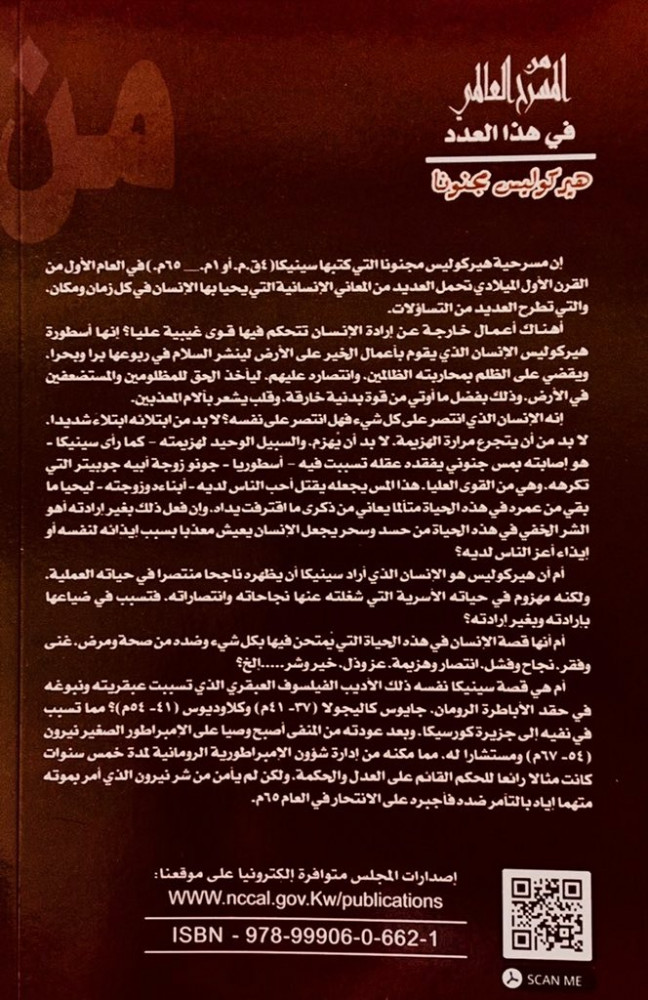
The play Hercules the Mad written by Seneca (circa 4 BC or 15 AD) in the first year of the first century AD carries many human meanings that humans live by in every time and place and raises many questions. Are there acts outside human will controlled by higher unseen forces? It is the myth of Hercules, the man who does good deeds on earth to spread peace in its land by land and sea and to eliminate injustice by fighting the unjust and triumphing over them to take the right for the oppressed and the weak on earth, thanks to his superhuman strength and a heart that feels the pain of the tortured. He is the man who overcame everything, so did he overcome himself? He must be tested with a severe trial; he must taste the bitterness of defeat. He must be defeated. The only way for his defeat — as Seneca saw — is to be struck by a mad spell that causes him to lose his mind, caused mythologically by Juno, the wife of his stepfather Jupiter, who hates him. She is one of the higher powers. This causes him to kill the dearest people to him — his children by his wife — so that he remains in this life suffering from the memory of what he committed. And if he does this involuntarily, is it the hidden evil in this life of envy and magic that makes humans live tortured because of harming themselves or harming their loved ones? Or is Hercules the man whom Seneca wanted to show as successful and victorious in his professional life but defeated in his family life, which distracted him from his successes and victories? Did he cause her loss by his own will and involuntarily? Or is it the story of humans in this life, tested in everything and against everything — health and sickness, wealth and poverty, success and failure, victory and defeat, honor and disgrace, good and evil...? Or is it the story of Seneca himself, the brilliant literary philosopher, whose genius and talent caused the hatred of the Roman emperors, Gaius Caligula (37-41 AD) and Claudius (41-54 AD); which led to his exile to the island of Corsica. After returning from exile, he became the guardian of the young emperor Nero (54-68 AD) and his advisor, which enabled him to manage the affairs of the Roman Empire for five years. He was a wonderful example of rule based on justice and wisdom, but he was not safe from Nero’s evil, who ordered his death, accusing him of conspiring against him, forcing him to commit suicide in 65 AD.

From Al Qatif