
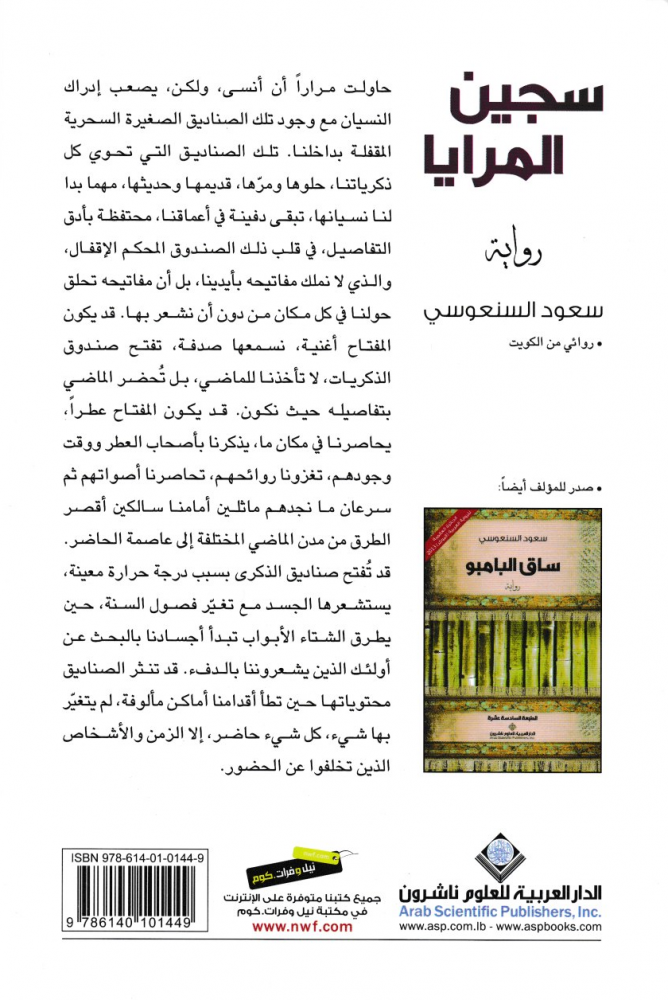
The Prisoner of Mirrors - Saud Al-Sanousi
29ر.س
Product description
In this work, the narrator approaches the human self and its hidden urges, skillfully blending modern narrative criticism theories with psychology and psychoanalysis techniques to craft a critical composition that seeks to explore multiple issues: homeland, the occupied other, punishment and reward, values and morals, sadness and loneliness, memories and associations. These are, in total, discourses or messages in which the novelist defines his perception of himself in relation to writing, and then leans toward focusing on the question of the act of writing, where insistence on experimentation appears as a strong demand, implying a preoccupation with the issue of the self. The story of its hero is "more like a boring cinematic film, with the main hero being the sadness that endured until the end. As for happiness, it is the poor girl who appeared in her white dress for a few minutes... As for my story, it was a dough of sadness, pain, orphanhood, and deprivation, sprinkled with traces of happiness too little to have any taste..." What distinguishes the work is that realistic vision tinged with the possibilities of romantic sentimentality and the tragic dimension, reflecting manifestations of loss and deprivation of the ego (individual) of the hero, as much as it points to the other side of the paradox, embodied in the dominance of terror imposed by the aftermath of the Kuwait invasion in the nineties on the hero's reality and the loss of his father, "Dawood Abdulaziz," who was martyred defending his country... From here, the narrative plot intensifies through the threads of the emotional scene marked by features of resistance, rejection, and arrogance that direct the behavior of the other—the aggressor—in contrast to the inflated sense of the ego with frustration and decline to the point of despair and atrophy in the hero. Especially after losing his mother later on. "Prisoner of Mirrors" is more than just messages or stories told from here and there; it is a deep dive into memory and a reading that encompasses this Kuwaiti diversity with all its vibrancy and astonishing backstage scenes. Al-Sanousi formulates a problematic where the (social and psychological) intertwines with the (cultural and cognitive) aspects of his country's history, highlighting between the lines the struggle between hope and despair, the surge of romantic love in its most sublime and delicate forms, and viewing the world solely through "the eyes of the heart."
Type of cover: regular paper
Size: 14×21

From Al Qatif