

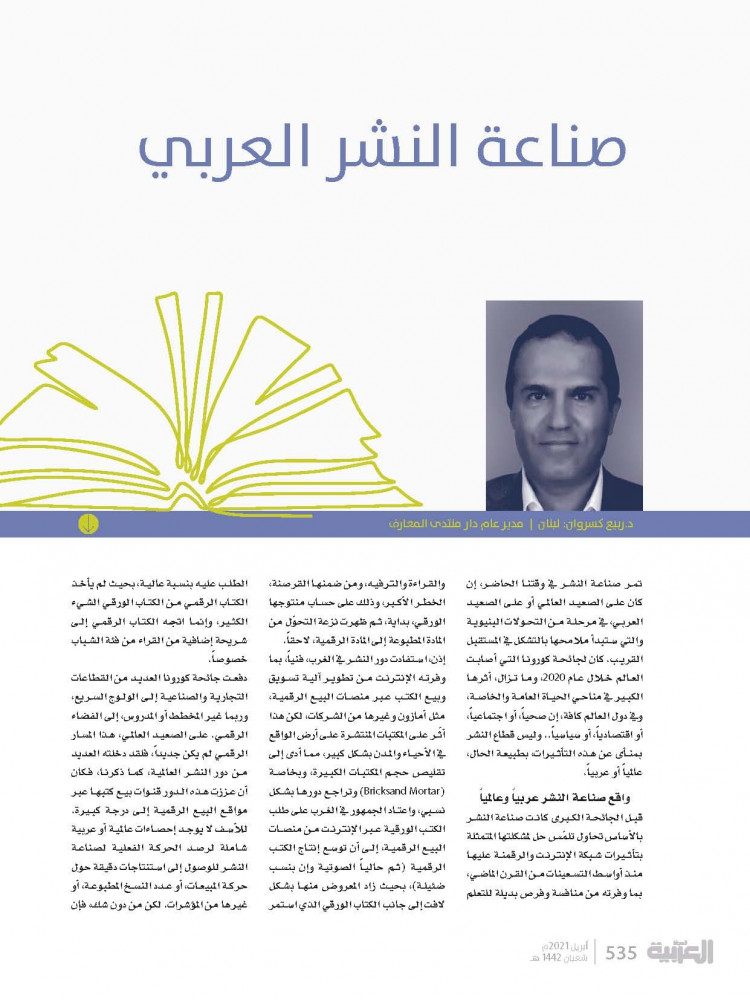

Arab publishing
13ر.س
Out of Stock
Product description
Introduction: The emergence of printing heralded the rise of new sectors and meanings for the traditional production line company that preceded it, and today, communication and information technology for the holiday (Eid) appears with a history that predates it. The sectors and contexts around which controversy revolves are witnessing a decline in the publishing industry and traditional methods of dissemination. The publishing industry, responsible for producing knowledge through books, translations, writings, and studies, faces many challenges today. The first of these is the existence of digital media that is easier, more accessible, less costly for transmitting knowledge, promoting it, reaching it, preserving it, retrieving it, and searching within it. The last challenge is the absence of official, institutional, and community support in general through issuing facilitation measures and discounts related to shipping, advertising, licensing, achievements of headquarters, issuing, funding projects, and more, as well as activating laws and legislation that limit violations of rights and intellectual properties. Today, I see that publishers face a critical, pivotal role that requires them to innovate mechanisms that can ensure their survival, which will not be achieved unless they confront the realities of the digital information and communication technology era. Will integration, for example, be one of the solutions? Or will they turn to digital publishing and adopt the production of electronic books (E-books), and what branches from it of audio, visual, and other copies? The role of book fairs remains significant, as they are considered the backbone of this industry, and through them, Arab publishers aspire to issue an international Eastern charter that provides facilitation measures to help sustain and develop this industry. Although it adopts the concept of the consumer production line, it is distinguished by its focus on the concept of awareness and deep human knowledge, which cannot have market and consumption values imposed on its exchange and identity. In conclusion, I greet you, readers of the Arab Magazine, with this file that carries debates about the knowledge industry, with the participation of a elite of publishers. In this issue, you will read: Arab publishing, Saud Al-Dughaythir... diplomatic tensions, blockchain technology, realism to the extreme, philosophy, legend, the concept of poetry in the opinion of Nizar Qabbani, Tawdih Fathnama on Persian historical writing, a deeper look at the water lilies painting.
From Al Qatif