
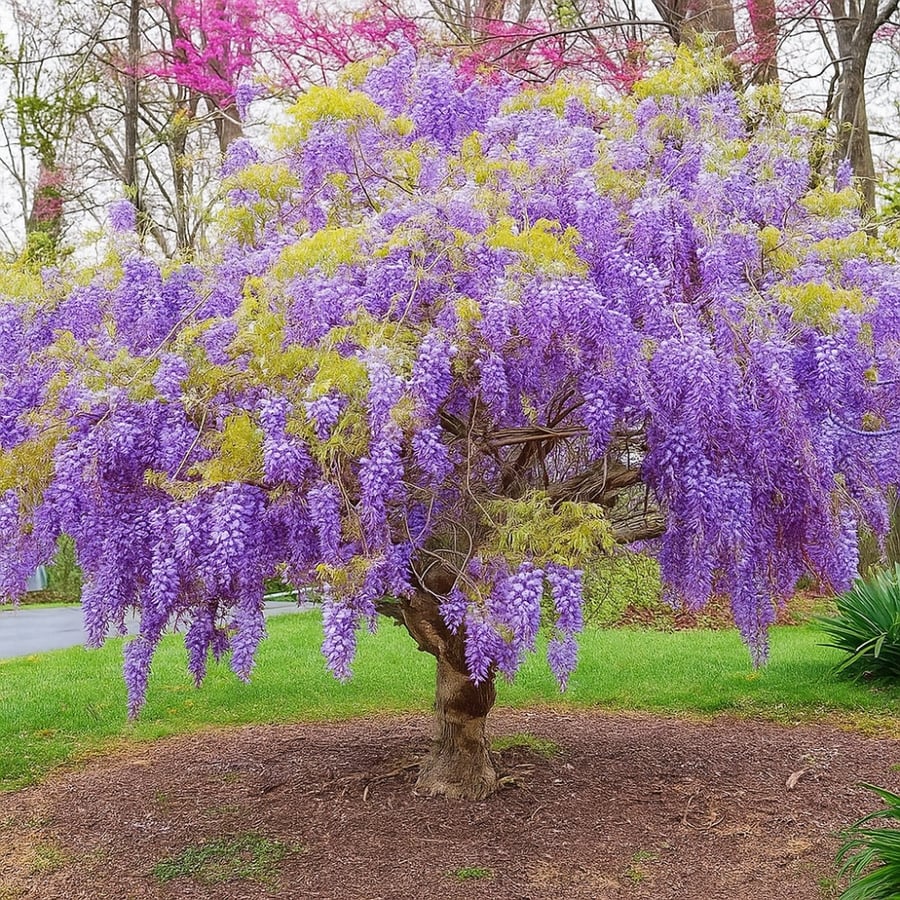
Violet Westeria tree seeds
27ر.س
Product description
Wisteria sinensis tree is considered one of the most beautiful decorative climbing plants in the world, characterized by its hanging purple flowers that fill the place with a fragrant scent and captivating beauty. It is planted in gardens, homes, and walkways to add a wonderful artistic touch to the landscape.
The original habitat of the purple Wisteria tree is in East Asia, especially China, Japan, and Korea, and some species are found in the United States. It is known for its ability to adapt to moderate climates and withstand cold winters.
Propagation of the purple Wisteria is done in several ways, most notably:
Seeds: the traditional method but it takes longer to bloom.
Air layering or cuttings: the faster and most used method to obtain plants identical to the original.
Blooming time:
The Wisteria sinensis tree usually blooms in spring, from March to May, and flowering may recur in autumn in some warm areas.
Its flowers hang in long clusters up to 30 cm or more, dense and very fragrant.
Planting time with seeds:
It is preferable to plant Wisteria seeds in spring after the cold waves end, or in early autumn in moderate areas, so that the seeds grow in a stable and warm environment.
Method of planting with seeds:
Collect mature seeds from dry pods at the end of summer.
Soak the seeds in lukewarm water for 24 hours to speed up germination.
Plant in moist, light soil inside small pots at a depth of about 2 cm.
Place in a warm, bright place without direct sunlight.
After germination, transfer the seedlings to the ground or larger containers after 3-4 months.
Suitable soil:
Wisteria sinensis prefers fertile, well-drained soil rich in organic matter.
It is recommended that the soil has a neutral or slightly alkaline pH (6.5 – 7.5).
It is advised to loosen the soil well before planting to stimulate root expansion and growth.
Fertilization:
Use decomposed organic fertilizer at the beginning of spring to nourish the plant.
Phosphorus and potassium fertilizers can be added during flowering to enhance flower density.
It is preferable to reduce nitrogen fertilizer to prevent excessive vegetative growth at the expense of flowers.

Questions you might have