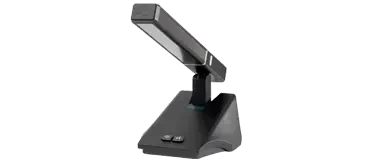
DSPPA D7122 Network Delegate Microphone with 5 Voting Keys and OLED
1948.23ر.س
Product description
The DSPPA D7122 is the seat unit for every delegate in a room running the D7101 system: request the floor, vote with five keys, sign in and follow the session on a 2.4-inch OLED. It suits boardrooms, general assemblies and university halls.
====
The DSPPA D7122 is the unit that sits in front of every delegate in a meeting room running the D7101 network conference system. From it, a delegate requests the floor, votes with five keys, signs in and follows the session on a 2.4-inch OLED screen. One network cable carries the audio, the data and the power.
DSPPA D7122 specifications
- Cardioid electret condenser microphone, -42±2 dBV/Pa sensitivity, 50 Hz to 20 kHz response.
- 125 dB maximum SPL and a signal-to-noise ratio above 70 dB.
- 1.5 W built-in speaker and a 3.5 mm headphone output at 9 dBu.
- +48 V from the host or a PoE switch; under 6 W at idle and 8 W maximum.
- 175 × 133 × 46 mm, 0.62 kg net.
Voting and sign-in at every seat
When a session ends in decisions, each delegate votes using the five keys DSPPA labels for voting and rating. Attendance is recorded with a key press before the meeting starts. Because every unit has its own ID, the host knows exactly who attended and how each seat voted. The host also self-checks each unit on connection, so the AV team spots faults before the meeting begins.
Clear listening without feedback
The built-in speaker lets delegates hear every contribution in a large hall, and it mutes the instant their own microphone opens to stop feedback. Prefer private listening? Plug headphones into the 3.5 mm jack; the speaker mutes and the volume keys adjust the level. An alert tone sounds when the microphone opens and can be switched off in settings, while the red and green LED ring shows the room who is live.
Where the D7122 is used in Saudi Arabia
- Board member seats in corporate and bank boardrooms.
- Municipal councils and general assemblies that vote item by item.
- Seminar rooms at universities and training centers.
- Meeting rooms in hotels and exhibition centers in Riyadh and Jeddah.
Installing with the D7101 system
The unit is passive, with no power adapter. Its 2 m cable plugs into a +48 V powered RJ45 port on the D7101 host or into a PoE switch. To extend the run, use a network coupler and keep the total length within DSPPA's recommended 80 m. The standard stem is square aluminum, a gooseneck is optional, and the stem detaches for storage. With tracking configured on the host, the camera turns to the delegate as soon as their microphone opens.
Delegate D7122 or chairman D7121?
The two units share the same housing and specs: same microphone, 2.4-inch display, five voting keys, 175 × 133 × 46 mm size and 0.62 kg weight. The D7121 adds a priority key, approves speaking requests and opens regardless of the open-mic limit. The D7122 follows whatever discussion mode the host sets. Use the D7122 for delegates and the D7121 for the person chairing the session.
Frequently Asked Questions
Can delegates vote on the DSPPA D7122?
Yes. It has five voting/rating keys and key-based sign-in, and each unit's unique ID tells the host how every seat voted.
Can I use headphones with the D7122?
Yes. There is a 3.5 mm jack at 9 dBu with volume keys, and the built-in speaker mutes automatically when headphones are plugged in.
How long is the D7122 cable and can it be extended?
The built-in cable is 2 m with an RJ45 plug. Extend it with a network coupler; DSPPA recommends 80 m total at most.
Specifications
- Model: D7122
- Type: Desktop network delegate unit, speech and voting
- Permissions: Follows host discussion mode and open-mic limit (no priority key)
- Compatible system: D7101 host
- Structure: Desktop
- Effective range (±3 dB), unit to unit: 50 Hz to 14 kHz
- Host line to unit: 30 Hz to 18 kHz
- Unit to host line output: 40 Hz to 16 kHz
- Built-in speaker power: 1.5 W
- Static power consumption: <6 W
- Max power consumption: 8 W
- Signal-to-noise ratio: >70 dB
- Harmonic distortion: <0.5%
- Headphone output: 9 dBu, 8 to 32 Ω, 3.5 mm
- Operating power: +48 V from host or PoE switch
- Unit interface: Network, built-in 2 m RJ45 cable (extend with a coupler, 80 m total recommended)
- Microphone type: Cardioid electret condenser
- Input sensitivity: -42±2 dBV/Pa
- Microphone frequency response: 50 Hz to 20 kHz
- Max SPL: 125 dB
- Microphone stem: Square aluminum (standard), gooseneck (optional), detachable, 5-pin screw connector
- Display: 2.4-inch high-brightness OLED
- Keys: Mic on/off, 5 voting/rating keys, volume keys
- Other functions: Key sign-in, unique unit ID, self-diagnostics, speaker mute on mic-open or headphone insert, switchable alert tone, camera tracking after setup
- Dimensions (W×D×H): 175×133×46 mm
- Net weight: 0.62 kg
Features
- 5 voting/rating keys: each delegate votes from their seat and the host collects the result.
- Key-based sign-in and a unique ID per unit: the system knows who attended and who voted.
- 1.5 W built-in speaker that mutes when the mic opens: clear listening without feedback.
- 3.5 mm headphone jack at 9 dBu: private listening with adjustable volume.
- One network cable with +48 V and 8 W maximum draw: tidy tables with no power adapters.
