DSPPA D7633 Full HD Streaming Encoder with HDMI Input and H.265
6335.11ر.س
Product description
The DSPPA D7633 is a Full HD streaming media encoding host from DSPPA's paperless conference range. It takes one HDMI source and encodes it in H.264 or H.265 for delivery over a TCP/IP network, so a presenter's laptop or a room camera can reach the rest of the system without long video cable runs.
====
The DSPPA D7633 is a Full HD streaming media encoding host. It takes a single HDMI source, such as a presenter's laptop or a room camera, and turns it into a compressed stream that travels over a standard TCP/IP network. DSPPA lists it in its Digital Paperless Conference System range. Video is encoded in H.264 or H.265 and audio in AAC-LC or G711, which gives you a practical way to move a meeting room picture across a building without long HDMI cable runs.
DSPPA D7633 specifications at a glance
Each unit handles one video source. A boardroom with a presentation PC and a camera therefore needs two encoders. Key figures from the manufacturer:
- Video input: 1× HDMI.
- Audio inputs: Phoenix-type LINE IN plus embedded HDMI audio.
- Video encoding: H.264 / H.265.
- Audio encoding: AAC-LC / G711.
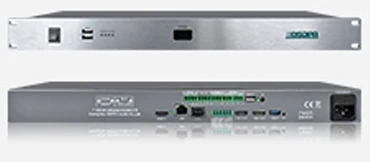
- Rear panel: HDMI in, RJ45 network port, DC power input, RS485 output.
Mixer audio and presentation video in one stream
In most meeting rooms, microphone audio runs through a mixer or amplifier rather than the laptop. The Phoenix LINE IN lets you feed the mixer output straight into the encoder, so the stream carries the slides and the speakers' voices together. When the sound comes from the source itself, for example a company video played at the start of a session, the D7633 picks it up from the HDMI cable.
OLED status screen for faster installs
A 0.96-inch OLED display on the unit shows its local IP address and operating information in real time. On a site with several encoders, the installer reads the address off each box instead of scanning the network with a discovery tool. DSPPA describes the design as low power and high efficiency for continuous operation.
Typical projects in the Kingdom
- Boardrooms at head offices in Riyadh and Jeddah that run a paperless conference system.
- University and institute training rooms that share the trainer's screen over the network.
- Hotel meeting floors where each room's source rides the same network instead of dedicated video cabling.
- Government meeting rooms and courts that use paperless conferencing.
Where the D7633 fits in a DSPPA system
DSPPA places the D7633 alongside its paperless conference products, such as the D7600 file management controller and the D7632R projection switcher. Confirm the full system design before you order, especially if the room already has equipment from another brand.
D7633 or D7700?
They solve different problems. The D7633 encodes an HDMI source for the network and has no camera or microphone. The D7700 is a USB video conference kit with a 12x optical zoom camera and a 12-microphone array for Zoom-style calls from a PC.
Frequently Asked Questions
Can one D7633 handle both a laptop and a camera?
No. DSPPA states that each unit connects to one video source over HDMI, so plan one encoder per source.
Does the D7633 stream audio as well?
Yes. It takes audio from HDMI or from the Phoenix LINE IN and encodes it in AAC-LC or G711.
How do I find the encoder's IP address?
The built-in 0.96-inch OLED screen displays the local IP address and operating status in real time.
Specifications
- Model: D7633
- Device type: Full HD Streaming Media Encoding Host
- Range: DSPPA Digital Paperless Conference System
- Operation: Fully digital network audio/video device based on TCP/IP
- Sources per unit: One video source per unit
- Video input: HDMI
- Audio input: Phoenix LINE IN, HDMI IN
- Video encoding: H.264 / H.265
- Audio encoding: AAC-LC, G711
- Built-in display: 0.96-inch OLED showing local IP and operating information in real time
- Rear panel: HDMI input, RJ45 network port, DC power connector, RS485 output
- Design: Low power consumption, high-efficiency design
Features
- One HDMI input per unit: dedicate one encoder to each source, laptop or camera, with no signal mix-ups.
- H.264 and H.265 video encoding: the newer H.265 codec shrinks the stream and eases the load on the room network.
- Two audio inputs (Phoenix LINE IN and HDMI audio) encoded in AAC-LC or G711: mixer sound travels with the slides.
- 0.96-inch OLED screen: shows the IP address and running status, so installers find each unit without a network scan.
- Four rear connections (HDMI, RJ45, DC, RS485): one network cable for the stream plus an RS485 output.
