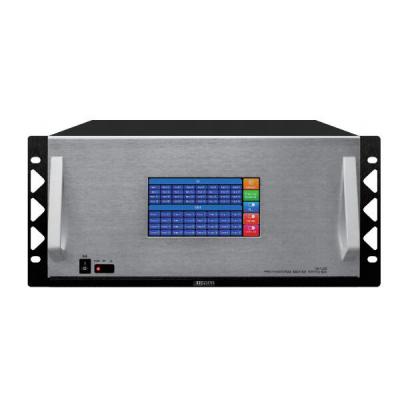
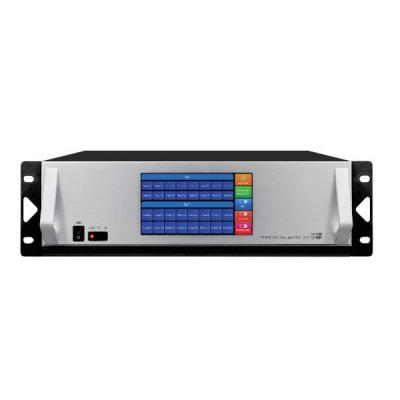
DSPPA D6108 8x8 Modular Hybrid Video Matrix Switcher
3454.55ر.س
Product description
The DSPPA D6108 is an 8-in, 8-out matrix switcher built on swappable HDMI, DVI, VGA, SDI and AV cards, so any source can go to any display or projector. It fits meeting rooms, training halls and control rooms that mix older and newer equipment.
====
Meeting rooms tend to collect sources and screens faster than anyone can rewire them. The DSPPA D6108 takes eight video inputs and distributes them to eight outputs, and a 4.3-inch touch screen decides which source appears on which display. Because it is built on swappable input and output cards, the DSPPA D6108 lets an old VGA projector, new HDMI screens and an SDI camera share one system.
DSPPA D6108 specifications
- 8 input channels and 8 output channels (8x8).
- Input and output cards in AV, VGA, DVI, HDMI and SDI formats, four channels per card, such as the D6104HR input and D6104HC output cards.
- Data rates up to 3.25 Gbps with HDCP, 3D and partial HDMI 1.4 support.
- Up to 10 saved switching scenes, kept through power cuts.
- 220V supply, 100W consumption, 483 x 330 x 88 mm chassis.
Switching without black frames
DSPPA states that switching happens without color loss, black screens or flicker, which matters when you cut between the presenter's laptop and the room camera in front of an audience. The built-in scaler converts any input to the output resolution and adapts the frame rate.
Audio travels with the picture
This is not an audio mixer, but it handles the sound that goes with each video source. AV and VGA inputs accept analog audio, while DVI, HDMI and SDI inputs can mix analog and digital audio; after switching, the audio is embedded into the HDMI, SDI or DVI outputs. Audio signal-to-noise is at least 76 dB on HDMI inputs and at least 80 dB on VGA inputs.
Choosing the cards
Start by listing your sources and displays. For modern laptops and receivers, one 4-channel HDMI input card such as the D6104HR covers four sources. If the room still has a VGA projector, add a VGA output card next to an HDMI output card such as the D6104HC, and SDI cards handle broadcast cameras.
Central control integration
The rear panel has an RJ45 network port, an RS-232 port and an RS-485 port for a 4-inch control panel, and the front carries an IR receiver. That lets a PC, a central control system or a wall panel drive the matrix, with scheduled or manual switching. EDID management works in automatic or manual mode when one output feeds displays with different resolutions.
Typical Saudi installations
- Corporate and government meeting rooms: put the speaker's laptop on the main and side screens.
- University and institute training halls: switch between the trainer's PC and a document camera.
- Control and monitoring rooms: route several device outputs to the display wall.
- Hotel ballrooms and conference venues: carry the stage feed to overflow rooms.
D6108 or D6116?
The D6108 has 8 channels, a 4.3-inch screen, an 88 mm tall chassis, 100W consumption and 6.7 kg net weight. The D6116 in the same series has 16 channels, a 7-inch screen, a 132 mm chassis, 200W consumption and 8.5 kg. With eight or fewer sources and displays, the D6108 does the job in a smaller chassis, and it uses the same card family as its larger siblings.
Frequently Asked Questions
Is the DSPPA D6108 an audio mixer?
No, it is an 8x8 video matrix. It carries the audio that comes with each video source and embeds it in HDMI, SDI and DVI outputs, but it does not mix microphones.
Can I run a VGA projector and an HDMI display together?
Yes. Fit a VGA output card and an HDMI output card; the built-in scaler sets the resolution for each output.
How is it controlled from a control room?
Over the RJ45 network port, RS-232, or an RS-485 control panel, plus the IR remote and front touch screen.
Specifications
- Model: D6108
- Type: 2K modular hybrid matrix switcher, card-based (D6108/D6116/D6132 series)
- Channels: 8 in x 8 out
- Card types: Input and output: AV, VGA, DVI, HDMI, SDI (4-channel cards such as D6104HR, D6104HC)
- Data rate and protocols: Up to 3.25 Gbps, HDCP, 3D, partial HDMI 1.4, DVI 1.0
- Switching: No color loss, black screen or flicker; HDMI interlaced and progressive output
- Scaler and EDID: Any input to any output resolution with frame-rate adaptation; auto or manual EDID for HDMI/DVI
- Audio: Analog audio mixing on AV/VGA inputs, analog and digital on DVI/HDMI/SDI, embedded into HDMI/SDI/DVI outputs
- HDMI input audio: 500 ±50 mV, 50 Hz-20 kHz, distortion 0.5% or less, S/N 76 dB or more, crosstalk -80 dB or less
- VGA / AV input audio: VGA 1000 ±100 mV, AV 1 ±0.1 V, 20 Hz-20 kHz, S/N 80 dB or more
- HDMI / SDI output audio: THD below 0.3%, S/N above 70 dB, noise floor below 0.5 mV
- Scenes: Up to 10 switching scenes with power-off memory
- Display: 4.3-inch color LCD, capacitive touch
- Control ports: RJ45, RS-232 (female), RS-485 for 4-inch control panel, IR remote
- Power supply: ~220V / 50Hz, F2AL250V fuse
- Power consumption: 100 W
- Dimensions: 483 x 330 x 88 mm
- Weight: Net 6.7 kg
Features
- 8 inputs x 8 outputs: send any PC, camera or receiver to any screen, or one source to all of them.
- Swappable 4-channel cards (HDMI, DVI, VGA, SDI, AV): run an old VGA projector and new HDMI displays in one system.
- Built-in scaler and EDID management: each display gets a resolution that suits it, even when screens differ.
- Up to 10 saved switching scenes: jump between lecture and meeting layouts with one touch.
- Control by 4.3-inch touch screen, RS-232, RS-485, network or IR remote: ties into the room's central control system.
