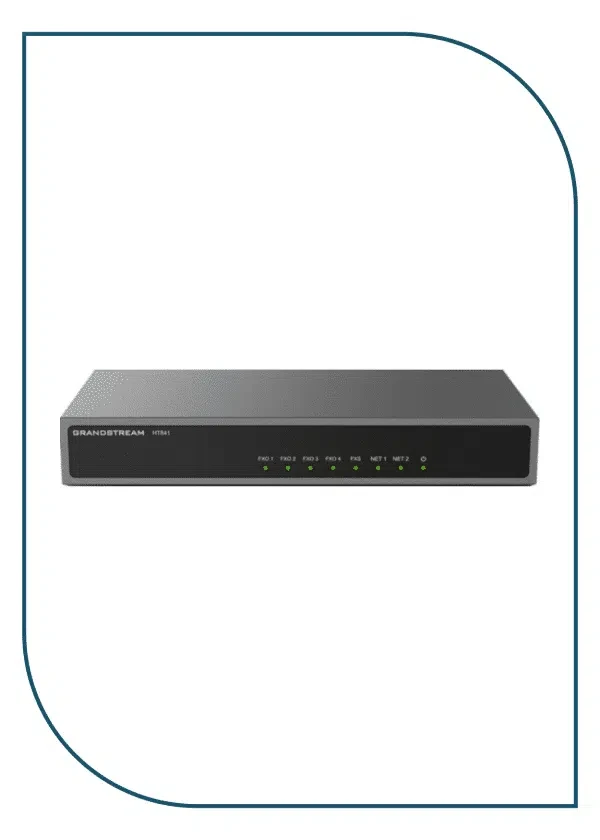
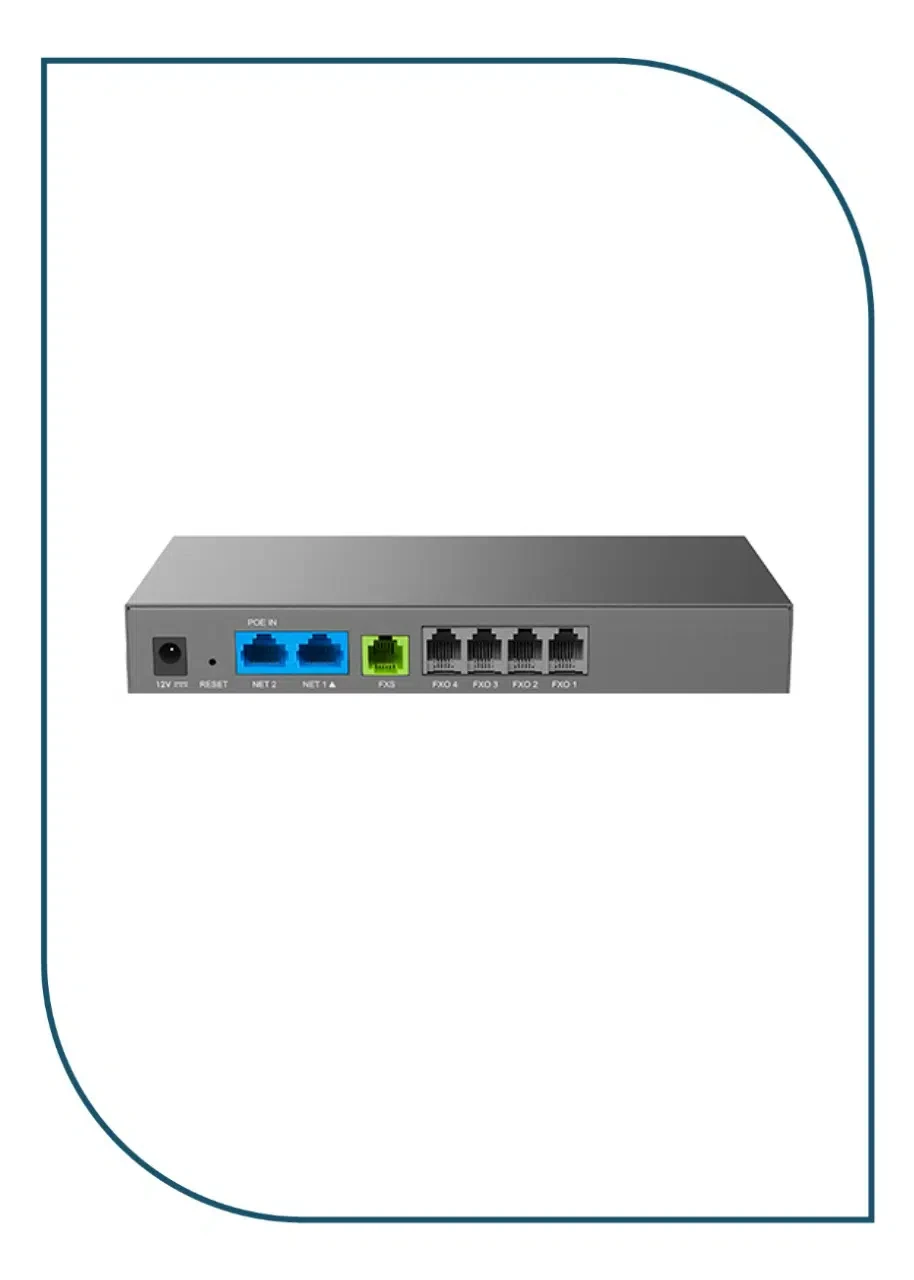
Grandstream HT841 4-Port FXO Gateway with Lifeline FXS
504.56ر.س
Product description
The Grandstream HT841 brings up to 4 analog landlines into an on-premise or hosted IP PBX, plus one FXS port for an analog phone that stays on a line during a power cut. It suits small offices, branches and clinics keeping their landline numbers after moving to IP.
====
The Grandstream HT841 connects up to 4 analog landlines to an IP PBX, so the office numbers your customers already know stay the same after you switch to IP phones. Plug your STC lines into the FXO ports, connect the gateway to the network, and incoming calls ring the extension you choose while outgoing calls leave on the same lines. It suits small offices, branches and clinics.
Grandstream HT841 at a glance
- 4 RJ11 FXO ports and 1 FXS port for a phone or fax.
- Lifeline: the analog phone connects straight to the fourth line during a power cut.
- Two RJ45 network ports, built-in NAT router, PoE on NET2.
- 3 SIP profiles with a backup SIP server.
- 190 × 100 × 28 mm, 0.46 kg.
An outside line even when the power fails
Without a UPS, IP phones and the PBX go quiet in a power cut. On the HT841 the FXS port is hard-relayed to FXO4, so the analog phone plugged into it can still make and take calls over the landline. Lifeline can be set to auto, always connected or always disconnected. Put that phone at reception or in the guard room.
One cable for data and power
NET2 accepts 802.3af PoE, so a PoE switch can power the gateway with no adapter. It can also run from a DC adapter. The power LED glows orange on PoE and green on the adapter, so a technician sees the power source at a glance. The unit ships in bridge mode and can be switched to NAT router mode.
Call handling and security
Caller ID works in Bellcore, ETSI, BT and NTT formats, and the gateway detects hang-up by busy tone, polarity reversal or loop current, so lines are not left tied up after the other side ends the call. Ring load is up to 3 REN. Security covers SRTP voice encryption, TLS and SIPS signaling, a per-unit certificate and AES-encrypted provisioning over TR-069.
Typical uses in Saudi Arabia
- An office or branch with 2 to 4 STC landlines moving to an IP PBX.
- A small clinic where the receptionist answers every line from one IP phone.
- A company on a hosted PBX that needs its landlines brought into the cloud system.
Works with SIP PBXs
The gateway works with any on-premise or hosted PBX that supports SIP, such as Grandstream UCM and Yeastar P-Series systems. Register each line with its own SIP account, or have the PBX send calls straight to the gateway's IP address without registration.
HT841 or HT881?
Both gateways share the same size, specs and power options; the only difference is line count. The HT841 has 4 FXO ports and the HT881 has 8. Pick the HT841 for up to 4 lines, and the HT881 if you have more or expect to add lines.
Frequently Asked Questions
Does it work with STC landlines?
Yes. The FXO ports are made for standard analog landlines, so regular STC lines plug straight in and reach your PBX.
What happens during a power cut?
The FXS port is hard-relayed to FXO4, so the analog phone on it can still call out and receive calls over the landline.
Specifications
- Model: HT841
- Series: HT8x1 analog FXO gateways (HT841/HT881)
- Telephony interfaces: 4 RJ11 FXO ports + 1 RJ11 FXS port
- Lifeline: FXS port hard-relayed to FXO4 during a power outage
- SIP profiles: 3 SIP profiles across the FXS port and FXO ports
- Network interface: 2 × RJ45, one with 802.3af PoE-PD
- Router: Built-in NAT router; bridge mode by default
- LED indicators: POWER, NET1, NET2, FXS, FXO
- Factory reset: Yes (hold 7 seconds)
- Telephony features: Caller ID display or block, call waiting, flash, blind or attended transfer, forward, hold, DND, 3-way conference
- Voice codecs: G.711 (PLC, VAD/CNG), G.723.1, G.729, G.726-32, iLBC, Opus, dynamic jitter buffer, line echo cancellation
- Fax over IP: T.38 Group 3 relay up to 14.4 kbps, auto switch to G.711 pass-through
- Ring load: 3 REN, up to 1 km on 24 AWG
- Caller ID: Bellcore Type 1 & 2, ETSI, BT, NTT, DTMF-based
- Dial methods: DTMF, pulse
- Disconnect methods: Busy tone, polarity reversal/wink, loop current
- Protocols: TCP/IP/UDP, RTP/RTCP, HTTP/HTTPS, ARP/RARP, ICMP, DNS, DHCP, NTP, TFTP, SSH, Telnet, STUN, SIP, SIP over TCP/TLS, SRTP, SNMP, TR-069, IMS/3GPP, IPoE
- QoS: 802.1Q VLAN, 802.1p, ToS, DiffServ, MPLS, traffic shaping
- DTMF methods: In-audio, RFC2833, SIP INFO
- Provisioning and control: HTTP, HTTPS, TFTP, SSH, TR-069, AES-encrypted auto provisioning, syslog
- Security: SRTP media; TLS, SIPS and HTTPS control; per-unit security certificate
- Management: Syslog, Telnet, SSH, web browser
- Power: PoE input 48 V / 0.5 A, or 12 V DC input
- Dimensions: 190 × 100 × 28 mm (L × W × D)
- Weight: 0.46 kg
- Operating temperature: 0–40°C (32–104°F)
- Storage temperature: -10 to 60°C (14–140°F)
- Humidity: 10–90% non-condensing
- Compliance: FCC, CE, RCM, IC, UKCA
- In the box: HT841 unit, Ethernet cable, quick installation guide
Features
- 4 RJ11 FXO ports: bring 4 landlines into the PBX so staff answer them on IP phones.
- Lifeline FXS port: in a power cut the analog phone is hard-relayed to FXO4, so you keep an outside line.
- 802.3af PoE on NET2: runs from a PoE switch on one cable, no adapter needed.
- 3 SIP profiles with failover: register to the office PBX and fall back to a backup server if it goes down.
- T.38 fax up to 14.4 kbps, switching to G.711 pass-through automatically when needed.
