DSPPA D7121 Network Chairman Microphone with Voting and Priority Key
2125.34ر.س
Product description
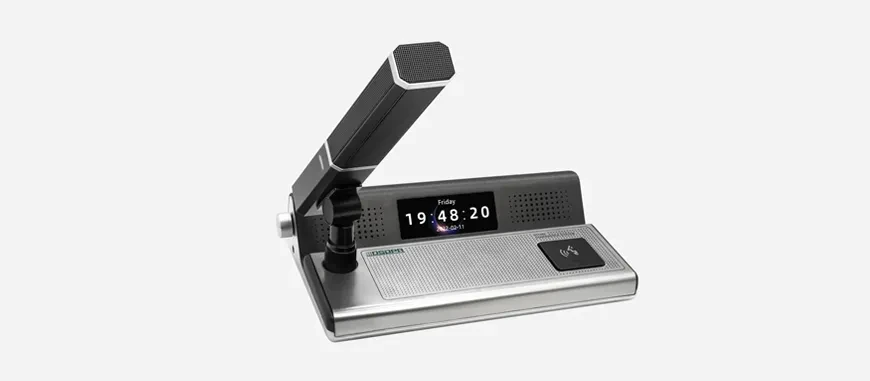
The DSPPA D7121 is the chairman's desktop unit for the D7101 network conference system, combining speech and five voting keys with a dedicated priority key and a 2.4-inch OLED screen. It suits board chairs and committee heads who run the floor and approve speaking requests.
====
The DSPPA D7121 is the chairman's desktop unit for the D7101 network conference system. It combines speech and voting in one housing and adds a priority key that hands the chair control of the discussion. A 2 m RJ45 cable links it to the system and carries +48 V from the host or a PoE switch, so there is no power adapter on the table.
What the DSPPA D7121 gives the chair
Chairman and delegate units differ in permissions. According to DSPPA, the D7121 adds:
- A dedicated Priority key.
- Priority and Podium modes, set on the host.
- Approval of speaking requests from delegate units.
- An open microphone at any time, regardless of the open-mic limit.
- No restriction on its position in the cabling, so it can sit anywhere on the table.
Microphone and audio quality
The capsule is a cardioid electret condenser with -42±2 dBV/Pa sensitivity, a 50 Hz to 20 kHz response and a 125 dB maximum SPL. A red and green LED ring shows the room when the chair is live. The standard stem is square aluminum, a gooseneck is optional, and the stem detaches for cleaning and storage between sessions. DSPPA also states good resistance to mobile phone interference.
Display, voting and monitoring
A 2.4-inch high-brightness OLED shows unit status in real time and lets the user switch display language. The chair has the same five voting keys and key-based sign-in as delegates, and every unit carries a unique ID. The 1.5 W built-in speaker mutes when the microphone opens, preventing feedback, and also mutes when headphones are plugged into the 3.5 mm jack.
Who the D7121 is for in Saudi Arabia
- Board chairs in corporate and bank boardrooms in Riyadh and Dammam.
- Session heads in municipal councils and committees that vote on decisions.
- Deans and department heads in university meeting halls.
- Meeting leaders in hotel and convention rooms in Jeddah and Makkah.
Compatibility and cabling
The D7121 runs on the D7101 host and plugs into its +48 V powered ports or into a PoE switch. For runs longer than 2 m, use a network coupler; DSPPA recommends a total length of no more than 80 m. Once tracking is set up on the host or PC software, the camera turns to the chair whenever they speak. The host also runs a self-check on each unit when it connects.
Chairman D7121 or delegate D7122?
Audio specs, size and weight are identical: same microphone, display, five voting keys, 8 W maximum draw and 175 × 133 × 46 mm housing. The difference is permissions only. The D7121 has the priority key, approves speaking requests, opens regardless of the open-mic limit and supports priority and podium modes. Put the D7121 at the chair's seat and the D7122 at every other seat.
Frequently Asked Questions
What is the difference between the DSPPA D7121 and D7122?
Audio specs and housing are identical. The D7121 chairman unit adds a priority key, request approval and opening outside the open-mic limit; the D7122 delegate unit does not.
Does the D7121 need a power adapter?
No. It takes +48 V over the network cable from the D7101 host or a PoE switch, drawing 8 W at most.
Can the chairman vote on the D7121?
Yes. It has five voting keys, key-based sign-in and a 2.4-inch OLED display, just like the delegate units.
Specifications
- Model: D7121
- Type: Desktop network chairman unit, speech and voting
- Chairman functions: Priority key, priority and podium modes set on the host, approves requests to speak, not limited by open-mic count, unrestricted connection position
- Compatible system: D7101 host
- Structure: Desktop
- Effective range (±3 dB), unit to unit: 50 Hz to 14 kHz
- Host line to unit: 30 Hz to 18 kHz
- Unit to host line output: 40 Hz to 16 kHz
- Built-in speaker power: 1.5 W
- Static power consumption: <6 W
- Max power consumption: 8 W
- Signal-to-noise ratio: >70 dB
- Harmonic distortion: <0.5%
- Headphone output: 9 dBu, 8 to 32 Ω, 3.5 mm
- Operating power: +48 V from host or PoE switch
- Unit interface: Network, built-in 2 m RJ45 cable (extend with a coupler, 80 m total recommended)
- Microphone type: Cardioid electret condenser
- Input sensitivity: -42±2 dBV/Pa
- Microphone frequency response: 50 Hz to 20 kHz
- Max SPL: 125 dB
- Microphone stem: Square aluminum (standard), gooseneck (optional), detachable, 5-pin screw connector
- Display: 2.4-inch high-brightness OLED
- Keys: Mic on/off, 5 voting/rating keys, volume keys
- Other functions: Key sign-in, unique unit ID, self-diagnostics, speaker mute on mic-open or headphone insert, switchable alert tone, camera tracking after setup
- Dimensions (W×D×H): 175×133×46 mm
- Net weight: 0.62 kg
Features
- Dedicated priority key: the chair can cut in at any moment, outside the open-mic limit.
- Approves speaking requests: the chair decides which delegate speaks in Apply mode.
- 5 voting keys and a 2.4-inch OLED: vote and follow session status from the same unit.
- Cardioid mic, -42 dBV/Pa sensitivity, 50 Hz to 20 kHz: picks up the speaker and rejects room noise.
- +48 V over one network cable, 8 W maximum draw: no power adapter on the chair's desk.
