Huawei AR730 Enterprise Router with 10GE SFP+ for 1,200 Users
4017.33ر.س
Product description
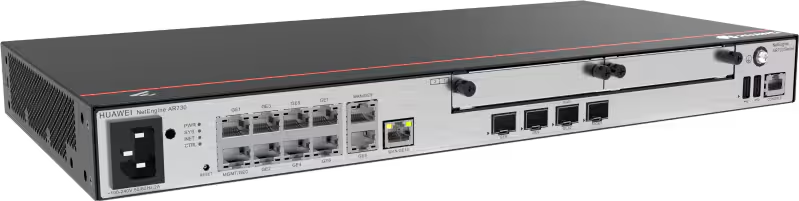
The Huawei AR730 tops the NetEngine AR700 Series, adding a 10GE SFP+ optical WAN port to two GE combo WAN ports. Rated for 1,200 users, it suits head offices and larger buildings with fiber faster than 1 Gbps or a 10G core switch.
====
The Huawei AR730 is the top model in the NetEngine AR700 Series, and its headline difference from the AR720 is a 10GE SFP+ optical WAN port. Huawei rates it for 1,200 wired users with forwarding of up to 25 Mpps. It is built for head offices and multi-floor buildings where the fiber line runs faster than 1 Gbps, or where the router needs a 10G link straight into the core switch.
Huawei AR730 ports and capacity
From Huawei's official pages:
- 3 WAN ports: two GE combo ports and one 10GE SFP+ optical port that also takes GE optics.
- 9 LAN ports: eight gigabit copper ports that can switch to WAN, plus one GE combo port.
- Rated for 1,200 users, with 9 to 25 Mpps forwarding.
- 4 GB memory, 1 GB flash, 2 USB ports and an RJ45 console.
- 28 W typical and 33 W maximum power draw.
Why the 10GE port matters
A gigabit WAN port caps out at 1 Gbps no matter what you pay for. Pay for a faster fiber plan and the extra speed is lost at the router. The AR730's SFP+ port fixes that in two ways: a 10G optical module to terminate the fiber, or a short DAC cable to the core switch at 10G. Since it accepts GE optics too, you can start on a 1 Gbps line and move up later without replacing the router.
Installation and running it in the server room
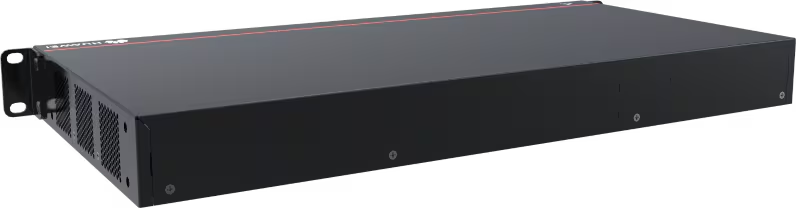
At 442 mm wide and 1U high it fits a standard 19-inch rack, and it can also sit on a bench or mount on a wall. It weighs 3.2 kg and runs from a built-in 90 to 264 V AC supply, so there is no external brick. A single internal fan moves air left to right, so leave clearance on both sides in the rack. It is rated to 45°C, but a cooled server room is still a must through a Riyadh or Dammam summer.
Expansion and security
Two SIC slots are on board, plus support for up to one WSIC card. Security covers firewall, IPS, antivirus and IPSec VPN, and per-packet load balancing lifts bandwidth utilization above 90% according to Huawei.
Typical AR730 deployments in KSA
- Head offices terminating VPN tunnels from branches in Jeddah and Al Khobar.
- Office towers and commercial complexes with high-speed fiber.
- Mid-size hotels in Makkah and Madinah running admin and guest networks behind one router.
- Private colleges and universities that need a 10G uplink to the core switch.
HUAWEI eKit or enterprise line?
The AR730 has its own official page as HUAWEI eKit AR730 on ekit.huawei.com, Huawei's line for small and mid-size businesses, and it also belongs to the NetEngine AR700 Series on the enterprise site e.huawei.com. Same hardware, same specs.
AR730 or AR720?
Both share 9 to 25 Mpps forwarding, two SIC slots, 4 GB memory and two USB ports. The AR730 adds the 10GE SFP+ WAN port and an extra GE combo LAN port, and is rated for 1,200 users against 700. If every line you have is gigabit and you have no 10G switch, the AR720 does the job.
Frequently Asked Questions
What is the difference between the Huawei AR730 and AR720?
The AR730 adds a 10GE SFP+ WAN port and a GE combo LAN port, and is rated for 1,200 users instead of 700. Core specs are otherwise the same.
Does the AR730 SFP+ port take 1G modules?
Yes. Huawei states the 10GE optical port is compatible with GE optics, so you can start at 1 Gbps and upgrade later.
How much power does the AR730 draw?
28 W typical and 33 W maximum, from a built-in AC supply rated for 90 to 264 V.
Specifications
- Model: AR730
- Part number: 02354GBM-001
- Series: NetEngine AR700 (also listed as HUAWEI eKit AR730)
- Type: Modular enterprise router
- Recommended users: 1,200 PCs / connected terminals (wired estimate)
- Forwarding performance: 9 to 25 Mpps
- Fixed WAN ports: 2 × GE combo, 1 × 10GE optical SFP+ (GE optical compatible)
- Fixed LAN ports: 1 × GE combo, 8 × GE electrical (switchable to WAN)
- SIC slots: 2
- WSIC slots (default / max): 0 / 1
- Console port: 1 × RJ45
- USB ports: 2
- Memory: 4 GB
- Flash: 1 GB
- Security: Firewall, IPS, antivirus (AV), IPSec VPN
- WAN optimization: Per-packet load balancing (over 90% bandwidth utilization), multi-send selective-receive
- Dimensions without packaging (H × W × D): Basic 44.4 × 442.0 × 220.4 mm, max 44.4 × 442.0 × 225.2 mm
- Chassis height: 1U
- Weight: 3.2 kg without packaging
- Installation: Rack, workbench, wall
- RTC: Supported
- Power consumption: 28 W typical, 33 W maximum
- Power supply: Built-in AC, 1 power module, 70 W max output
- Input voltage: 90 to 264 V, 47 to 63 Hz
- Cooling: Built-in fan (1 module), left-to-right airflow
- Operating temperature: 0 to 45°C (max drops 1°C per 220 m between 1,800 and 5,000 m altitude)
- Operating humidity: 5% to 95% RH, non-condensing
- Safety: IEC/EN/UL 60950-1, IEC/EN/UL 62368-1, GB 4943.1
- EMC: EN 55032, EN 55035, CISPR 32, GB 9254, EN 55024, CISPR 24, GB/T 17618, EN 300 386, VCCI-CISPR 32, AS/NZS CISPR32, IEC/EN 61000-3-2, IEC/EN 61000-3-3
- Environmental: RoHS, REACH, WEEE
Features
- 10GE SFP+ optical WAN port: carries fiber lines faster than 1 Gbps and also accepts GE optics.
- 3 fixed WAN and 9 LAN ports: two combo WAN plus 10G, and 8 gigabit LAN ports that can switch to WAN.
- Rated for 1,200 users with 9 to 25 Mpps forwarding: sized for a head office or multi-floor building.
- 28 W typical, 33 W max on a built-in AC supply: no external adapter and a light load on the server room.
- 2 SIC slots plus firewall, IPS and IPSec VPN: room for expansion cards later, edge protection and encrypted branch links.
