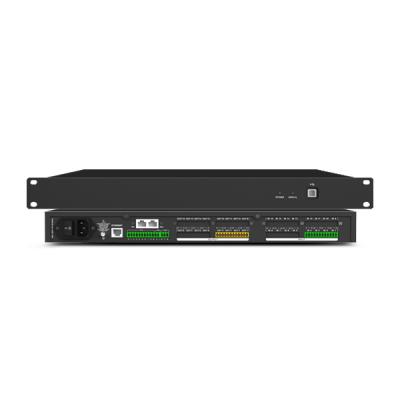
DSPPA D6648 4x8 DSP Audio Processor with 60 Presets
3276.98ر.س
Product description
The DSPPA D6648 is a 4-input, 8-output DSP audio processor that shapes microphone audio and sends it to speaker zones, each with its own EQ, delay and level. It suits meeting rooms, lecture halls and mosques with few sources and many speaker zones.
====
The DSPPA D6648 is a DSP audio processor with 4 analog inputs and 8 analog outputs. It takes your microphone or mixer signal, cleans it up and sends it to separate groups of speakers, each with its own level and delay. Inside is a 40-bit DSP with 24-bit/48 kHz conversion and memory for 60 presets. DSPPA calls it a conference audio processor, and it works well in meeting rooms, lecture halls and mosques with several speaker zones.
DSPPA D6648 specifications at a glance
- 4 analog inputs and 8 analog outputs.
- 40-bit floating-point DSP at 400 MHz.
- Frequency response of 20 Hz to 20 kHz within ±0.3 dB.
- SNR of 111 dB or better and THD+N no higher than 0.005%.
- 4.1 ms transmission delay and +18 dBu maximum input and output level.
Why 4 inputs and 8 outputs?
This layout suits venues with a few sources and many speaker zones. Picture a mosque with imam, minbar and iqama microphones plus a mixer feed, and separate outputs for the front ceiling speakers, the rear ceiling speakers, the column speakers, the women's prayer area and the courtyard. Matrix mixing lets you choose which input reaches which output and at what level.
Processing tools built in
- EQ to correct the room's sound, and a noise gate to cut hum between phrases.
- Compressor and limiter to protect speakers from sudden peaks.
- AGC that balances a presenter close to the mic with one standing further back.
- Crossover to send low frequencies to a subwoofer and the rest to full-range speakers.
- Output delay from 0 to 1500 ms in 0.02 ms steps, so rear speakers arrive in time with the front ones.
- Input sensitivity in 14 steps of 3 dB, up to 42 dB of gain.
Presets and control options
The D6648 stores up to 60 presets. Build one for Friday prayer, one for lessons and one for events, then switch between them. GPIO handles up to 8 scenes triggered by external contacts, and RS232 and RS485 accept commands from central control systems. Setup runs from a web page over RJ45 with no driver, or from a handheld device through a Wi-Fi login page, in English or Chinese.
Where it fits in Saudi Arabia
- Corporate meeting rooms and boardrooms.
- Mosques and jami mosques with more than one speaker zone.
- University training rooms and lecture halls.
- Hotel function rooms that can be divided.
D6648 or D6692?
DSPPA publishes the same processor, conversion, audio performance and 60-preset memory for both models. The difference is channel count: 4 inputs and 8 outputs on the D6648, against 12 inputs and 12 outputs on the D6692. Choose the D6648 when you have four sources or fewer, and the D6692 for a conference hall with many microphones. If feedback is a problem in the room, add a D6576 before the processor.
Frequently Asked Questions
How many sources and zones does the DSPPA D6648 handle?
4 analog inputs and 8 outputs, so up to four sources routed to eight speaker zones through a full matrix.
Can I save different settings for prayers and events?
Yes. It stores 60 presets, and up to 8 scenes can be switched through GPIO or with RS232 and RS485 commands.
How do I configure it?
From a web page in a PC browser over RJ45, with no driver to install. The interface is available in English.
Specifications
- Model: D6648
- Inputs × outputs: 4 × 8
- I/O type: Analog
- Signal processor: 40-bit floating-point DSP, 400 MHz
- Bit depth: 24-bit
- Sampling frequency: 48 kHz
- Input impedance: <10 kΩ
- Output impedance: 200 Ω
- A/D dynamic range: 118 dB
- D/A dynamic range: 118 dB
- Max input level: +18 dBu
- Max output level: +18 dBu
- Transmission delay: 4.1 ms
- Output channel delay: 0 to 1500 ms (0.02 ms steps)
- THD+N: ≤0.005% (+4 dBu, 1 kHz)
- Frequency response: 20 Hz to 20 kHz, ±0.3 dB
- CMRR: ≥55 dB
- Crosstalk: ≤-100 dB
- SNR: ≥111 dB (20 Hz to 20 kHz)
- Dynamic range: ≥111 dB (20 Hz to 20 kHz)
- Noise floor: ≤-93 dBu (20 Hz to 20 kHz)
- Input sensitivity: 14 steps of 3 dB, up to 42 dB gain
- DSP functions: Input/output gain, noise gate, EQ, matrix mixing, crossover, delay, compressor, limiter, AGC
- GPIO: 8-channel scene switching
- Connection / control: TCP/IP (driver-free web page over RJ45), RS232, RS485
- Presets: 60
- Interface language: English or Chinese
- Size: 482 × 253 × 44 mm
- Net weight: 3.3 kg
Features
- 4 inputs, 8 outputs with full matrix mixing: decide which source reaches which speaker zone and at what level.
- Up to 1500 ms delay per output in 0.02 ms steps: rear speakers line up with front ones, so long halls lose the echo.
- 60 presets and 8 GPIO scenes: switch between sermon, lesson and event settings without reprogramming.
- 40-bit DSP with 24-bit/48 kHz conversion: SNR of 111 dB or better and THD+N no higher than 0.005%.
- Driver-free web setup over RJ45: plus RS232 and RS485 for room control systems.
