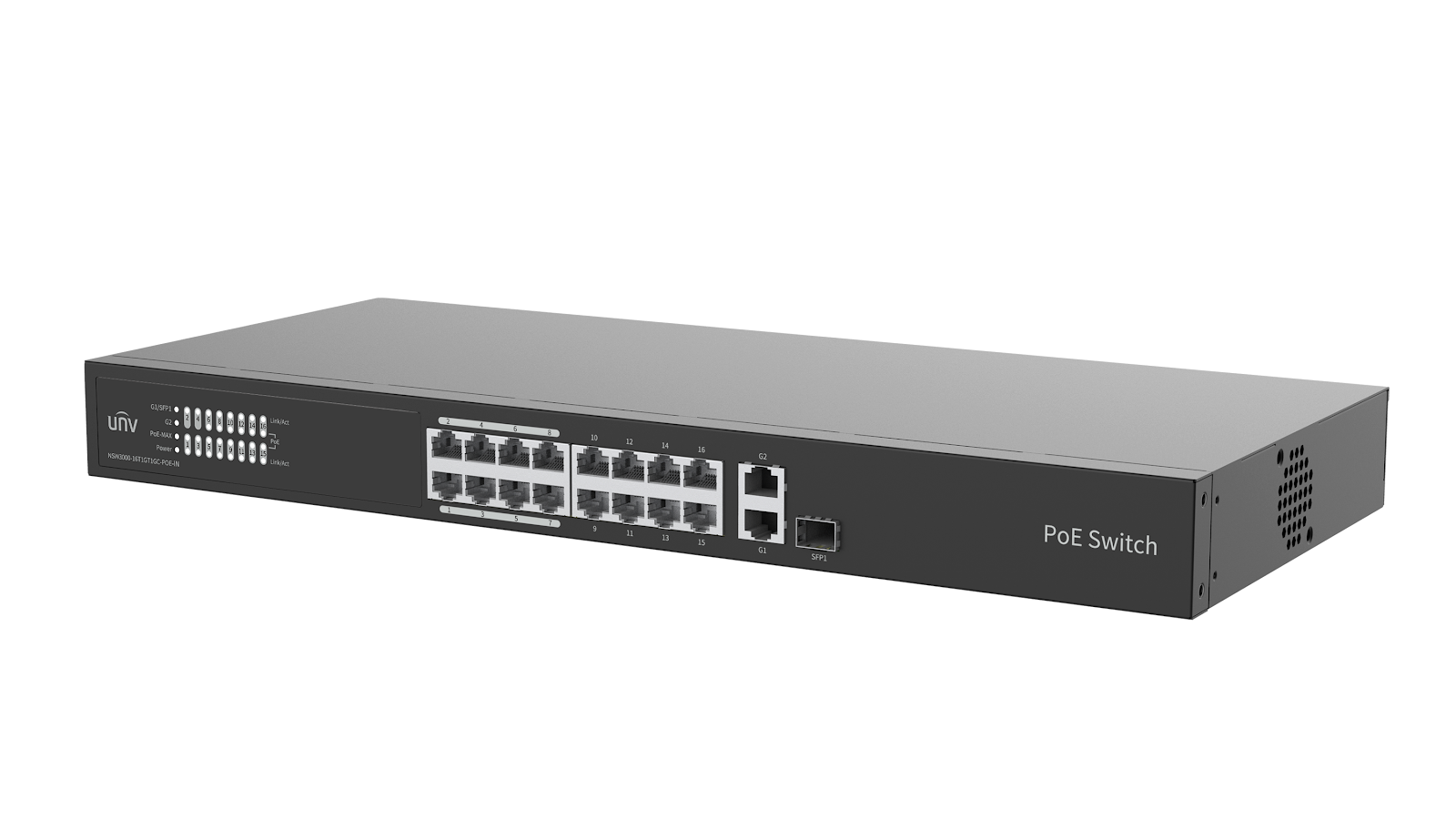
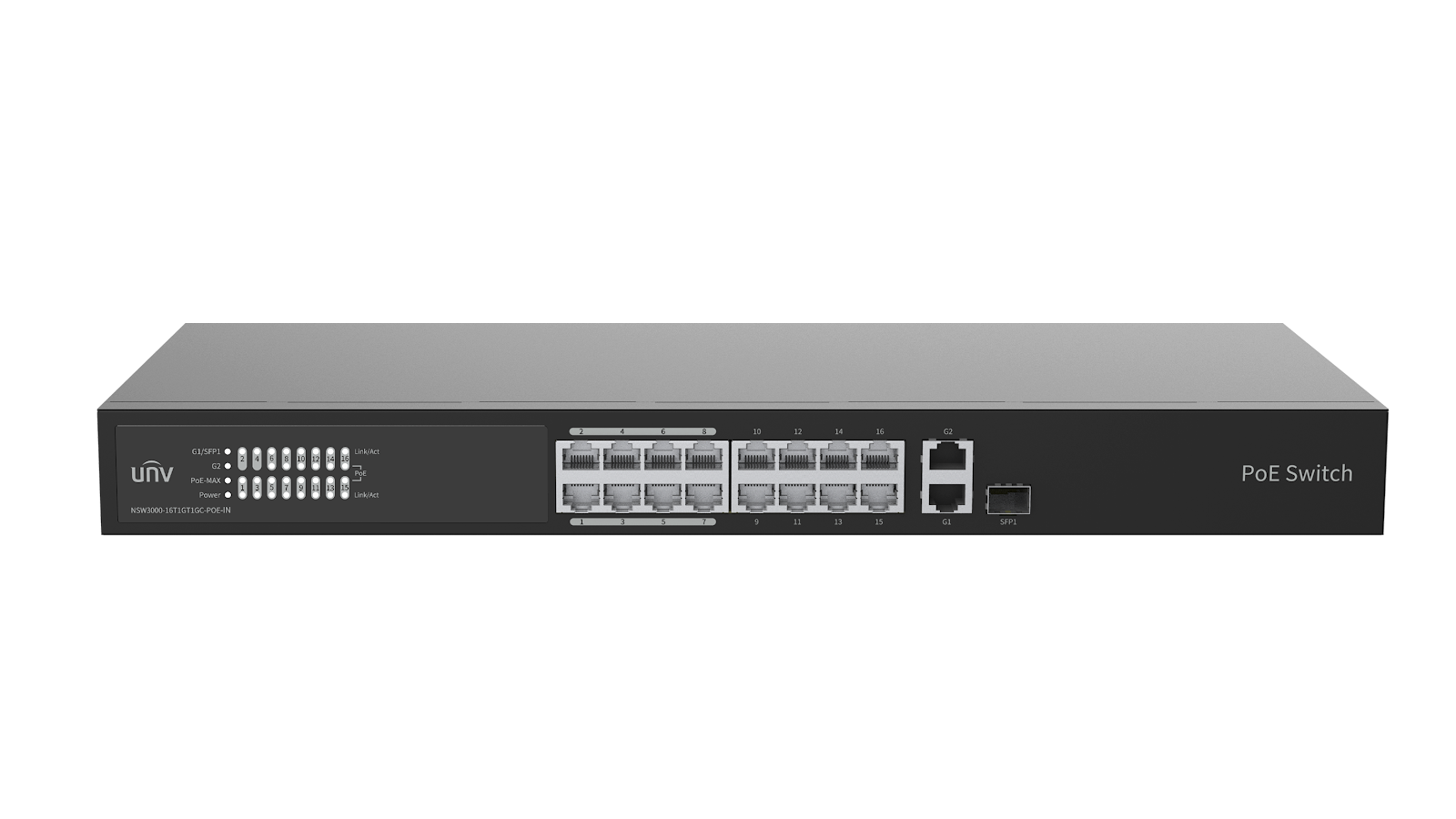
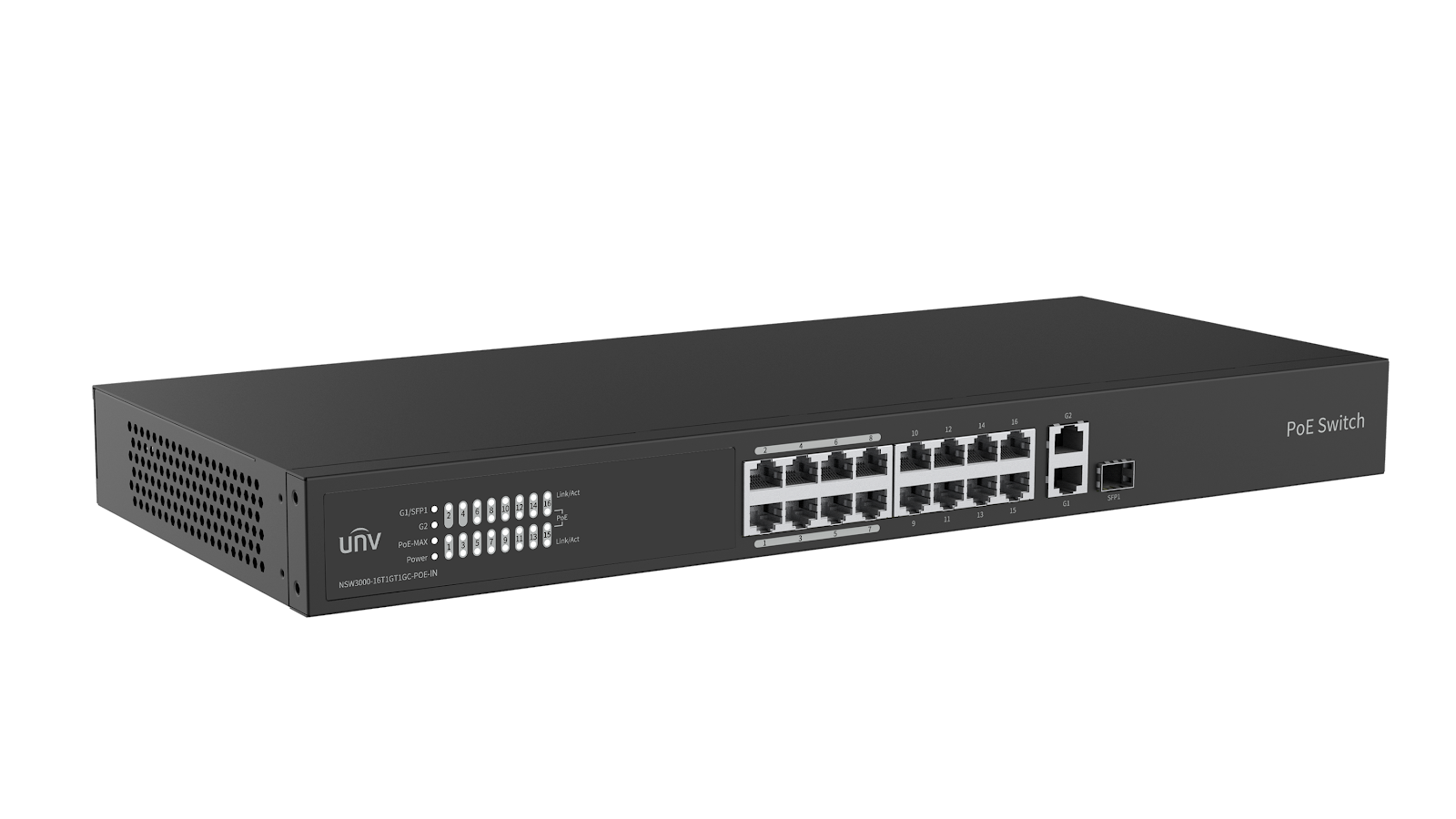
Uniview NSW3000-16T1GT1GC-POE-IN 16-Port PoE Switch, 250W Budget
445.88ر.س
Product description
The Uniview NSW3000-16T1GT1GC-POE-IN is a PoE switch from the NSW3000 line with 16 10/100 Mbps ports sharing a 250W power budget, plus two Gigabit uplinks for the recorder or the rest of the network. It fits mid-size CCTV jobs in warehouses, shops and apartment buildings.
====
The Uniview NSW3000-16T1GT1GC-POE-IN is a 16-port PoE switch for CCTV systems that have outgrown an 8-port unit. Each camera gets power and sends video over a single Ethernet cable, so there is no need for a socket next to every camera on a perimeter wall or warehouse ceiling. Uniview (UNV) positions the NSW3000 line as cloud-managed PoE switches.
Key specifications
- 16 × 10/100 Mbps RJ45 ports with PoE.
- 1 × Gigabit RJ45 port and 1 × Gigabit combo port (copper or SFP).
- 7.2 Gbps switching capacity, 5.36 Mpps forwarding rate.
- 16K MAC address table and 4 Mbit packet buffer.
- 250W total PoE budget, up to 30W on a single port.
How far does 250W go?
Spread across all 16 ports at once, 250W works out to roughly 15.6W each. That covers most fixed cameras, and any port can still deliver up to 30W (IEEE 802.3at) for a PTZ. Check the maximum draw of each camera before you plan the port layout.
A MAX LED on the front lights up when total PoE draw passes 85% of capacity, an early warning that the switch is near its limit. Both 802.3af and 802.3at are supported, with Mode A and Mode B power delivery. 100 Mbps per port is plenty for a typical surveillance stream, while the Gigabit uplinks carry the combined traffic to the recorder.
Management, topology and port control
The switch discovers connected cameras and other video devices and draws a network topology in Uniview's management software, listing up to 64 video devices and up to 32 switches on the same network. PoE can be cycled per port from the same screen, the quickest way to reboot a frozen camera without a ladder.
- Up to 32 VLANs in access or trunk mode to keep cameras off the office LAN.
- Loop detection and N:1 port mirroring.
- Downlink port isolation and login lock for up to 64 IP addresses.
- Ports 1 to 8 designated as priority ports.
Typical installations in Saudi Arabia
- Warehouses in Riyadh or Dammam with cameras on fences, aisles and loading bays.
- Apartment buildings covering entrances, parking and lift lobbies.
- Shops and showrooms watching tills, doors and stockrooms.
- Farms and istirahas, with a remote building linked over fiber through the combo port.
Compatibility
Any IP camera or access point powered by 802.3af or 802.3at will work, Uniview or third party. Run the Gigabit RJ45 uplink to a non-PoE recorder such as the Uniview NVR502-16B, and use the combo port for fiber with a Gigabit SFP module or to cascade a second switch. The two uplinks can also be bundled into one link aggregation group.
NSW3000-16T1GT1GC-POE-IN or NSW3000-24T1GT1GC-POE-IN?
Both share the same uplinks and feature set. The 24-port model adds 8 PoE ports and raises the budget to 370W (385W max draw, 2.9 kg). This model offers 16 ports and 250W (265W max draw, 2.1 kg). If you run 12 cameras today and expect 20 later, go for the 24-port unit. For Gigabit on every port, look at the NSW5130 series.
Frequently Asked Questions
How many cameras can the NSW3000-16T1GT1GC-POE-IN power?
Up to 16 on its PoE ports, as long as the total stays within 250W and no single camera needs more than 30W.
Are the ports Gigabit?
The 16 PoE ports run at 10/100 Mbps. Only the two uplinks (RJ45 and combo) are Gigabit. For Gigabit on every port, see the NSW5100 or NSW5130 models.
Can I connect fiber?
Yes. The combo port takes a Gigabit SFP module, so you can link a second building or the server room over fiber.
Specifications
- Model: NSW3000-16T1GT1GC-POE-IN
- Category: Cloud Managed Ethernet PoE Switch
- Ports: 16 × 10/100 Mbps PoE RJ45, 1 × Gigabit RJ45, 1 × Gigabit combo
- Standards: IEEE 802.3, 802.3u, 802.3z, 802.3ab, 802.3x, 802.3af, 802.3at, 802.3az
- Switching capacity: 7.2 Gbps
- Forwarding rate: 5.36 Mpps
- Packet buffer: 4 Mbit
- MAC address table: 16K, dynamic MAC clearing
- PoE standards: IEEE 802.3af, 802.3at
- PoE budget: 250W total, up to 30W per port
- PoE modes: Mode A (1/2/3/6), Mode B (4/5/7/8)
- Priority ports: 1 to 8
- Ethernet: Full/half duplex and auto-negotiation, flow control, one link aggregation group of the two uplinks, port statistics, port enable/disable
- VLAN: Access and trunk, up to 32 VLANs, IDs 1 to 4094
- PoE management: View PoE status and power, enable/disable PoE per port
- QoS: Port rate limiting, broadcast storm control
- Security: Downlink port isolation, login lock for up to 64 IP addresses
- Maintenance: Loop detection, N:1 port mirroring, video device discovery and topology, upgrade, factory reset, config import/export, log export and reboot from the software
- System: View up to 32 switches and up to 64 video devices on the same network
- Indicators: Power, PoE, Link/Act, MAX (on when PoE draw exceeds 85%)
- Cooling: 1 fan
- Power supply: 100 to 240V AC, 50/60Hz
- Max power consumption: 265W
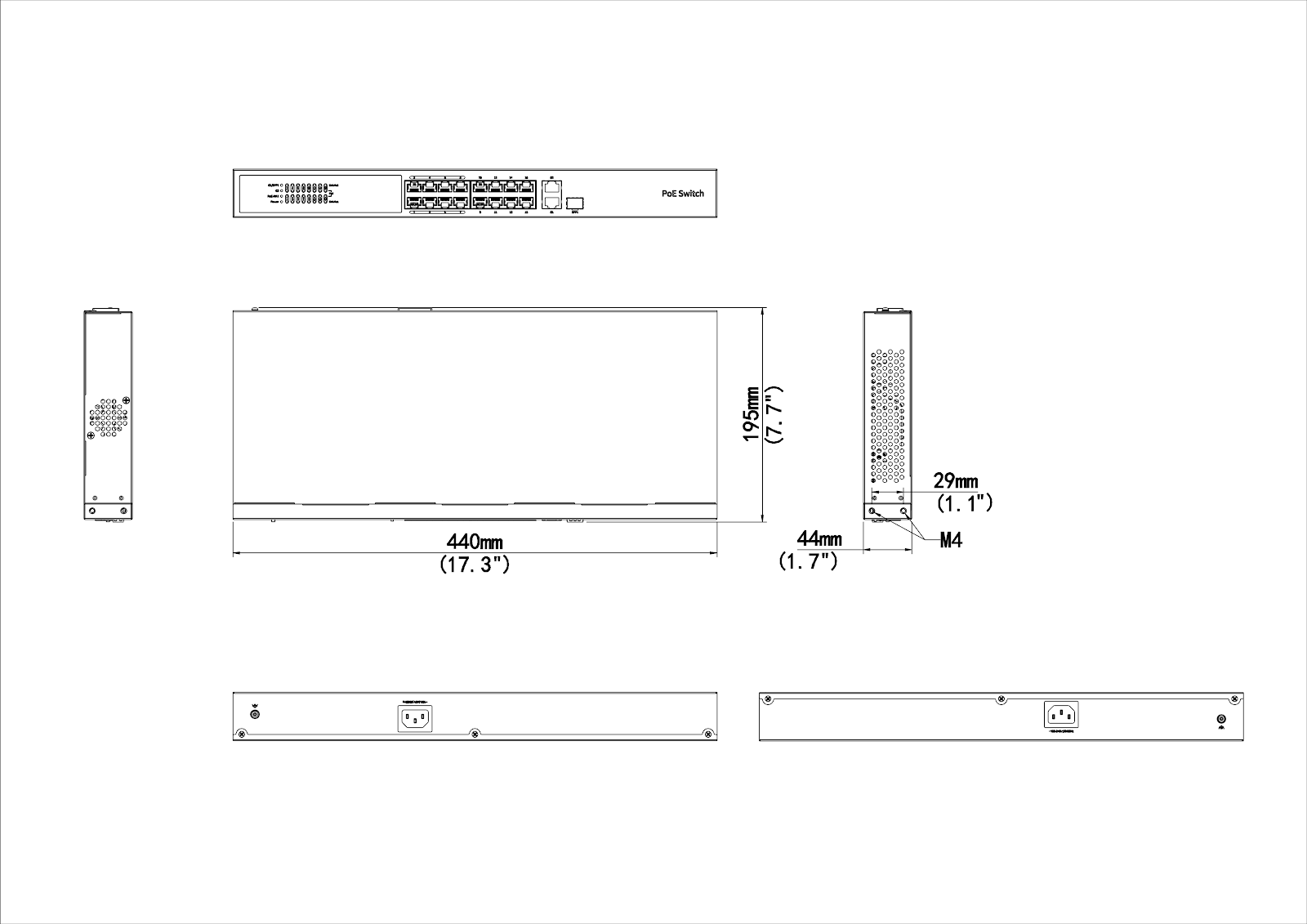
- Dimensions (W × D × H): 440 × 189.8 × 44 mm
- Weight: 2.1 kg
- Operating temperature: 0 to 45°C
- Operating humidity: 5% to 90% RH, non-condensing
- Compliance: NDAA
Features
- 16 PoE ports at 10/100 Mbps: run up to 16 IP cameras on one Ethernet cable each, with no local power adapters.
- 250W PoE budget with up to 30W per port: enough for fixed cameras plus PTZ units on any port via 802.3at.
- One Gigabit RJ45 and one Gigabit combo uplink: copper to the NVR, fiber to another building through SFP.
- Discovers up to 64 video devices and 32 switches: the management software maps which camera sits on which port.
- MAX LED on the front panel: lights once PoE draw passes 85% of capacity, so you know when to add a switch.
