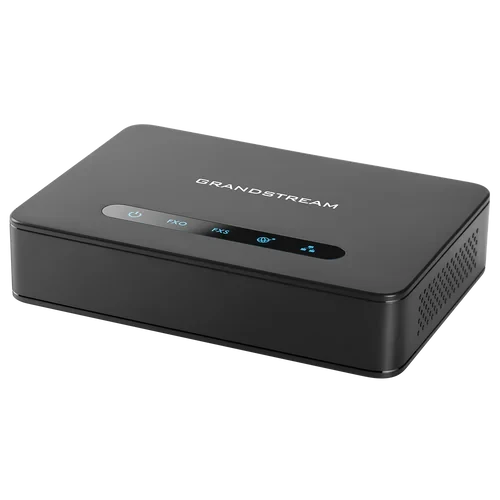
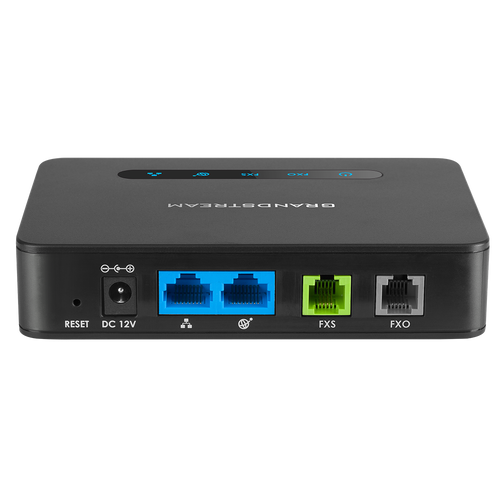
Grandstream HT813 Hybrid ATA with FXS and FXO Lifeline Port
271.69ر.س
Product description
The Grandstream HT813 combines an FXS port for an analog phone with an FXO port for a landline, plus LAN and WAN ports with a built-in NAT router and 2 SIP accounts. It suits an office or home moving to VoIP that wants the landline kept as a backup during power cuts.
====
The Grandstream HT813 joins three networks in one compact unit: an analog phone on the FXS port, a landline on the FXO port, and your IP network through LAN and WAN ports. It carries 2 SIP accounts and a built-in NAT router. Pick it when a small office or villa is moving to an IP PBX or SIP provider but wants to keep its STC landline as a fallback.
Grandstream HT813 key specs
- 1 FXS port for an analog phone or fax.
- 1 FXO port for a landline, with lifeline support.
- LAN and WAN 10/100 Mbps ports with NAT router.
- 2 SIP accounts, 3-way conferencing per port.
- T.38 fax up to 14.4 kbps.
- 12 V / 0.5 A power, 130.5 × 90.5 × 29 mm.
Landline backup when the power goes
Lifeline is the reason most buyers choose the HT813. When the adapter loses power, an internal relay ties the FXS port to the FXO port, so the phone runs directly on the landline. Grandstream's guide adds that the same hand-off happens if the unit loses its SIP registration, so the handset never goes dead.
Use your landline from anywhere
The FXO port has its own SIP account, which puts the landline on the network. You can dial out through the landline from an IP extension, or take landline calls on a remote phone. That helps a small business owner who wants to keep using the old landline number while away from the office.
A small router built in
The WAN port goes to your router or modem, and the LAN port serves a PC or small switch behind the adapter through built-in NAT. Plug a computer straight into LAN and the HT813 acts as a DHCP server and hands it an address. The unit also uses AES encryption with a unique certificate per device, supports GDMS cloud management, and provisions in bulk over TR-069.
Typical uses in Saudi Arabia
- A small office moving to an IP PBX that wants to keep its landline number.
- A villa with a landline and a phone in the majlis, plus a fallback during power cuts.
- A remote branch linking its landline to the head office PBX.
- A rest house or farm with one landline and one phone to bring onto the network.
PBX compatibility
The HT813 uses standard SIP and works with Grandstream UCM, Yeastar and any other SIP PBX or provider. It supports G.711, G.729A/B, G.726, iLBC and OPUS, with VLAN and DiffServ tagging to prioritize voice.
HT813 vs HT801 V2 vs HT841
The HT801 V2 has an FXS port only, so choose it when there is no landline to keep. The HT813 adds an FXO port, lifeline and a second network port. If you have four landlines to bring onto a PBX, the HT841 gateway with four FXO ports is the better match.
Frequently Asked Questions
What happens to the phone during a power cut?
Lifeline relays the FXS port straight to the FXO port, so the phone keeps working on the landline until power returns.
Do I need a landline to use the HT813?
No. It works as a single-phone ATA on its own. The FXO port and lifeline feature only matter once a landline is connected.
Does the HT813 support PoE?
No. It runs from the 12 V / 0.5 A power adapter included in the box.
Specifications
- Model: HT813
- Type: Hybrid ATA with FXS and FXO ports
- Lines / SIP accounts: 2 (one via FXS, one via FXO)
- Telephone interfaces: 1 × RJ11 FXS port, 1 × RJ11 FXO PSTN line port with lifeline support
- Network interfaces: 2 × 10/100 Mbps RJ45 (LAN and WAN) with integrated NAT router
- LED indicators: POWER, FXO, FXS, WAN, LAN
- Buttons: Factory reset button (hold 7 s; short press reboots)
- Telephony features: Caller ID display or block, call waiting, flash, blind or attended transfer, forward, hold, DND, 3-way conference per port
- Voice codecs: G.711 (Annex I PLC, Annex II VAD/CNG), G.723.1, G.729A/B, G.726, iLBC, OPUS; dynamic jitter buffer, line echo cancellation
- Fax over IP: T.38 Group 3 fax relay up to 14.4 kbps, auto-switch to G.711 pass-through
- Caller ID: Bellcore Type 1 & 2, ETSI, BT, NTT, DTMF-based
- Disconnect methods: Busy tone, polarity reversal/wink, loop current
- DTMF methods: In-audio, RFC2833 and/or SIP INFO
- QoS: Layer 2 (802.1Q VLAN, 802.1p) and Layer 3 (ToS, DiffServ, MPLS)
- Ring load: 3 REN, up to 1 km on 24 AWG
- Protocols: TCP/IP/UDP, RTP/RTCP, HTTP/HTTPS, FTP/FTPS, ARP/RARP, ICMP, DNS, DDNS, DHCP, NTP, TFTP, SSH, Telnet, STUN, SIP (RFC3261), SIP over TCP/TLS, SRTP, TR-069
- Security: SRTP media; TLS/SIPS/HTTPS control; AES encryption with a unique security certificate per unit
- Provisioning and upgrade: HTTP, HTTPS, SSH, FTP, FTPS, Telnet, TFTP, TR-069, AES-encrypted auto-provisioning, syslog; GDMS cloud management
- Power: External adapter: 100–240 VAC 50/60 Hz in, 12 V / 0.5 A out; no PoE
- Operating temperature: 0–40°C (32–104°F)
- Storage temperature: -10–60°C (14–140°F)
- Humidity: 10–90% non-condensing
- Dimensions: 130.5 × 90.5 × 29 mm
- Weight: 142 g
- Compliance: FCC, CE, C-TICK, ITU-K.21
- In the box: HT813 unit, 12 V power adapter, Ethernet cable, quick installation guide, GPL statement
Features
- 1 FXS + 1 FXO port with lifeline: during a power cut the phone is relayed straight to the landline.
- 2 SIP accounts: one for the phone and one for the landline, so you can place and take landline calls remotely.
- LAN and WAN 10/100 ports with NAT router: connect a PC or small switch behind the adapter.
- T.38 fax up to 14.4 kbps: fax over the network with automatic G.711 fallback.
- AES encryption and a unique per-unit certificate: protects accounts and config; managed via GDMS and TR-069.
