DSPPA DP1680 16-Channel Conference Audio Processor with AEC
5035.05ر.س
Product description
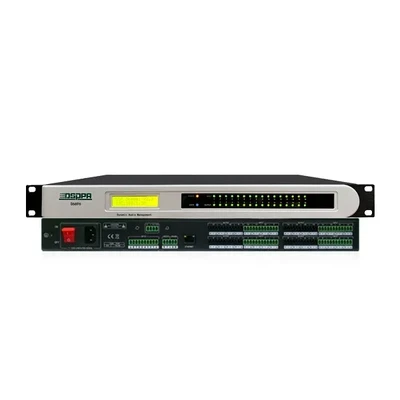
The DSPPA DP1680 is a DSP processor that takes 16 mic or line inputs and cleans them with acoustic echo cancellation (AEC), noise cancellation (ANC), feedback control (AFC) and automatic gain (AGC). It is aimed at large meeting rooms and halls that join video calls with branches or clients.
====
The DSPPA DP1680 is a DSP processor that brings 16 mic or line inputs into one unit and cleans the signal with acoustic echo cancellation (AEC), noise cancellation (ANC) and feedback control (AFC). It belongs in large meeting rooms and in halls that hold hybrid meetings, where echo and feedback are what annoy people most, both in the room and on the far end of the call.
DSPPA DP1680 inputs, outputs and DSP
Each input is set to mic or line level in software, so table microphones and other sources share the same box.
- 16 balanced inputs on 3.81 mm Phoenix blocks, 16 kΩ input impedance.
- 48 V phantom power per mic input and 40 sensitivity steps of 1 dB.
- Balanced line-level outputs with 150 Ω output impedance.
- 32-bit floating-point DSP at 400 MHz, 24-bit/48 kHz conversion, under 3 ms latency.
AEC and ANC for hybrid meetings
In a video call, the remote participant's voice leaves the room speakers and gets picked up again by the mics, so they hear themselves a moment later. The DP1680's AEC removes that echo before the audio goes back to the call. ANC lowers air-conditioning and projector noise in local meetings, AFC suppresses feedback with two selectable levels, and AGC keeps every mic at a steady level so a talker leaning back does not disappear.
Auto mix and camera tracking
Sixteen open microphones add up to a lot of background noise. Auto mix gives priority to the mic someone is speaking into and pulls the rest down. Matrix mix sends any input to any output: room speakers, a recorder or the video conferencing codec. The processor also supports camera tracking with most common camera control protocols, so a camera can turn to whoever switches on their mic. Each input and output has 8 PEQ bands plus HPF and LPF filters.
Control and room integration
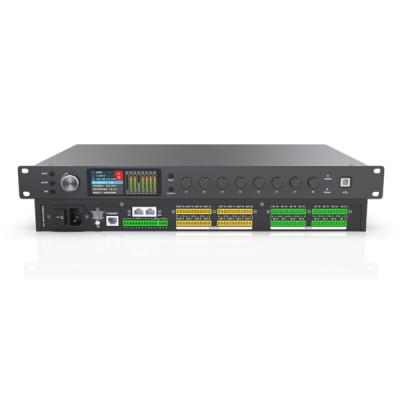
Set it up with Mconsole software on Windows 7 to 11 over USB or the network. For central control there are RS232, RS485 and GPIO, and an optional touch-screen wall panel connects over RS485. Presets can be stored and locked so settings stay put.
Typical Saudi projects
- Boardrooms and large conference halls in Riyadh, Jeddah and Dammam with many table microphones.
- University lecture halls that stream classes to remote students.
- Multipurpose hotel ballrooms where the layout changes from event to event.
- Government meeting rooms connected to branch offices by video.
DP1680 or DP8001?
The difference is input count and echo handling. The DP1680 has 16 inputs, AEC, ANC and AGC, a 400 MHz DSP, 8 PEQ bands per channel and 40 sensitivity steps, managed from Mconsole or a wall panel. The DP8001 has 8 inputs and 8 outputs, feedback suppression without AEC or ANC in its official specs, a 300 MHz DSP with under 1 ms latency, 31 PEQ bands per input, a front LCD and a mobile app. Choose the DP1680 for rooms that join video calls or need more than 8 mics.
Frequently Asked Questions
Does the DP1680 cancel echo on video calls?
Yes. It has AEC for remote meetings, plus ANC for noise reduction and AFC for feedback control.
How many microphones can I connect?
16 balanced inputs, each switchable between mic and line, with 48 V phantom power per input.
Specifications
- Model: DP1680
- Type: Conference DSP matrix audio processor with ANC & AEC
- DSP: 32-bit floating point, 400 MHz
- System latency: < 3 ms
- AD/DA: 24-bit, 48 kHz
- Analog inputs: 16 balanced, Line/Mic selectable
- Input connector: 3.81 mm Phoenix, 12-pin
- Input impedance: 16 kΩ
- Max input level: 17 dBu (Line); -3 dBu (Mic at 20 dB sensitivity)
- Phantom power: +48 V DC, 5.5 mA per input
- Mic sensitivity: 40 steps, 1 dB each
- Analog outputs: Balanced, Line level
- Output connector: 3.81 mm Phoenix, 12-pin
- Output impedance: 150 Ω
- Frequency response: 20 Hz-20 kHz ±0.5 dB (Line); ±1.5 dB (Mic)
- THD+N: -90 dB @ 17 dBu (Line); -90 dB @ -6 dBu (Mic)
- SNR: 110 dB (Line); 100 dB (Mic)
- Voice algorithms: AFC (2 levels), AEC, ANC, AGC, auto mix, matrix mix
- EQ and filters: 8 PEQ per input and per output; HPF/LPF Butterworth, Bessel, Linkwitz-Riley
- Ports: USB Type A-B, RS232, RJ-45 TCP/IP, RS485, GPIO
- Control software: Mconsole for Windows 7 to 11
- Options: Touch-screen wall panel over RS485
- Indicators: Input signal, +48V, Link, output signal
- Power supply: AC 90-264 V, 50/60 Hz
Features
- 16 balanced mic/line inputs: many table mics on one unit, each with switchable 48 V phantom power.
- AEC and ANC built in: the far end of a video call hears no echo of itself and no air-conditioning hum.
- AFC with 2 levels plus AGC: louder room speakers without feedback, and even levels for near and far talkers.
- 32-bit floating-point DSP at 400 MHz with under 3 ms latency: processing nobody in the room will notice.
- USB and TCP/IP control plus RS232, RS485 and GPIO: ties into central control systems and supports camera tracking.
