Grandstream HT881 8-Port FXO Gateway with Lifeline FXS
728.81ر.س
Product description
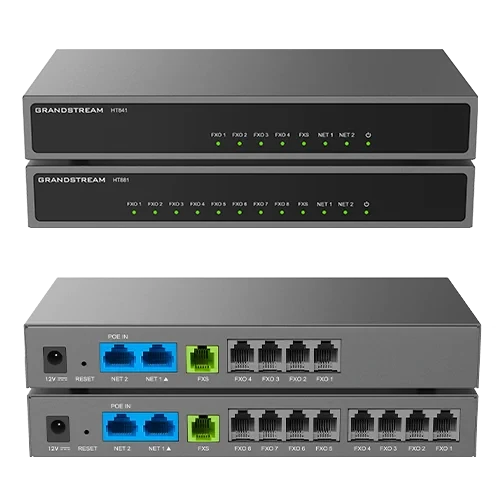
The Grandstream HT881 brings up to 8 analog landlines into an IP PBX, with one FXS port and two network ports including PoE. It fits companies, hotels and medical centers that run a large bank of landlines and want them handled by one PBX.
====
The Grandstream HT881 gathers up to 8 analog landlines and feeds them into an IP PBX, which treats them as outside lines and routes them to extensions. If your reception desk has a bank of STC lines and you want staff to answer them on IP phones, this gateway does it in one box. It runs from a PoE switch on a single cable, so it needs no power socket in the network room.
Grandstream HT881 specs
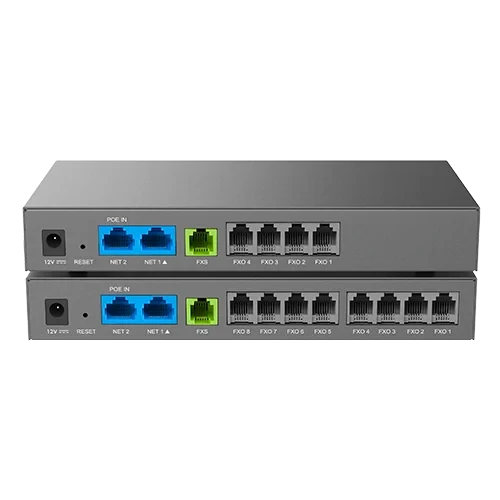
- 8 RJ11 FXO ports and 1 FXS port.
- Two RJ45 network ports, one with 802.3af PoE.
- 3 SIP profiles with automatic failover to a backup SIP server.
- T.38 fax up to 14.4 kbps and 3 REN ring load.
- Powered over PoE or a 12V adapter.
Decide which line each call uses
Eight lines need clear rules. A prefix of up to 10 digits picks a specific FXO port, so sales calls leave on one line and accounts calls on another, or you let the gateway take the first free line in the group. Incoming calls on each line go to whichever extension or ring group you set on the PBX, and caller ID in Bellcore, ETSI, BT and NTT formats shows the customer's number before you answer.
Link sites without inter-city call charges
The HT881 also works without a PBX, paired with a GXW42xx FXS gateway at another site. A branch user dials an outside number and the call leaves on the head office lines over the network. This gateway-to-gateway setup helps companies with a warehouse or branch in another city that want to use head office lines.
Monitoring and security for IT
The gateway supports SNMP v1, v2c and v3, syslog, encrypted provisioning over TR-069 and HTTPS, and an OpenVPN client. Voice is encrypted with SRTP and signaling with TLS and SIPS. In a power cut the FXS port is hard-relayed to FXO8, so at least one analog phone can still reach the outside world.
Where it fits in Saudi Arabia
- Reception at a hotel or medical center with 5 to 8 landlines.
- Companies moving an old phone system to an IP PBX while keeping their numbers.
- Head offices sharing their landlines with branches and warehouses.
Compatibility
The HT881 works with any on-premise or hosted PBX that supports SIP, including Grandstream UCM and Yeastar P-Series systems. Out of the box it runs in bridge mode on your network, and it can be switched to NAT router mode. Its single FXS port keeps one phone or fax machine wired straight to the gateway.
HT881 or HT841?
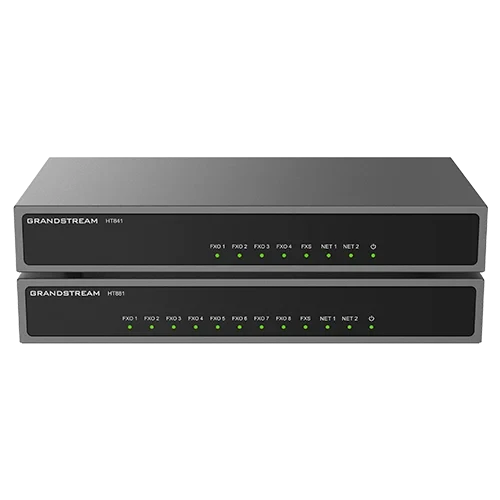
Power and specs are identical. The HT881 has 8 FXO ports with lifeline tied to the eighth line, while the HT841 has 4 ports with lifeline on the fourth. If you have 4 lines or fewer, the HT841 is enough.
Frequently Asked Questions
How many landlines does the HT881 support?
Eight analog landlines, one per FXO port, plus one FXS port for a phone or fax machine.
Can I choose which line a call goes out on?
Yes. Set a prefix of up to 10 digits to pick a specific FXO port, or let the gateway use the line group.
Does it need a power adapter?
Not when you run it from a PoE switch. It can also run from a 12V adapter.
Specifications
- Model: HT881
- Series: HT8x1 analog FXO gateways (HT841/HT881)
- Telephony interfaces: 8 RJ11 FXO ports + 1 RJ11 FXS port
- Lifeline: FXS port hard-relayed to FXO8 during a power outage
- SIP profiles: 3 SIP profiles across the FXS port and FXO ports
- Network interface: 2 × RJ45, one with 802.3af PoE-PD
- Router: Built-in NAT router; bridge mode by default
- LED indicators: POWER, NET1, NET2, FXS, FXO
- Factory reset: Yes (hold 7 seconds)
- Telephony features: Caller ID display or block, call waiting, flash, blind or attended transfer, forward, hold, DND, 3-way conference
- Voice codecs: G.711 (PLC, VAD/CNG), G.723.1, G.729, G.726-32, iLBC, Opus, dynamic jitter buffer, line echo cancellation
- Fax over IP: T.38 Group 3 relay up to 14.4 kbps, auto switch to G.711 pass-through
- Ring load: 3 REN, up to 1 km on 24 AWG
- Caller ID: Bellcore Type 1 & 2, ETSI, BT, NTT, DTMF-based
- Dial methods: DTMF, pulse
- Disconnect methods: Busy tone, polarity reversal/wink, loop current
- Protocols: TCP/IP/UDP, RTP/RTCP, HTTP/HTTPS, ARP/RARP, ICMP, DNS, DHCP, NTP, TFTP, SSH, Telnet, STUN, SIP, SIP over TCP/TLS, SRTP, SNMP, TR-069, IMS/3GPP, IPoE
- QoS: 802.1Q VLAN, 802.1p, ToS, DiffServ, MPLS, traffic shaping
- DTMF methods: In-audio, RFC2833, SIP INFO
- Provisioning and control: HTTP, HTTPS, TFTP, SSH, TR-069, AES-encrypted auto provisioning, syslog
- Security: SRTP media; TLS, SIPS and HTTPS control; per-unit security certificate
- Management: Syslog, Telnet, SSH, web browser
- Power: PoE input 48 V / 0.5 A, or 12 V DC input
- Operating temperature: 0–40°C (32–104°F)
- Storage temperature: -10 to 60°C (14–140°F)
- Humidity: 10–90% non-condensing
- Compliance: FCC, CE, RCM, IC, UKCA
Features
- 8 RJ11 FXO ports: one PBX handles 8 landlines.
- Port selection by prefix of up to 10 digits: send a call out on a specific FXO line or leave it to the line group.
- 3 SIP profiles with failover: the gateway moves to a second SIP server if the primary drops.
- Lifeline FXS port tied to FXO8: an analog phone keeps an outside line during a power cut.
- SNMP v1, v2c and v3 plus TR-069: IT monitors the gateway from its NMS and provisions it remotely.
