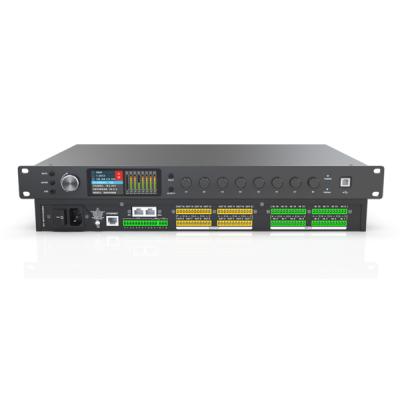
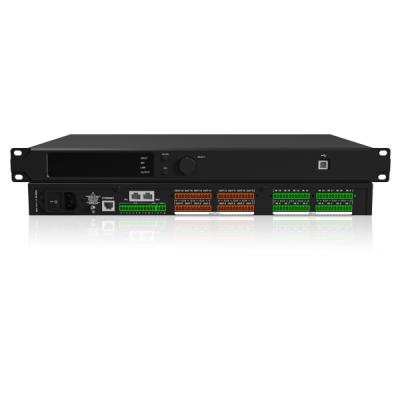
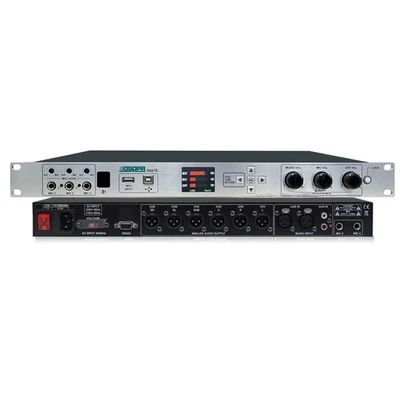
DSPPA D6696 16x16 DSP Audio Processor with 60 Scene Presets
6166.92ر.س
Product description
The DSPPA D6696 is a 16-input, 16-output analog DSP processor with per-channel EQ, dynamics and delay, plus 60 stored presets. It is built for conference halls, lecture theaters and multi-purpose venues that route many microphones to several speaker zones.
====
The DSPPA D6696 is a 16-in, 16-out analog DSP audio processor in a 482×253×44mm chassis. It replaces a stack of separate boxes: gain staging, EQ, compression, limiting, delay, crossover and full matrix routing all happen inside one unit. DSPPA positions it for meeting rooms, conference halls, courtrooms, auditoriums and multi-purpose halls.
Core audio performance
Processing runs on a 40-bit floating-point DSP clocked at 400MHz, fed by 24-bit/48kHz AD/DA converters. In practice that means a clean signal path with no audible hiss, even in a quiet lecture theater.
- Inputs and outputs: 16×16 analog.
- AD and DA dynamic range: 118dB.
- Signal-to-noise ratio: 111dB or better.
- THD+N: 0.005% or lower at +4dBu, 1kHz.
- Frequency response: 20Hz to 20kHz, ±0.3dB.
- Latency through the unit: 4.1ms.
How the 16×16 matrix helps a busy hall
A matrix lets you send any input to any output at its own level. The podium microphone can feed the main hall speakers, a press desk feed and a recorder at the same time, each with a different gain. Every channel carries EQ, gate, compressor, limiter and AGC, so a soft-spoken presenter and a loud one end up at similar volume.
Input sensitivity has 14 steps of 3dB up to 42dB of gain, which covers both microphones and line sources. Output delay runs from 0 to 1500ms in 0.02ms steps. In a long hall you delay the rear speakers so their sound lines up with the front stack instead of arriving early.
Presets, GPIO and remote control
The D6696 stores 60 scene presets: one for a lecture, one for a gala dinner, one for a closed board meeting. GPIO handles 8-scene switching from a simple wall button, with no laptop needed. A PC connects over TCP/IP for web-based adjustment, and control systems can drive the unit through RS232 and RS485 commands. The software interface switches between English and Chinese.
Typical projects in Saudi Arabia
- Hotel ballrooms in Riyadh and Jeddah that split into smaller rooms, each with its own preset.
- University lecture theaters and auditoriums that need delayed rear speakers and room EQ.
- Courtrooms and government meeting rooms routing podium mics to speakers and recorders.
- Multi-purpose halls in mixed-use complexes that change layout every event.
What it connects to
All I/O is analog with a maximum level of +18dBu, so it pairs with power amplifiers, mixers and wireless microphone receivers that have analog outputs. The official page does not list Dante or acoustic echo cancellation, so for rooms built mainly around video conferencing, ask about DSPPA processors designed for that job.
DSPPA D6696 or D6692?
The D6696 gives you 16 inputs and 16 outputs. The D6692 is a 12×12 processor. Go with the D6696 when microphones, sources or speaker zones exceed 12, or when the room is likely to grow. Smaller rooms with a few microphones can use the D6648, a 4×8 unit.
Frequently Asked Questions
How many microphones can the DSPPA D6696 take?
16 analog inputs, each with 14 gain steps up to 42dB, so it accepts mics and line sources.
Is the D6696 an amplifier?
No. It is a line-level processor; feed its 16 outputs into power amplifiers to drive speakers.
Can I switch settings without a laptop?
Yes. It stores 60 presets, GPIO handles 8-scene switching from external buttons, and it accepts RS232/RS485 commands from control systems.
Specifications
- Model: D6696
- Input / Output: 16×16
- Input / Output type: Analog
- Signal processor: 40-bit floating-point DSP, 400MHz
- Bit depth: 24-bit
- Sampling frequency: 48kHz
- Input impedance: <10KΩ
- Output impedance: 200Ω
- A/D dynamic range: 118dB
- D/A dynamic range: 118dB
- Max input level: +18dBu
- Max output level: +18dBu
- Transmission delay: 4.1ms
- Output channel delay: 0 to 1500ms (step 0.02ms)
- THD+N: ≤0.005% (+4dBu, 1kHz)
- Frequency response: 20Hz to 20kHz ±0.3dB
- CMRR: ≥55dB
- Crosstalk: ≤-100dB
- SNR: ≥111dB (20Hz to 20kHz)
- Dynamic range: ≥111dB (20Hz to 20kHz)
- Noise floor: ≤-93dBu (20Hz to 20kHz)
- Input gain: 14 steps of 3dB, up to 42dB
- Processing: Input/output gain, noise gate, EQ, matrix mix, crossover, delay, limiter, compressor, AGC, level meters
- Connection type: TCP/IP, RS232, RS485
- GPIO: 8-channel scene switching
- Presets: 60
- Interface language: English and Chinese
- Size: 482×253×44mm
- Net weight: 3.3kg
Features
- 16×16 analog matrix: send any mic or source to any speaker zone at its own level.
- 40-bit floating-point DSP with 24-bit/48kHz conversion: clean audio with 118dB AD/DA dynamic range.
- Output delay up to 1500ms in 0.02ms steps: keeps rear speakers in sync with the front in long halls.
- 60 presets plus 8-scene GPIO switching: change the room setup with one button.
- TCP/IP, RS232 and RS485 control: browser-based tuning and integration with control systems.
