DSPPA DP8001 8-Channel Conference Audio Processor
4638.16ر.س
Product description
The DSPPA DP8001 is a 1U DSP processor with 8 mic/line inputs and 8 outputs, feedback suppression on every input, auto mixing and 31 PEQ bands per input. It suits local meeting and training rooms that need clear speaker sound without howling.
====
The DSPPA DP8001 handles 8 microphones or sources and 8 outputs from a single 1U box, with a feedback suppressor on every input, auto mixing and detailed PEQ. It is meant for meeting and training rooms where the audio stays mostly local and the goal is louder, clearer speakers without howling.
What the DSPPA DP8001 does
It replaces the separate mixer, feedback suppressor and equalizer that a room like this used to need.
- 8 balanced inputs, each switchable between mic and line, on 3.81 mm Phoenix blocks.
- 8 balanced line-level outputs, 150 Ω output impedance.
- 9 sensitivity steps per mic and 48 V phantom power (10 mA) with its own switch on each input.
- 32-bit DSP running at 300 MHz with audio latency under 1 ms.
Feedback suppression on every input
Feedback happens when a mic picks up a nearby speaker and sends the sound straight back to it. Each DP8001 input has a two-level feedback suppressor, so you gain extra speaker level before howling starts. AUTOMIX opens the active talker's mic and lowers the rest, while matrix mixing routes any input to any output, such as the room speakers or a recorder.
31 PEQ bands per input
Marble floors and glass walls bounce sound around and smear speech. The DP8001 gives you 31 PEQ bands on each input and 10 on each output, plus a crossover and compressor, so the installer can shape every mic and every speaker zone to the actual room. Official performance figures: 105 dB SNR and -90 dB THD+N on a line input.
Control from the front panel, phone or PC
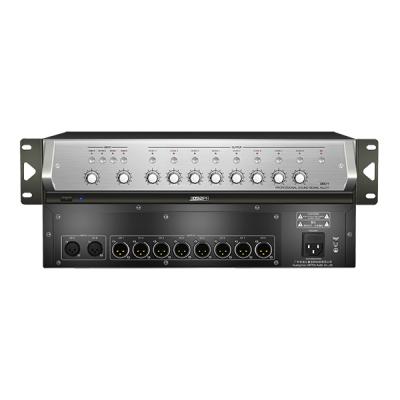
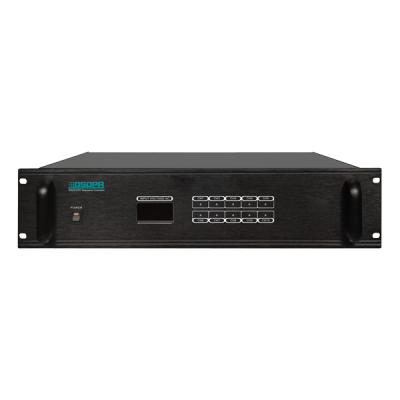
An LCD2402 display with buttons on the front lets you make basic changes without a laptop. You can also control it from a mobile app, a touch screen or a wired connection, and the Micro-B USB port is driver-free. RS232, RS485 and GPIO handle central control, alongside an RJ-45 network port. Camera tracking works with most common camera control protocols.
Typical uses in Saudi Arabia
- Corporate and institute training rooms with a modest number of microphones.
- Mid-size meeting rooms with eight mics around the table.
- Lecture rooms and small auditoriums in private schools.
- Small hotel function rooms where staff need quick adjustments from a phone.
DP8001 or DP1680?
The DP8001 is an 8×8 unit with feedback suppression, a 300 MHz DSP, under 1 ms latency, 31 PEQ bands per input, a front LCD and app control, weighing 2.8 kg. The DP1680 offers 16 inputs, a 400 MHz DSP, echo cancellation (AEC), noise cancellation (ANC) and automatic gain (AGC), with 8 PEQ bands per channel, managed from Mconsole software. If your room does not join video calls and uses 8 mics or fewer, the DP8001 is enough. If remote meetings are part of daily work, go with the DP1680.
Frequently Asked Questions
Does the DP8001 have AEC?
The official specs list feedback suppression and auto mixing, not AEC or ANC. For video meetings, the DP1680 adds AEC and ANC.
Can I control it from my phone?
Yes. DSPPA lists mobile app control, alongside the front LCD, USB and network control.
How many microphones does it take?
8 balanced inputs, each mic or line level, with 48 V phantom power per input.
Specifications
- Model: DP8001
- Type: 8-channel conference audio processor
- Signal processor: 32-bit fixed/floating-point DSP, 300 MHz
- Audio latency: < 1 ms
- A/D and D/A: 24-bit
- Sample rate: 48 kHz
- Input channels: 8 balanced, mic/line
- Connectors: 3.81 mm Phoenix, 12-pin
- Input impedance: 11.5 kΩ
- Max input level: 12 dBu (line), -9 dBu (mic)
- Phantom power: +48 V DC, 10 mA, selectable per input
- Mic sensitivity: 9 steps per input
- Output channels: 8 balanced, line level
- Output impedance: 150 Ω
- Frequency response: 20 Hz-20 kHz ±0.5 dB (line); ±1.5 dB (mic)
- THD+N: -90 dB @ 12 dBu (line); -86 dB @ -7 dBu (mic)
- SNR: 105 dB (line); 95 dB (mic)
- Processing: 2-level feedback suppressor per input, automix, matrix mix, crossover, compressor
- EQ: 31-band PEQ per input, 10-band PEQ per output
- Camera tracking: Supports most common camera control protocols
- USB: Micro-B, driver-free
- Network: TCP/IP, RJ-45
- Central control: RS232 and RS485, Phoenix connectors
- GPIO: Phoenix connector, customizable presets
- Display and buttons: LCD2402 with buttons
- Control options: Mobile app, touch screen, wired
- LED indicators: Power, Link, +48V, input and output signal
- Power supply: AC 100-240 V, 50/60 Hz
- Dimensions: 44×483×210 mm
- Net weight: 2.8 kg
Features
- 8 mic/line inputs and 8 balanced outputs: enough for an eight-mic table and several speaker zones.
- Feedback suppressor on every input, 2 levels: raise room speaker level before howling starts.
- 31 PEQ bands per input and 10 per output: tune the sound to rooms with marble floors or glass walls.
- Under 1 ms latency on a 32-bit 300 MHz DSP: audio stays in sync with the speaker's lips.
- Front LCD, mobile app and driver-free Micro-B USB: adjust it at the rack or from your phone.
