Grandstream HT801 V2 1-Port FXS Analog Telephone Adapter
157.41ر.س
Product description
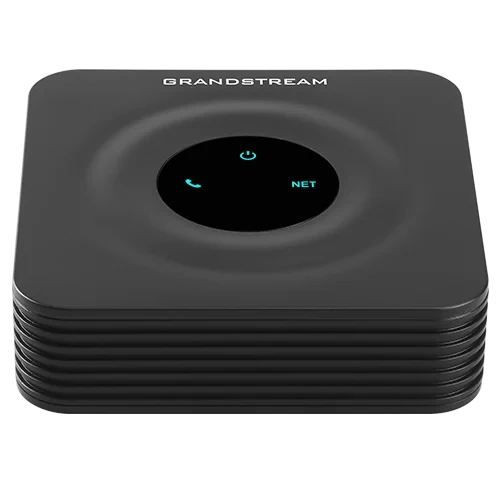
The Grandstream HT801 V2 is a compact adapter with one FXS port and one 10/100 Ethernet port that puts a single analog phone or fax machine on a SIP PBX. It fits guard rooms, home offices and the fax machine in a clinic or office.
====
The Grandstream HT801 V2 is a palm-sized analog telephone adapter that turns any ordinary phone or fax machine into an extension on a SIP PBX or a SIP account. It has one FXS port and one 10/100 Ethernet port, and runs from a 5 V adapter on a Micro USB input. It is the low-cost way to keep one analog handset in service after you move to an IP PBX, instead of buying a new IP phone for a guard room, a home office or a clinic fax line.
Grandstream HT801 V2 at a glance
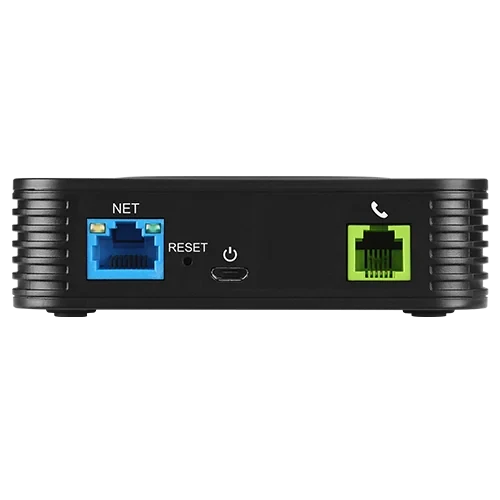
- 1 RJ11 FXS port for an analog phone or fax machine.
- 1 auto-sensing 10/100 Mbps Ethernet port.
- 5 REN ring load, up to 1 km on 24 AWG wire.
- T.38 fax up to 14.4 kbps with automatic G.711 fallback.
- TLS and SRTP encryption; TR-069 and XML provisioning.
- 100 × 100 × 29.5 mm, 102 g.
Your analog phone, now a PBX extension
Plug the handset into the FXS port and the NET port into your router or switch, then register the adapter to the PBX with the extension number and password. From then on the phone dials other extensions and takes transferred calls, with call waiting, transfer, hold, do not disturb and 3-way conferencing. If the main SIP server drops, the adapter fails over to a backup server you define.
Fax over the network with T.38
Many clinics, suppliers and purchasing teams still send orders and reports by fax. The HT801 V2 relays fax with T.38 at up to 14.4 kbps and switches to G.711 pass-through when the far end does not support T.38. Connect the fax machine exactly as you did to the old landline, and its number moves onto the PBX.
Setup in minutes, managed remotely
Find the adapter's IP address from the phone itself: press *** then option 02 and the unit reads it out. Open that address in a browser and sign in as admin with the password printed on the label under the unit. IT teams get more: bulk provisioning over TR-069 or AES-encrypted XML files, cloud management in GDMS, and zero-touch setup when it registers to a Grandstream UCM.
Where it fits
- A gate guard room at a villa compound or warehouse, using a basic phone on the site PBX.
- A home office that needs an extension from the company PBX.
- A fax machine in a clinic, law office or purchasing department.
- An annex or rest house with an older handset you want back on the network.
PBX and SIP provider compatibility
Because it speaks standard SIP, the adapter registers to Grandstream UCM systems, Yeastar PBXs and any SIP-based PBX or provider. Codec support covers G.711, G.722, G.729A/B and OPUS, and VLAN and DiffServ tagging give voice traffic priority on a busy network.
HT801 V2 vs HT802
The HT801 V2 has one FXS port and a 5 REN ring load, so it suits one number with one or several handsets on it. The HT802 adds a second FXS port with its own SIP account, so one box serves two numbers, or a phone and a fax. If you also want to keep a landline as backup, the HT813 adds an FXO port for exactly that.
Frequently Asked Questions
Does the HT801 V2 need a PBX?
It needs a SIP server: an IP PBX such as a Grandstream UCM or Yeastar, or a SIP account from a provider. The adapter is not a PBX itself.
Is the HT801 V2 PoE powered?
No. It runs from a 5 V / 1 A adapter on its Micro USB input, and the adapter is in the box.
Can I connect a fax machine instead of a phone?
Yes. The FXS port takes an analog phone or a fax machine, and the unit supports T.38 fax up to 14.4 kbps.
Specifications
- Model: HT801 V2
- Series: HandyTone HT80x V2 (HT801 V2 / HT802 V2)
- Telephone interface: 1 × RJ11 FXS port
- Network interface: 1 × 10/100 Mbps auto-sensing Ethernet port (RJ45)
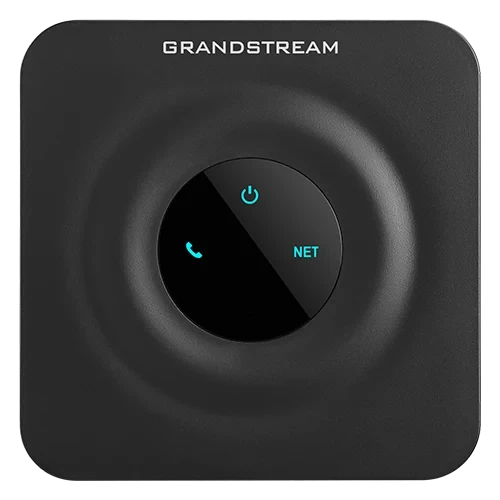
- LED indicators: POWER, NET, PHONE
- Buttons: Factory reset button (hold 7 seconds)
- Telephony features: Caller ID display or block, call waiting, flash, blind or attended transfer, forward, hold, DND, 3-way conference
- Voice codecs: G.711 (Annex I PLC, Annex II VAD/CNG), G.722, G.723.1, G.729A/B, G.726-32, iLBC, OPUS; dynamic jitter buffer, line echo cancellation
- Fax over IP: T.38 Group 3 fax relay up to 14.4 kbps, auto-switch to G.711 pass-through
- Caller ID: Bellcore Type 1 & 2, ETSI, BT, NTT, DTMF-based
- Disconnect methods: Busy tone, polarity reversal/wink, loop current
- DTMF methods: In-audio, RFC2833 and/or SIP INFO
- QoS: Layer 2 (802.1Q VLAN, 802.1p) and Layer 3 (ToS, DiffServ, MPLS)
- Ring load: 5 REN, up to 1 km on 24 AWG
- Dial methods: DTMF, pulse
- Protocols: SIP (RFC3261), SIP over TLS, RTP/RTCP, STUN, SRTP, DHCP, NTP, TR-069, SNMP
- Security: SRTP media; TLS/SIPS/HTTPS control; syslog, SSH, Telnet management
- Provisioning and upgrade: HTTP, HTTPS, SSH, TFTP, TR-069, AES-encrypted auto-provisioning, syslog; GDMS cloud management
- IVR voice prompts: English, Chinese, Russian, Spanish
- Power: External adapter: 100–240 VAC 50/60 Hz in, 5 VDC / 1 A out via Micro USB; no PoE
- Operating temperature: 0–40°C (32–104°F)
- Storage temperature: -10–60°C (14–140°F)
- Humidity: 10–90% non-condensing
- Dimensions: 100 × 100 × 29.5 mm
- Weight: 102 g (unit only)
- Compliance: FCC Part 15B; CE (EN55032, EN55024, EN61000-3-2, EN61000-3-3, EN60950-1); RCM (AS/NZS CISPR22, AS/NZS60950.1, S003); K.21
- In the box: HT801 V2 unit, Ethernet cable, 5 V power adapter, quick installation guide
Features
- 1 RJ11 FXS port: connect an analog phone or fax machine to your PBX instead of buying an IP phone.
- 5 REN ring load up to 1 km: enough for several handsets on one line or a long in-building cable run.
- T.38 fax up to 14.4 kbps: send and receive faxes over the network, with auto-fallback to G.711.
- TLS and SRTP encryption: protects account credentials and call audio.
- TR-069, XML and GDMS provisioning: set up dozens of units centrally, zero-config on a UCM PBX.
