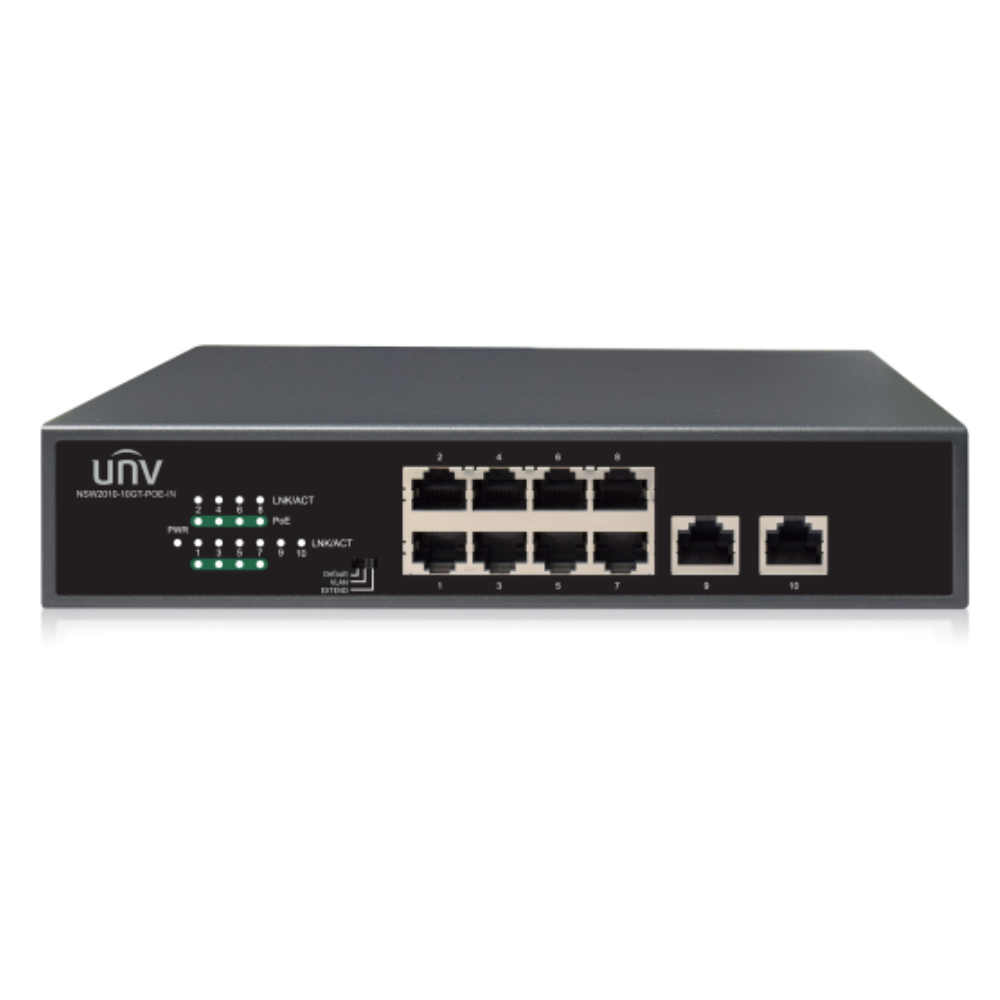
Uniview NSW2010-10GT-POE-IN 8-Port Gigabit PoE Switch, 120W
230.90ر.س
Product description
The Uniview NSW2010-10GT-POE-IN is an unmanaged switch with eight gigabit PoE ports, two gigabit uplinks and a 120W budget. Three working modes, including EXTEND for 250 m runs, make it a natural match for 8-camera systems in large villas, warehouses and retail.
====
The Uniview NSW2010-10GT-POE-IN is the switch size most CCTV installers reach for: eight gigabit PoE ports for eight cameras and two gigabit uplinks for the NVR and router. It shares a 120W PoE budget, delivers up to 30W per port and offers three working modes. The one installers value most is EXTEND, which stretches cable runs to 250 m instead of the usual 100 m.
Specifications
Part of Uniview's (UNV) unmanaged NSW2010 series, it works out of the box with no web interface to learn. Key figures:
- 8 × 1000 Mbps PoE ports plus 2 × 1000 Mbps non-PoE ports.
- 120W total PoE budget, up to 30W per port on 802.3at, compatible with 802.3af devices.
- 20 Gbps switching capacity, 14.88 Mpps forwarding, 2K MAC table and 2 Mbit packet buffer.
- Direct AC input from 100 to 240V, 130W maximum draw and one cooling fan.
Three working modes for different sites
- Default: every port talks to every other port, like any standard switch. Use it when the switch carries cameras and office devices together.
- VLAN (secure): downlink ports only talk to the uplinks, never to each other. This isolates cameras and keeps broadcast traffic down.
- EXTEND (surveillance): cable runs of up to 250 m with the same isolation. This is how you reach a farm's outer gate camera or the far end of a warehouse.
Is 120W enough for your cameras?
Add up each camera's maximum draw, and leave headroom for infrared at night, which raises consumption. If the total stays under 120W, this switch covers it. If not, step up to the NSW2010-18GT2GP-POE-IN with 185W. Port power priority is supported, so key cameras stay on if the budget is reached.
Typical Saudi installations
- A two-floor villa with an annex: eight cameras covering entrances, courtyard and parking on one switch.
- A warehouse in Dammam or Jeddah: EXTEND mode reaches cameras at distant loading bays.
- A showroom: cameras, an access point and IP phones together in default mode.
- An istiraha or farm: a gate camera 200 m away with no intermediate switch.
Compatibility
Works with Uniview cameras and any camera, access point or IP phone that supports 802.3af or 802.3at, using Mode A power delivery. The two uplinks connect to a non-PoE NVR, or to your router for viewing cameras on your phone.
NSW2010-10GT-POE-IN or NSW2020-10T-POE-IN?
Both have eight PoE ports and two uplinks. The NSW2010-10GT-POE-IN runs at gigabit speed with a 120W budget, direct AC power and a VLAN mode. The NSW2020-10T-POE-IN uses 100 Mbps ports, an 88W budget and an external adapter, and it is fanless. Choose the gigabit model for 4K cameras or when the switch also serves the office network, and the NSW2020 for a simpler, lower-resolution camera system.
Frequently Asked Questions
What does EXTEND mode do on the NSW2010-10GT-POE-IN?
It extends the cable run between switch and camera to up to 250 m, so distant gate and perimeter cameras need no extra switch.
Can it run eight PoE cameras?
Yes. It has 8 PoE ports with a 120W total budget and up to 30W per port. Just keep the cameras' combined draw under 120W.
Does it need an external power adapter?
No. It takes a direct 100 to 240V AC input.
Specifications
- Model: NSW2010-10GT-POE-IN
- Series: NSW2010 Gigabit Ethernet Switches (unmanaged)
- Ports: 8 × 1000 Mbps PoE RJ45 + 2 × 1000 Mbps RJ45
- Standards: IEEE 802.3, 802.3u, 802.3az, 802.3x, 802.3af, 802.3at
- Switching capacity: 20 Gbps
- Forwarding rate: 14.88 Mpps
- MAC address table: 2K
- Packet buffer: 2 Mbit
- PoE standard: IEEE 802.3af, IEEE 802.3at
- PoE mode: Mode A (1236)
- PoE budget: 120W total, up to 30W per port
- PoE features: Automatic PD detection, safe for non-PoE devices, port power priority
- Switching: Store-and-forward, line-speed forwarding, IEEE 802.3x flow control and half-duplex backpressure, Auto-MDI/MDIX
- Working modes: Default: all ports talk to each other; VLAN (secure): downlink ports talk to uplink ports only; EXTEND (surveillance): up to 250 m, downlink ports talk to uplink ports only
- Power input: AC 100-240V, 50/60Hz
- Max power consumption: 130W
- Cooling fans: 1
- Operating temperature: 0°C to 40°C (32°F to 104°F)
- Storage temperature: -40°C to 70°C
- Operating humidity: 10% to 90%, non-condensing
- Storage humidity: 5% to 90%, non-condensing
- Indicators: PWR: solid when AC input is normal; PoE: solid when PoE is normal, flashing when abnormal; LINK/ACT: flashing during data transfer
- Dimensions (W × D × H): 220 × 150 × 44 mm (8.7 × 5.9 × 1.7 in)
- Weight: Under 1.24 kg
Features
- 8 gigabit PoE ports at up to 30W each: enough for small PTZ cameras and high-draw access points.
- 120W total PoE budget: eight cameras on one switch with no power adapters.
- EXTEND mode up to 250 m: reach gate and perimeter cameras without an extra switch midway.
- Secure VLAN mode: camera ports are isolated from each other and only talk to the uplinks.
- 20 Gbps switching and two gigabit uplinks: room to feed every stream to the NVR and the LAN.
