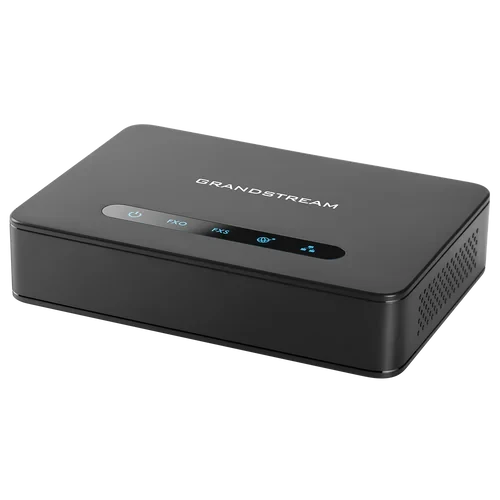
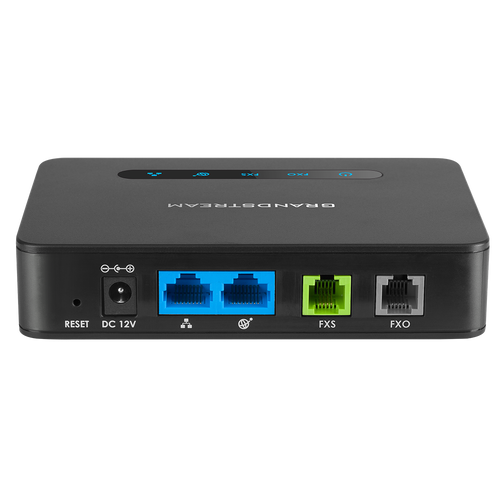
Grandstream HT802 2-Port FXS Analog Telephone Adapter
159.56ر.س
Product description
The Grandstream HT802 is an analog telephone adapter with 2 FXS ports, 2 SIP accounts and a 10/100 Ethernet port, putting two analog phones, or a phone and a fax, on a SIP PBX with a separate number on each port. It suits small offices, villas and small hotels that want to keep their analog handsets.
====
The Grandstream HT802 connects two analog phones to a SIP PBX from one box and one network cable, with a separate SIP account and number on each port. It has two FXS ports, a 10/100 Ethernet port and T.38 fax support. It suits an office with two older handsets, a team that needs a phone plus a fax line, or a villa that wants the guard room and the majlis on the home PBX.
What the Grandstream HT802 gives you
- 2 RJ11 FXS ports, 2 SIP accounts.
- 1 auto-sensing 10/100 Mbps Ethernet port.
- T.38 fax up to 14.4 kbps with automatic G.711 fallback.
- TLS and SRTP encryption for accounts and calls.
- 3-way conferencing, call waiting, transfer and hold.
- 100 × 100 × 29.5 mm, 114 g.
Two numbers from one box
Each FXS port registers to the PBX on its own account, so the first phone can be extension 101 and the second 102, each ringing independently. That beats buying two single-port adapters: one switch port, one power adapter and one spot on the shelf. You can also give the second port to a fax machine and keep the phone free while a fax goes out.
Keep analog phones after the move to VoIP
Moving to an IP PBX does not mean replacing every handset. Analog phones in the warehouse, the guard room or the meeting room stay where they are, and the HT802 brings them onto the new system. Existing phone wiring carries the line from the adapter to the handset, with a 2 REN ring load per port and reach of up to 1 km on 24 AWG wire.
Easy provisioning for IT
On a Grandstream UCM PBX the adapter configures itself with zero manual setup. On any other PBX you set it up from the browser interface, or provision dozens of units through TR-069 and AES-encrypted XML files. If the primary SIP server goes offline, the adapter switches to a backup server on its own.
Good fits
- Villa: one phone in the guard room, another in the majlis, both on the home PBX.
- Accounting office or clinic: reception phone on port 1, fax on port 2.
- Small hotel or serviced apartments: two rooms from one adapter.
- Warehouse: basic phones at the loading bay and in the site office.
PBX compatibility
The HT802 uses standard SIP and works with Grandstream UCM, Yeastar and any other SIP PBX or provider. It supports G.711, G.722, G.729A/B and OPUS codecs and prioritizes voice on the LAN with VLAN and DiffServ tagging.
HT802 vs HT801 V2 vs HT802 V2
The HT801 V2 has a single FXS port with a 5 REN ring load, enough for one phone. The HT802 serves two phones with two numbers from the same unit. Grandstream also lists an HT802 V2 with the same port count, size and weight, and if you need more than two ports, the HT818 V2 offers eight.
Frequently Asked Questions
Can I run two phones with different numbers on the HT802?
Yes. Each FXS port has its own SIP account, so each phone gets its own extension on the PBX.
Does the HT802 come with a power adapter?
Yes. The box includes a 5 V power adapter, an Ethernet cable and the quick installation guide. The unit does not support PoE.
What is the difference between the HT802 and HT802 V2?
The HT802 V2 is a second revision listed by Grandstream with the same port count, size and weight.
Specifications
- Model: HT802
- Series: HandyTone HT80x (HT801 / HT802)
- Lines / SIP accounts: 2 (one per FXS port)
- Telephone interfaces: 2 × RJ11 FXS ports
- Network interface: 1 × 10/100 Mbps auto-sensing Ethernet port (RJ45)
- Buttons: Factory reset button (hold 7 seconds)
- Telephony features: Caller ID display or block, call waiting, flash, blind or attended transfer, forward, hold, DND, 3-way conference
- Voice codecs: G.711 (Annex I PLC, Annex II VAD/CNG), G.722, G.723.1, G.729A/B, G.726-32, iLBC, OPUS; dynamic jitter buffer, line echo cancellation
- Fax over IP: T.38 Group 3 fax relay up to 14.4 kbps, auto-switch to G.711 pass-through
- Caller ID: Bellcore Type 1 & 2, ETSI, BT, NTT, DTMF-based
- Disconnect methods: Busy tone, polarity reversal/wink, loop current
- DTMF methods: In-audio, RFC2833 and/or SIP INFO
- QoS: Layer 2 (802.1Q VLAN, 802.1p) and Layer 3 (ToS, DiffServ, MPLS)
- Ring load: 2 REN, up to 1 km on 24 AWG
- Protocols: TCP/IP/UDP, RTP/RTCP, HTTP/HTTPS, ARP/RARP, ICMP, DNS, DHCP, NTP, TFTP, SSH, Telnet, STUN, SIP (RFC3261), SIP over TCP/TLS, SRTP, SNMP, TR-069, IMS/3GPP, IPoE
- Security: SRTP media; TLS/SIPS/HTTPS/SSH control; syslog, SSH, Telnet and web management
- Provisioning and upgrade: HTTP, HTTPS, FTP, FTPS, SSH, Telnet, TFTP, TR-069, AES-encrypted auto-provisioning, syslog
- Power: External adapter: 100–240 VAC 50/60 Hz in, 5 VDC / 1 A out via Micro USB; no PoE
- Operating temperature: 0–40°C (32–104°F)
- Storage temperature: -10–60°C (14–140°F)
- Humidity: 10–90% non-condensing
- Dimensions: 100 × 100 × 29.5 mm
- Weight: 114 g (unit only)
- In the box: HT802 unit, 5 V power adapter, Ethernet cable, quick installation guide, GPL statement
Features
- 2 FXS ports, 2 SIP accounts: two phones with separate numbers from one box and one network drop.
- Single 10/100 Ethernet port: one cable serves two rooms, or a phone plus a fax.
- T.38 fax up to 14.4 kbps: dedicate one port to fax and keep the other for voice.
- TLS and SRTP encryption: protects both accounts and the calls on them.
- Zero-config on UCM plus TR-069 and XML provisioning: fast rollout across many units.
