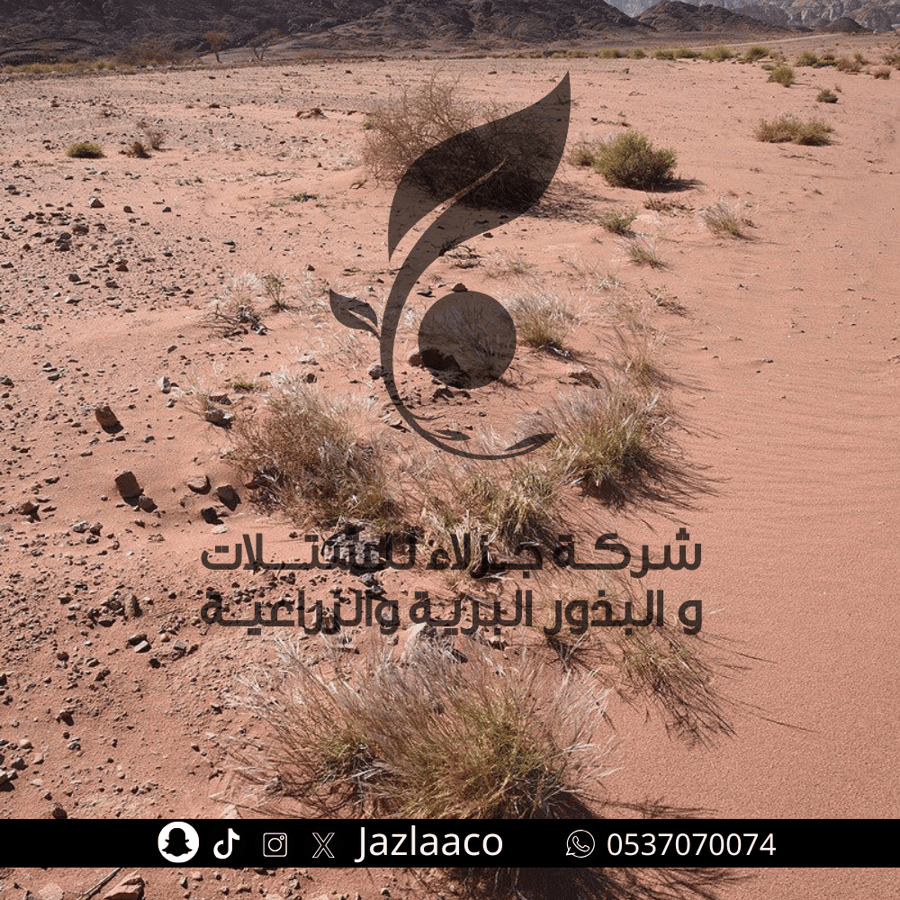
Text seeds - Stipagrostis plumosa
9.50ر.س
Product description
Stipagrostis plumosa is a perennial herbaceous plant from the grass family (Poaceae). It is an important desert herb, characterized by its high tolerance to drought, heat, wind, and sand. It is considered one of the distinctive herbs of sandy environments and desert dunes.
General Description
It grows as a perennial grass forming clumps, and usually reaches a height of about 20–60 cm. The leaves and stems cluster together from the base of the plant, forming clumps that help to stabilize soil and sand.
Papers
Its leaves are long, narrow, and linear, ranging in color from green to gray-green, and may curl or curl when drought is severe. Their narrow shape helps to reduce water loss and adapt to heat and wind.
Inflorescences and flowers
It produces slender spike-like inflorescences on upright stems, and its spikelets are characterized by a long, distinctly feathery sheath, a defining feature of the genus Stipagrostis. The inflorescences have a light, feathery appearance, especially when mature.
Fruits and seeds
It produces tiny seeds within spikelets, attached to long stalks and structures that aid in wind dispersal. These structures also help anchor the seed among sand grains after it falls.
Endurance and suitability
My plant is highly resistant to drought, heat, wind, and shifting sands, and can even withstand being partially buried in sand. It responds to seasonal rains by growing and producing new seeds.
Uses
It has pastoral and environmental importance, providing fodder for grazing animals and wildlife, especially when green growth is present. It also contributes to sand stabilization and reduces dune movement and erosion, and can be used in vegetation restoration and desertification control projects.
natural spread
Stipagrostis plumosa is widespread in areas of North Africa, the Middle East and the Arabian Peninsula, and is associated with dunes, sandy plains and dry desert areas.
Preservation status
Stipagrostis plumosa is not known to be globally threatened and is well-adapted to desert environments. Its local population density may be affected by overgrazing, habitat degradation, and vehicle traffic in sandy areas.