
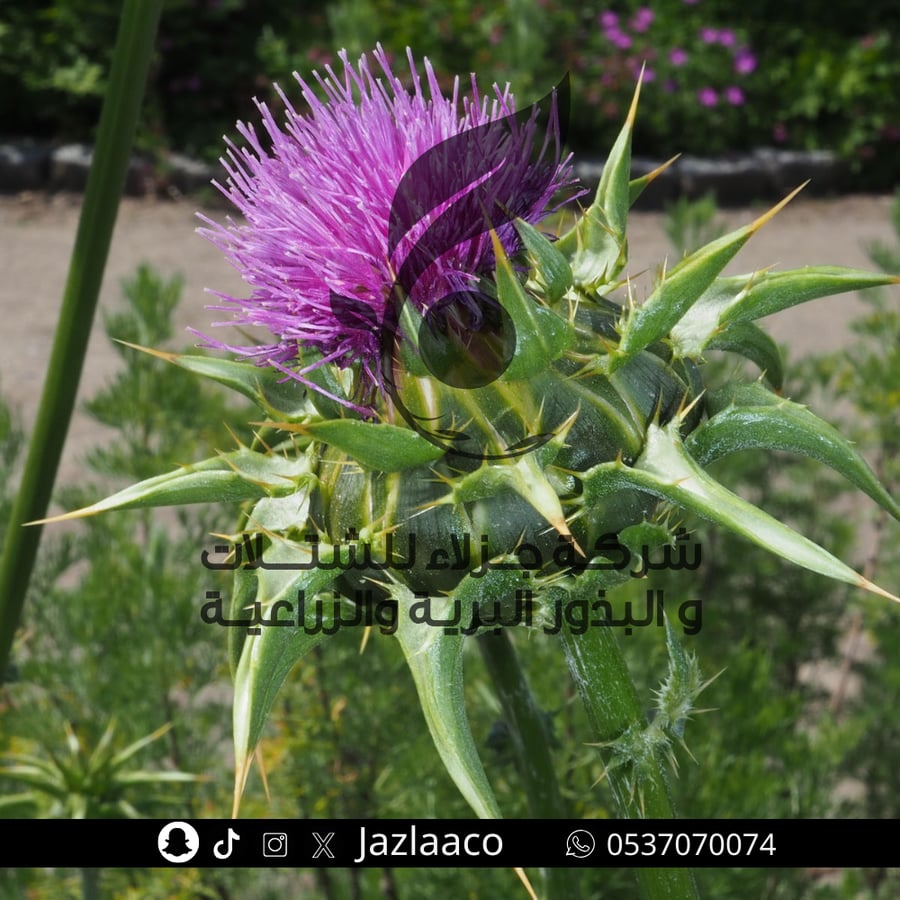


Wild artichoke - Silybum marianum
15ر.س
Product description
Wild artichoke (Silybum marianum) is an annual or biennial herbaceous plant belonging to the Asteraceae family. It is known for its large, white-spotted leaves and bright purple flowers. It is widespread in open areas, farmland, and pastures, and is characterized by its ability to grow in a wide range of environments.
General Description
It grows as an upright herbaceous plant, typically reaching a height of 60–150 cm, and may exceed this under suitable conditions. It is characterized by a strong, branching stem, and the upper parts of the plant are equipped with leaves and thorny parts that help protect it from grazing.
Papers
Its leaves are large and deeply lobed, dark green in color, and characterized by distinct white veins or spots on their surface. The leaf edges bear sharp spines, and the lower leaves may be larger than those on the upper part of the plant.
flowers
It produces large, purple or crimson flower heads that appear singly at branch ends. The flower head is surrounded by prominent spiny bracts, and the flowers appear during the growing season, attracting bees, insects, and pollinators.
Fruits and seeds
It produces small, dry, drupe-like fruits that are brown or black in color and covered with white down that aids in wind dispersal. Seeds are the plant's primary means of reproduction.
Endurance and suitability
Wild artichoke is remarkably tolerant of relatively dry conditions and thrives in various soil types, including farmland, pastures, and degraded areas. It prefers sunny locations and well-drained soils and can utilize seasonal moisture to complete its growth cycle.
Uses
It has environmental importance as a source of nectar and pollen for a number of insects and pollinators. Its seeds are also known for containing plant compounds, most notably silymarin, and therefore the plant has been associated with traditional uses and medicinal studies; however, medicinal use does not necessarily guarantee therapeutic efficacy for all conditions.
natural spread
Silybum marianum is naturally distributed across large areas of Europe, the Mediterranean basin, North Africa, and western Asia, and has been introduced through cultivation or naturalization to other parts of the world. It can be found in open fields, pastures, roadsides, and farmland.
Preservation status
Silybum marianum is not considered a globally threatened species, and it enjoys wide distribution and good adaptability to different environments. It has also become naturalized in many areas outside its natural range.
