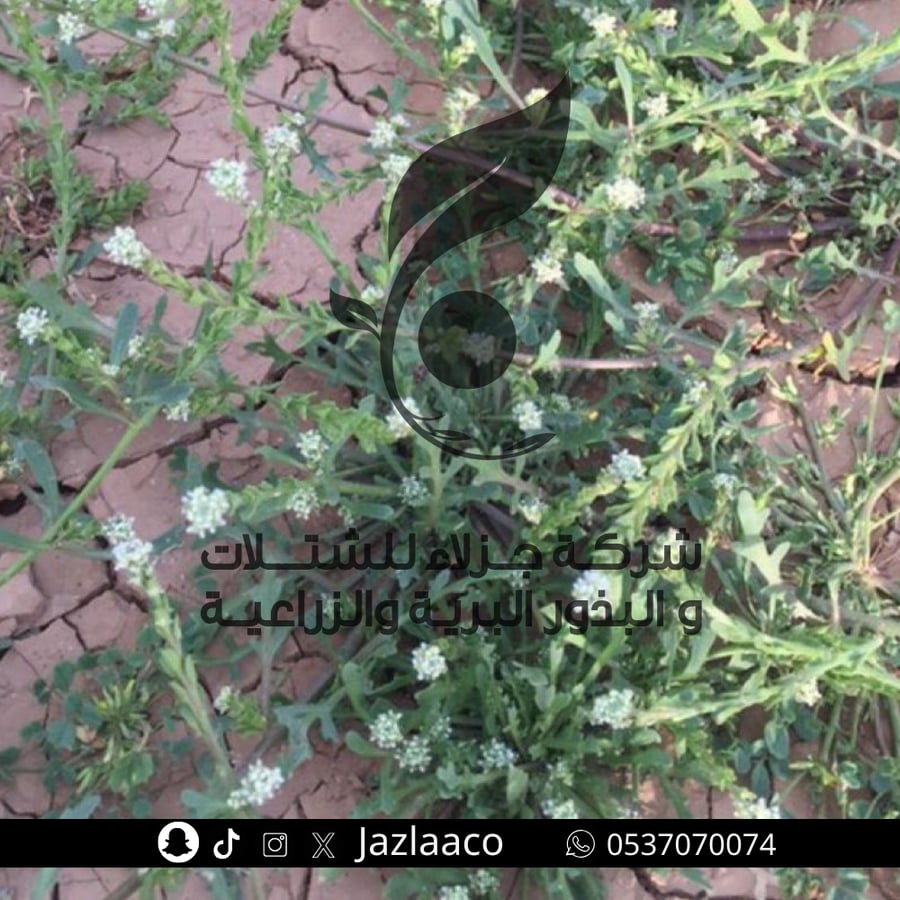
Wild cress - Lepidium aucheri
9.50ر.س
Product description
Wild cress (Lepidium aucheri) is a short-lived annual or perennial herbaceous plant of the Brassicaceae family. It grows in dry, semi-dry, and open environments, and is characterized by its lobed leaves, small white flowers, and distinctive fruit pods.
General Description
It grows as a small, upright or spreading herbaceous plant, typically ranging in height from 10 to 40 cm, though its size may vary depending on environmental conditions and moisture availability. It is found in open fields, sandy and gravelly areas, and locations receiving seasonal rainfall.
Papers
Its leaves are simple and alternate, with the basal leaves typically being larger and more lobed, while the upper leaves become smaller and less lobed. They are green in color and may be covered with fine hairs to varying degrees.
flowers
It produces small white flowers consisting of four petals, clustered in inflorescences at the ends of the stems. The flowers appear during the growing season when moisture is available, attracting a number of insects and pollinators.
Fruits and seeds
It produces small, flattened, round to oval fruits, a characteristic feature of the genus Lepidium. Each fruit contains small seeds, which mature after flowering to contribute to plant regeneration and propagation.
Endurance and suitability
Wild cress is adapted to arid and semi-arid environments and can grow in sandy and gravelly soils and open areas. It benefits from seasonal rainfall to complete its growth cycle and produce seeds, and it tolerates periods of drought after the growing season ends.
Uses
It has ecological importance among native wild plants, and its flowers provide a source of nectar and pollen for insects and pollinators. It can be utilized in projects for plant biodiversity conservation, arid land rehabilitation, and the restoration of natural vegetation cover.
natural spread
Lepidium aucheri is naturally found in parts of the Middle East and the Arabian Peninsula, and is associated with arid and semi-arid regions, sandy and gravelly lands, and open sites.
Preservation status
Lepidium aucheri is not currently known to be globally threatened, but information regarding its global conservation status is limited compared to more well-studied plant species. Its density varies locally depending on climatic conditions and the state of its natural habitat.
