
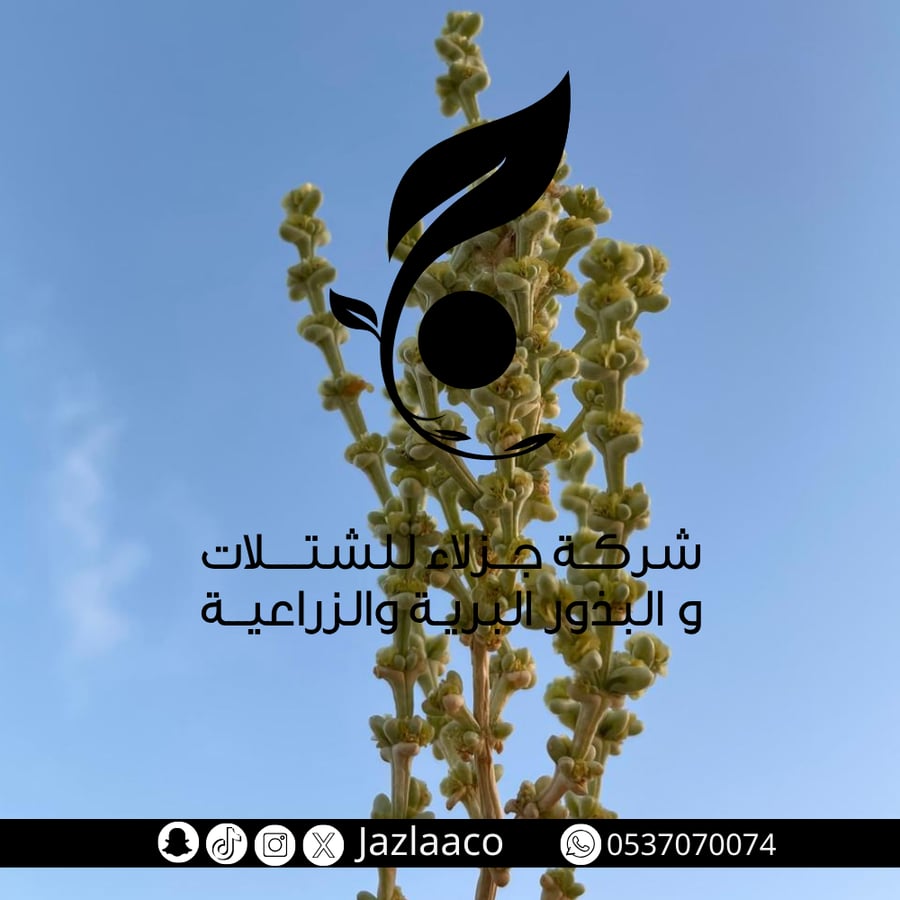
Sha'ran - Anabsis setifera Moq
9.50ر.س
Product description
Anabasis setifera is a perennial shrub of the Amaranthaceae family. It is a desert plant adapted to drought, heat, and salinity, and is characterized by its dense, thin branches and its ability to grow in arid environments and sandy and gravelly soils.
General Description
It grows as a small, highly branched shrub, typically reaching a height of 20–60 cm. The branches are upright or spreading, giving the plant a dense and tangled appearance. It is notable for its ability to survive in harsh desert conditions.
bark and stem
Older stems and branches are relatively woody, with a gray to grayish-brown color, while newer branches are greener and more supple. As the tree ages, the branches become rougher and more branched.
Papers
Its leaves are very small, simple, and fleshy, growing close together from the stems and branches, and tending towards a grayish-green color. The small size and fleshy nature of the leaves help to minimize water loss and improve tolerance to drought and heat.
flowers
It produces small, inconspicuous flowers, ranging in color from green to yellowish-green, which appear in clusters at branch nodes. The flowers are small relative to the size of the plant, and after flowering, they produce fruit-like structures that aid in seed dispersal.
Fruits and seeds
It produces small, dry fruits, and the structures surrounding the fruit are characterized by fine extensions or appendages that help protect the seeds and contribute to their dispersal. The fruits contain tiny seeds capable of remaining in the soil until suitable conditions are provided for germination.
Endurance and suitability
The plant is highly resistant to drought and heat, tolerates varying degrees of salinity, and thrives in sandy and gravelly soils, plains, and open desert areas. Its branching growth habit helps it withstand wind and harsh environmental conditions.
Uses
It has environmental importance within the desert vegetation cover, as it contributes to soil stabilization and reduces erosion, and provides cover and shelter for small desert organisms. It can be utilized in vegetation restoration projects and combating desertification in arid regions.
natural spread
Anabasis setifera is widespread in parts of the Middle East and the Arabian Peninsula, and is associated with desert environments, sandy and gravelly plains, and dry and saline areas.
Preservation status
Anabasis setifera is not known to be globally threatened and is well-adapted to desert and saline environments. Its density varies locally depending on the condition of natural habitats, grazing intensity, and human disturbances.
