
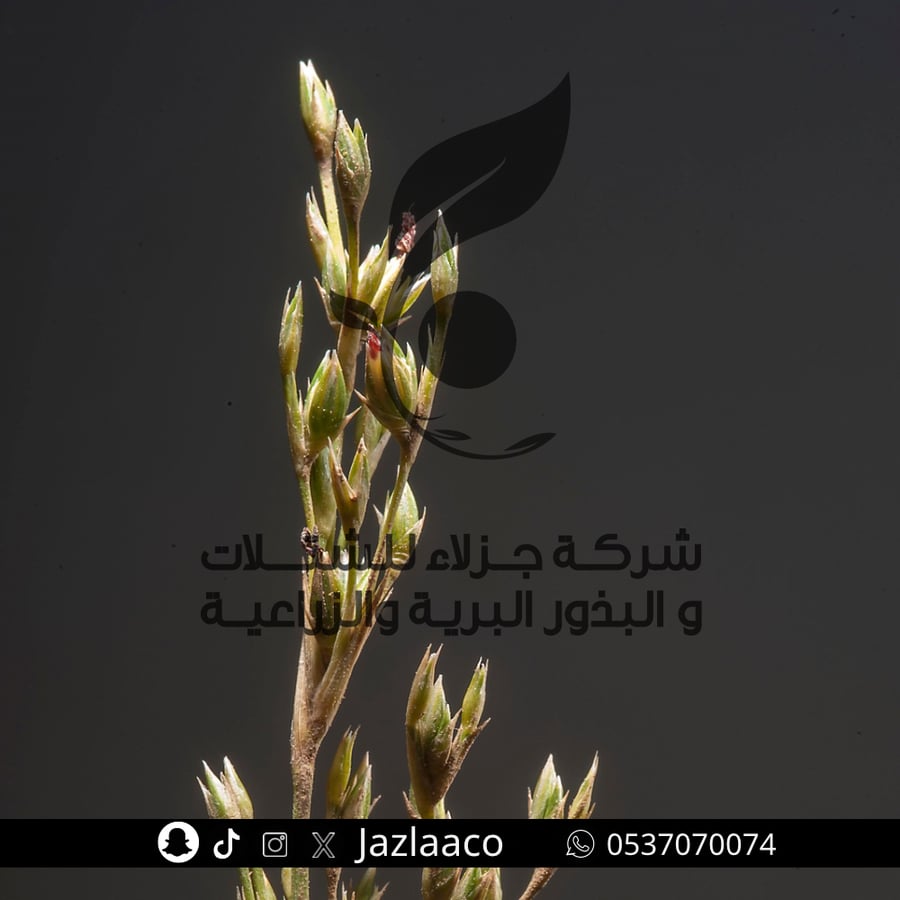
Juncus rigidus
9.50ر.س
Product description
Juncus rigidus is a perennial herbaceous plant from the Junaceae family. It is a plant adapted to saline and dry environments, and it grows especially in marshes, wet and saline areas, valley edges, and water bodies.
General Description
It grows in dense, upright clumps, typically reaching a height of 50–150 cm. These clumps can be wide and dense due to propagation from the base and roots. Its stems are characterized by being rigid, upright, and almost cylindrical, traits that reflect its scientific name, rigidus, meaning "hard."
leaves and stems
The leaves and stems are green to gray-green, long and stiff, and have a cylindrical or semi-cylindrical shape. The leaves are often basal or attached to the base of the plant, while the green stems play an important role in photosynthesis.
flowers
The inflorescences appear near the stem tips and consist of clusters of small, brown to greenish-brown flowers. The inflorescence may appear lateral due to the stem extending beyond the inflorescence. The flowers appear during the growing season and contribute to seed production.
Fruits and seeds
It produces small, dry fruits containing numerous tiny seeds, and the fruits turn brown when ripe. The seeds are dispersed near the plant or by water and wind, and the plant can also spread vegetatively through roots and rhizomes.
Roots and rhizomes
It possesses a robust root system with rhizomes that enable it to form dense clumps and spread locally. These roots and rhizomes help stabilize soil and sediment, especially in humid and saline environments.
Endurance and suitability
Rough-leaved asparagus is characterized by its high tolerance to salinity, as well as its ability to withstand drought and heat, and it can grow in saline soils and relatively high-salinity waters. It is considered an important plant in coastal environments, salt marshes, and salt-affected areas.
Uses
It has significant environmental importance in stabilizing soil and sediments and reducing erosion, and it also provides cover and shelter for some wildlife. It can be utilized in projects for reclaiming saline lands, stabilizing soil, and restoring vegetation cover in coastal and desert environments affected by salinity.
natural spread
Juncus rigidus is widespread in large areas of the Middle East, North Africa and the Arabian Peninsula, and is associated with salt marshes, saline and humid areas, valley edges and water bodies.
Preservation status
Juncus rigidus is not currently known to be globally threatened and is well-adapted to saline and arid environments. Its density varies locally depending on moisture availability, salinity levels, and the condition of its natural habitat.
