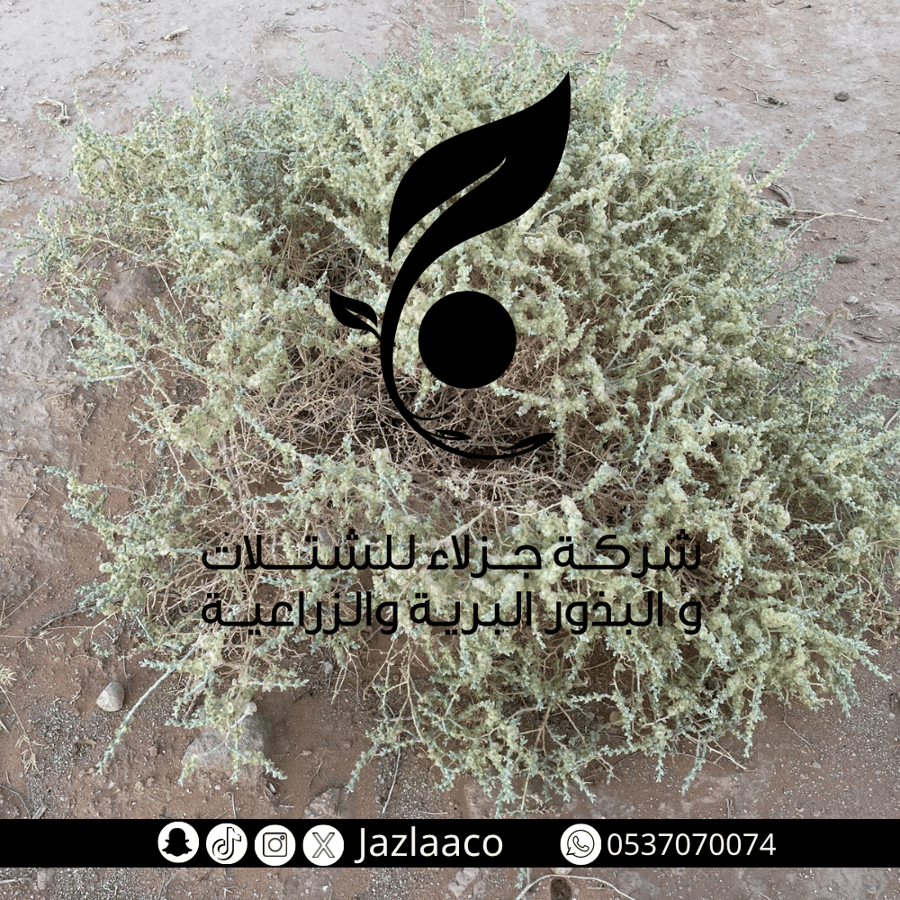

Halothamnus iraqensis
9.50ر.س
Product description
Halothamnus iraqensis is a perennial desert shrub of the Amaranthaceae family. It is a plant adapted to drought, heat, and salinity, and grows in desert, semi-desert, plains, and sandy and gravelly areas.
General Description
It grows as a branching shrub, typically reaching a height of 30–100 cm, with upright or spreading branches forming a relatively dense crown. It is characterized by its ability to withstand harsh conditions and low water levels.
Papers
Its leaves are small, simple, and relatively fleshy, ranging in color from green to gray-green, and are spaced apart on the branches. The small size and fleshy nature of the leaves help to minimize water loss and promote tolerance to drought and salinity.
flowers
It produces small, inconspicuous flowers, green to yellow-green, that appear in the leaf axils on the branches. The flowers are solitary or in small clusters, and appear during the growing season.
Fruits and seeds
Its fruits are characterized by distinct wings or membranous appendages around the fruiting part, a distinctive feature of the genus Halothamnus that aids in wind dispersal. The fruits ripen and turn shades of brown or pale pink as they mature.
Endurance and suitability
The *Qadqad* plant is highly tolerant of drought, heat, and salinity, and thrives in sandy, gravelly, clay, and marsh soils. It can survive in water- and nutrient-poor lands. Its deep roots and branching spread help it take advantage of limited moisture.
Uses
It has environmental importance in stabilizing soil and reducing erosion, and it also provides cover and shelter for some desert organisms. It can be used in vegetation restoration projects, the rehabilitation of arid and saline lands, and combating desertification.
natural spread
Halothamnus iraqensis is widespread in parts of Iraq, the Arabian Peninsula and adjacent desert regions, and is associated with desert plains, sandy and gravelly areas and salinity-affected environments.
Preservation status
Halothamnus iraqensis is not currently known to be globally threatened, but its local status may be affected by habitat degradation, grazing, and human activities. Its density varies depending on climatic conditions, soil state, and natural habitat.
