

Artemisia Judaica
9.50ر.س
Product description
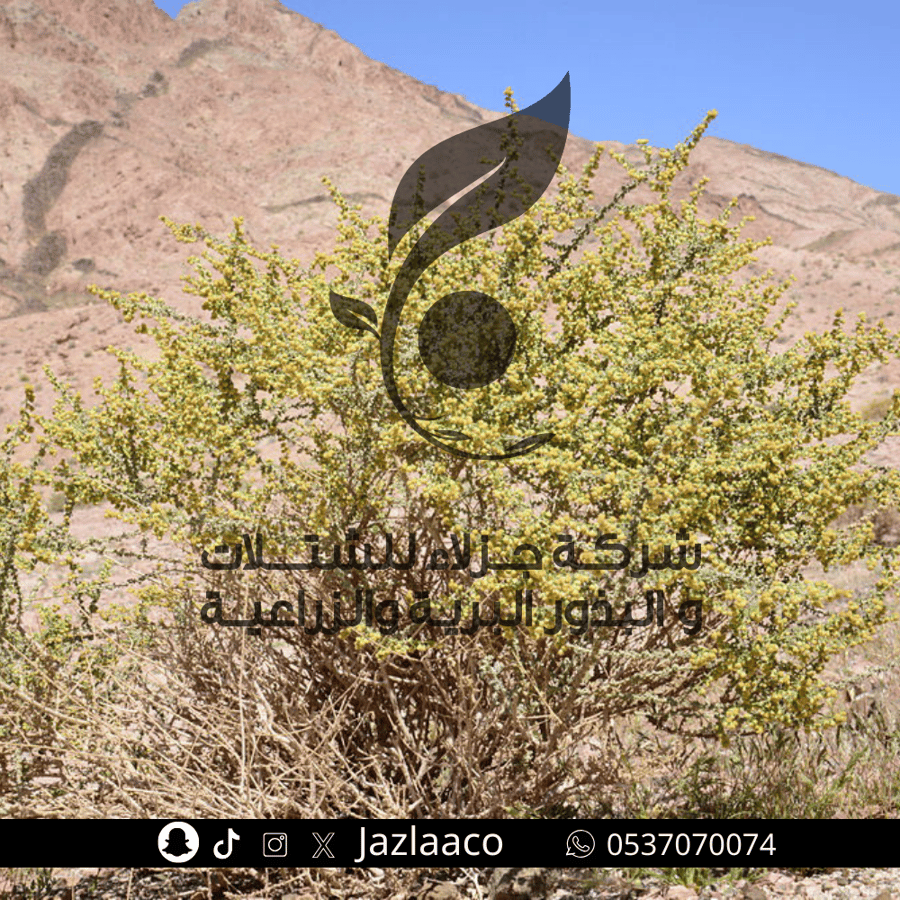
Artemisia judaica is a fragrant perennial desert shrub from the Asteraceae family. It is a plant characteristic of dry desert environments, and is distinguished by its silvery leaves, strong scent, and high tolerance to drought and heat.
General Description
It grows as a small, highly branched shrub, usually reaching a height of about 30–80 cm. The branches are upright or spreading, and the plant forms a relatively dense mass, especially in suitable locations.
bark and stem
Older stems are woody, and the bark is gray to brownish-gray, becoming rougher with age. Younger branches are greenish-gray and covered with fine hairs.
Papers
Its leaves are small and divided into fine lobes, ranging in color from gray-green to silvery, and are covered with fine hairs that give the plant a distinctive silvery appearance. The leaves contain essential oils responsible for its strong fragrance.
flowers
It produces very small, yellow to greenish-yellow flower heads that cluster on the branches. The flowers are not prominent in relation to the size of the plant, but it produces a quantity of seeds after flowering is complete.
Fruits and seeds
It produces very small, dry spores, which are often dispersed near the plant or by wind. The seeds of the genus Artemisia are characterized by their small size and their need for suitable moisture conditions to germinate.
Endurance and suitability
It is highly drought and heat tolerant, and thrives in sandy and gravelly soils and extremely arid desert regions. Its small leaves, hairs, and essential oils help minimize water loss and protect the plant from harsh conditions.
Uses
It is important in traditional folk medicine, and parts of it have been used in some regions for various purposes. It is also characterized by its strong aromatic scent. Environmentally, it is used as a desert plant, providing cover and shelter for small organisms and contributing to plant diversity.
It is not recommended to use it therapeutically or to take its preparations in unknown doses, because the different types of Artemisia contain active compounds whose concentrations vary according to the type and source.
natural spread
Artemisia judaica is widespread in areas of North Africa, the Sinai Peninsula and the Middle East, and is associated with very dry sandy and gravelly desert environments.
Preservation status
Artemisia judaica is not known to be globally threatened, but its local populations may be affected by overgrazing, habitat degradation and removal from the wild.