
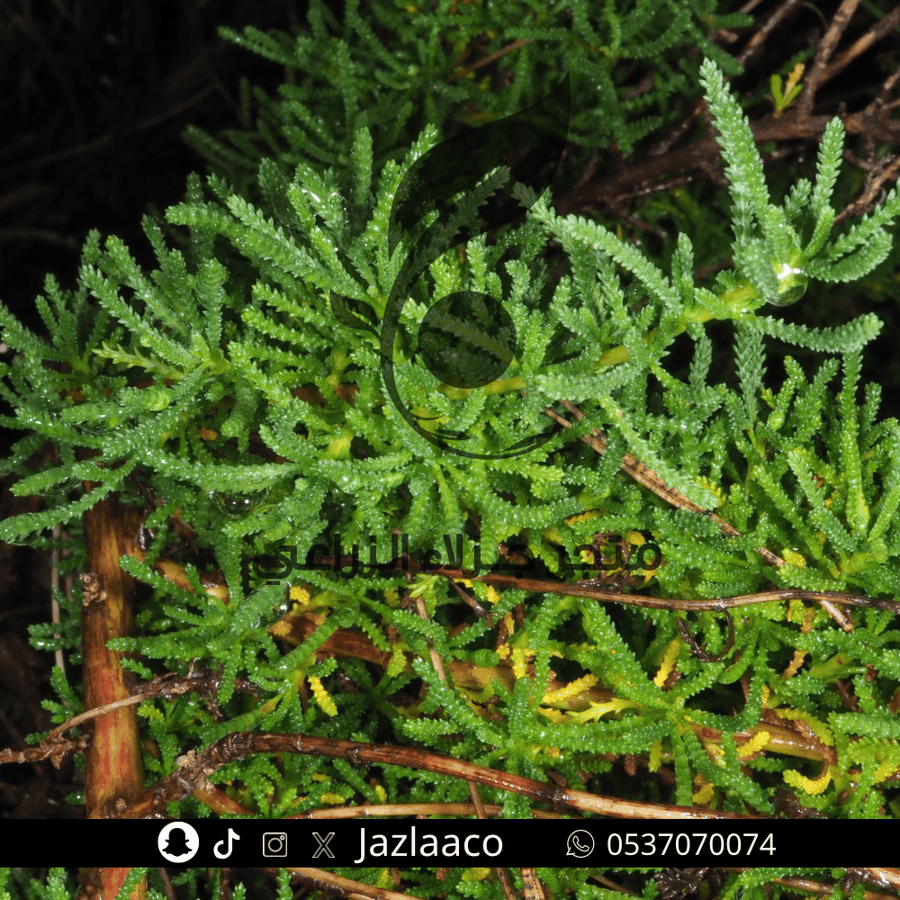
Green lavender - Cotton lavender - Santolina rosmarinifolia
9.50ر.س
Product description
Green lavender (Santolina rosmarinifolia) is a fragrant, evergreen perennial shrub of the Asteraceae family, characterized by its fine green leaves, aromatic scent, and spherical yellow flowers. It tolerates drought and heat well.
General Description
It grows as a small, dense, highly branched shrub, typically reaching a height of 30–60 cm, though it may spread horizontally beyond its height. The branches are thin and dense, and the plant retains its green appearance for most of the year under suitable conditions.
bark and stem
Older stems are woody, with gray-brown to gray bark that may become rough with age. Newer branches are greener, softer, and denser with leaves.
Papers
Its leaves are very small and narrow and divided into fine lobes, with a distinct green color, and contain aromatic oils that give the plant a distinctive scent when the leaves are rubbed.
flowers
It produces small, spherical, bright yellow flower heads that rise on flower stalks above the mass of leaves. The flowers appear during the flowering season and attract some insects and pollinators.
Fruits and seeds
It produces small dry seeds after the flower heads have dried out, and these can be collected and used to propagate the plant.
Endurance and suitability
It tolerates drought and heat well after its establishment is complete, prefers direct sunlight and well-drained soil, and is negatively affected by water stagnation and excessive moisture.
Uses
It is used as an ornamental and aromatic plant in gardens and rockeries, and can be used in low-watering landscaping. Some varieties of Santolina are also traditionally used in perfumery and for some household purposes, and are characterized by their strong fragrance.
natural spread
Native to southwestern Europe and the Iberian Peninsula, it is particularly widespread in Spain, Portugal and some neighboring regions, and was later cultivated as an ornamental plant in other areas.
Preservation status
Santolina rosmarinifolia is not known to be globally threatened, however some of its local wild populations may be affected by land-use change and habitat degradation.
