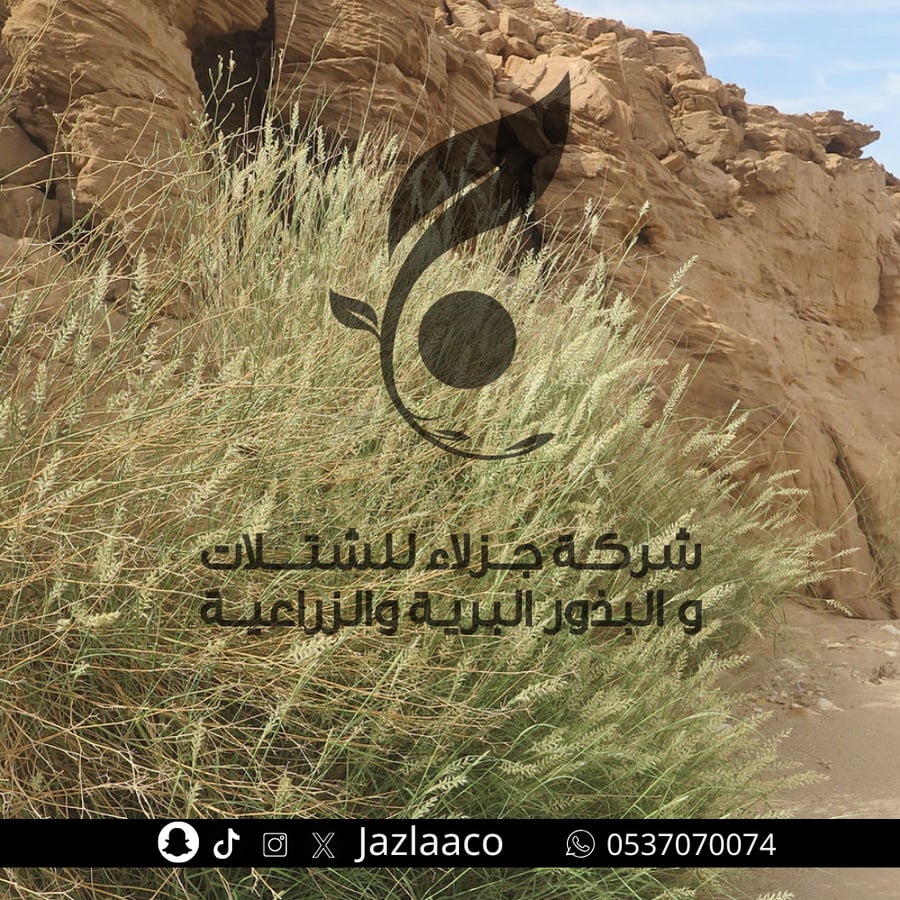

Thymum - Dye - Pennisetum divisum
9.50ر.س
Product description
Thymum (Pennisetum divisum) is a perennial herbaceous plant from the grass family (Poaceae), a grass of desert and semi-desert regions, and is characterized by its ability to withstand drought, heat, grazing and living in sandy and gravelly soils.
General Description
It grows as a perennial herb forming clumps, and usually reaches a height of about 20–60 cm. The stems and leaves cluster together from the base of the plant, and it has a relatively dense appearance, especially in locations where seasonal moisture is available.
Papers
Its leaves are long, narrow, and linear, ranging in color from green to gray-green, and may be rough to the touch. They emerge in tufts from the base of the plant. The narrow leaf shape helps to reduce water loss in desert conditions.
Inflorescences and flowers
It produces dense, distinctive spikes, composed of spikelets surrounded by long hairs that give the inflorescence a feathery or brushy appearance. The color of the inflorescences may vary between green, beige, and light brown as they mature.
Fruits and seeds
It produces small grains inside the spikelets, which are released when the inflorescences dry. The seeds can be dispersed by wind or animal movement, while the tufts and roots help the plant survive from season to season.
Endurance and suitability
It is characterized by good tolerance to drought and heat, as well as varying degrees of grazing, and grows in sandy and gravelly soils, open areas, and desert plains. It benefits from seasonal rainfall for rapid growth and seed production.
Uses
It has pastoral and environmental importance, serving as a source of fodder for some grazing animals and wildlife, and contributing to soil and sand stabilization and erosion reduction. It can also be utilized in rangeland and desert vegetation restoration projects.
natural spread
Pennisetum divisum is found in areas of North Africa, the Middle East and the Arabian Peninsula, and is associated with sandy and gravelly areas, desert and semi-desert plains.
Preservation status
Pennisetum divisum is not known to be globally threatened and is well distributed in arid environments. Its local density may be affected by overgrazing, rangeland degradation, and human activities.
