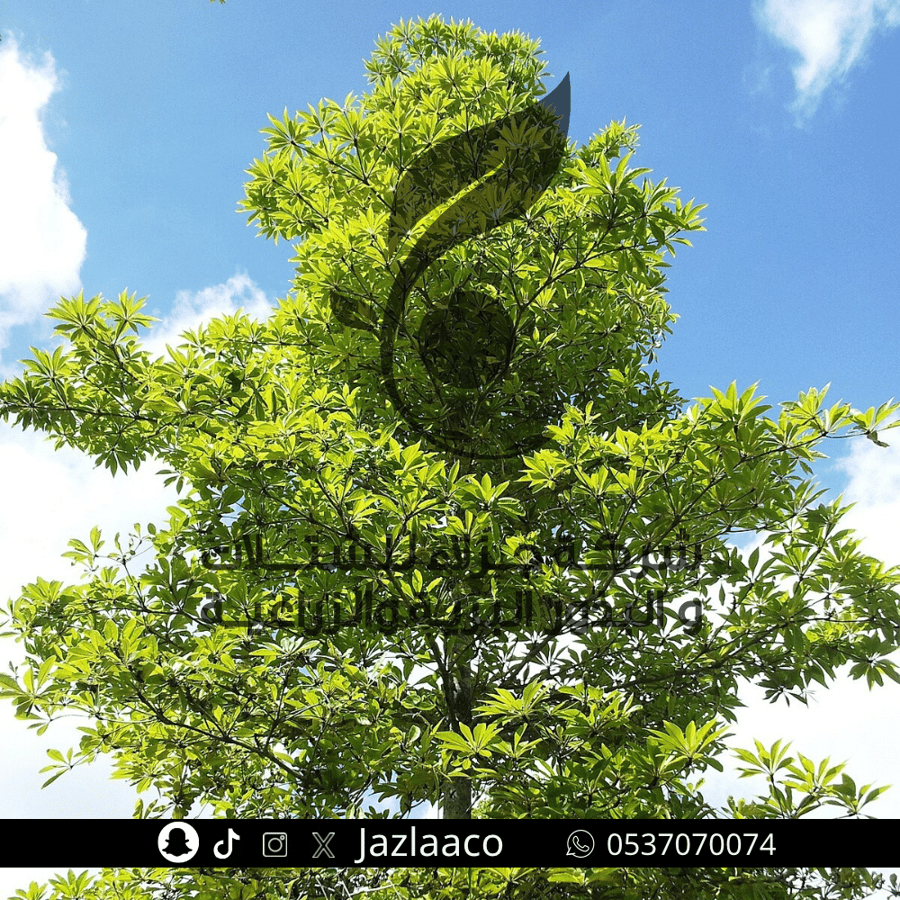
Terminalia Bentzoe
9.50ر.س
Product description
Terminalia bentzoe is a perennial tree belonging to the Combretaceae family. It is native to the islands of the Indian Ocean and is naturally found in Mauritius, Réunion, and Rodrigues. It grows mainly in humid tropical environments.
General Description
It grows as a medium to large tree, characterized by a strong trunk and a relatively dense, branching crown. It is adapted to humid tropical environments and is naturally found in forests and areas with warm, humid climates.
Papers
Its leaves are simple and alternate, sometimes clustered near branch tips, and are oval to oblong in shape with a green surface. The shape and size of the leaves vary depending on environmental conditions and the tree's age.
flowers
It produces small flowers that cluster in inflorescences, and these flowers are usually inconspicuous compared to those of larger ornamental trees. It also contributes to the process of reproduction and the production of fruit and seeds.
Fruits and seeds
It produces fruit containing a single seed, and seeds are the plant's primary means of reproduction. Seeds can be used to propagate trees when suitable conditions for germination and growth are present.
Endurance and suitability
Terminalia bentzoe belongs to the group of trees primarily adapted to humid tropical environments, and therefore differs from the drought-tolerant desert species. It prefers warm, humid locations and well-drained soils.
Uses
The tree has ecological value in its natural habitats, contributing to vegetation formation and providing habitats for living organisms. It can also be used as an ornamental tree and for landscaping in areas with suitable climatic conditions.
natural spread
Terminalia bentzoe is naturally found in Mauritius and Réunion, and the subspecies Terminalia bentzoe subsp. rodriguesensis is found naturally on Rodrigues Island. The Kew base confirms that the species grows primarily in humid tropical regions.
Preservation status
According to Kew's current data, Terminalia bentzoe does not have an official published IUCN Red List rating on its species page, while the latest AERP 2024 extinction risk prediction for flowering plants classifies the species as Least Concern, with a low confidence level. Therefore, the most accurate classification is: Least Concern according to the AERP prediction, not an official IUCN classification.
