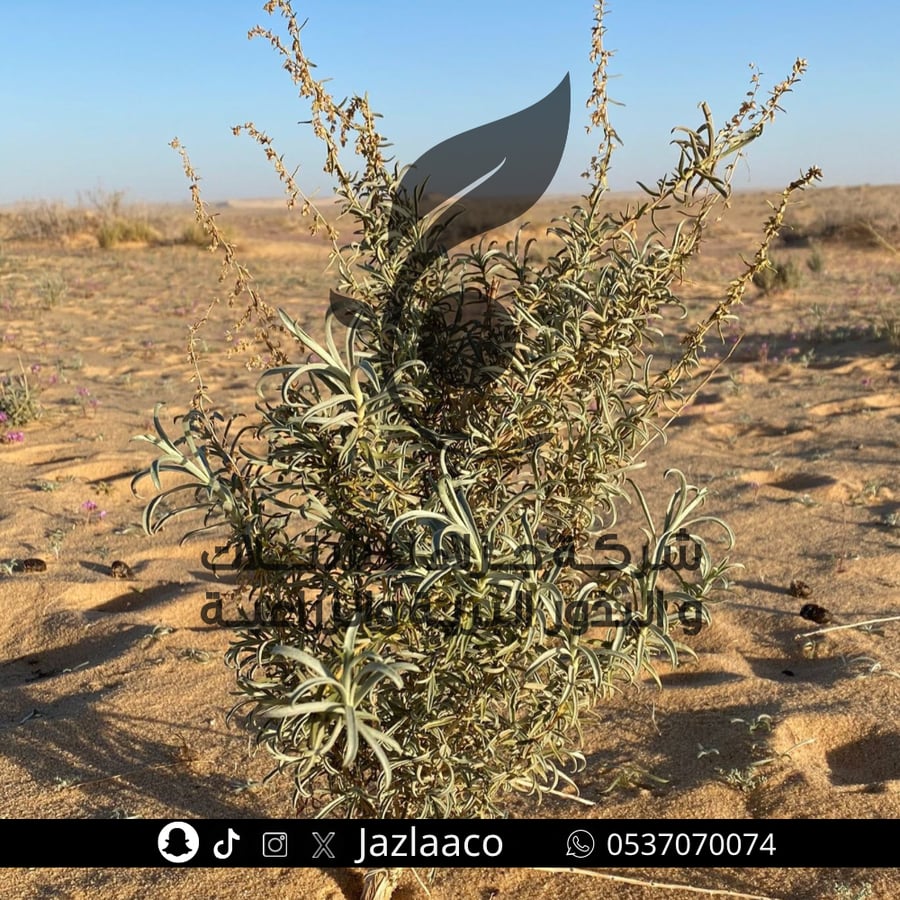
Artemisia monosperma seeds
9.50ر.س
Product description
Artemisia monosperma is a perennial desert shrub belonging to the Asteraceae family. It is a distinctive wild plant found in the sandy environments of Saudi Arabia and the Arabian Peninsula. It is characterized by its small, silvery or gray leaves, its aromatic scent, and its high tolerance to drought, heat, wind, and sand movement.
General Description
It grows as a branching shrub, typically reaching a height of about 50–100 cm, with branches that may extend horizontally for greater distances. It has woody stems at the base and fine green branches, and is relatively dense in suitable sandy locations.
Papers
Its leaves are small and delicate, and may be lobed or whole depending on their position on the stem. They are characterized by a grayish-green or silvery color. The leaves are covered with fine hairs that help reflect sunlight and reduce water loss, and they have a distinct aromatic scent when rubbed.
flowers
It produces small, yellow or greenish-yellow flower heads, clustered in bunches or inflorescences on branches. The inflorescences are small and inconspicuous compared to some other members of the Asteraceae family, but they appear in large numbers during the flowering season and provide food sources for insects.
Fruits and seeds
It produces small, dry, drupe-like fruits, each containing a single seed. The seeds are small and light, which helps them to disperse in sandy environments via wind and natural sand movement.
Endurance and suitability
The *Adhar* plant is highly tolerant of drought, heat, wind, and shifting sands, and thrives in sand dunes and sandy plains. Its extensive root system and spreading branches help stabilize the sand and reduce soil movement, making it an important plant in desert environments.
Uses
It has significant environmental importance in stabilizing sand dunes, combating desertification, and supporting desert vegetation. It also provides shelter and food for a number of wildlife and insects, and can be utilized in projects to rehabilitate sand dunes and degraded desert areas.
natural spread
Artemisia monosperma is naturally distributed across large areas of North Africa, the Arabian Peninsula and the eastern Mediterranean, and is found in Saudi Arabia in particular in sandy areas, dunes and open deserts.
Preservation status
Artemisia monosperma is not currently known to be globally threatened and has a wide natural distribution and good adaptability to harsh desert environments. Conserving its natural habitat remains important for its role in stabilizing sand and supporting desert plant diversity.
