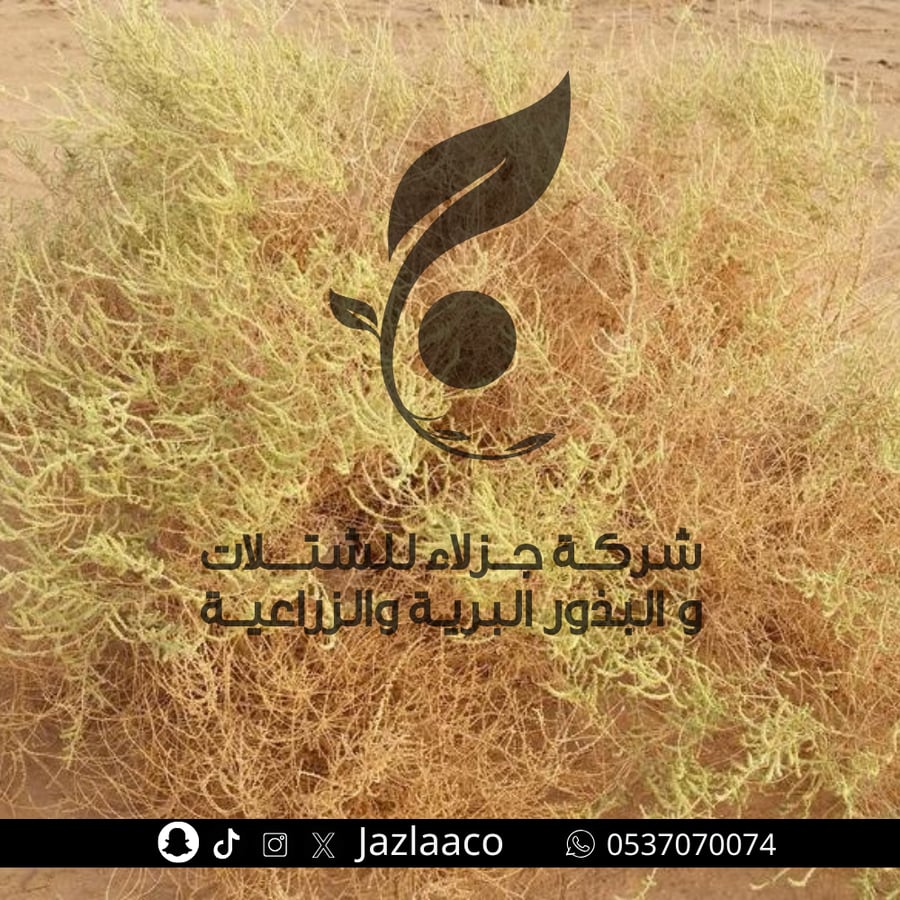


Thermoid - Pentanema divaricatum
9.50ر.س
Product description
Thermad (Pentanema divaricatum) is a perennial herbaceous plant from the Asteraceae family. It is a wild plant adapted to desert and semi-desert environments, and is characterized by its branching stems, yellow flowers, and ability to withstand drought and heat.
General Description
It grows as a branching herbaceous plant, upright or spreading, and usually reaches a height of about 20–60 cm. The stems emerge from the base of the plant and branch out widely, giving it a relatively spreading appearance.
Papers
Its leaves are green to gray-green, simple and alternate, ovate to lanceolate in shape, and may be covered with fine hairs. The lower leaves are relatively larger, while the leaves decrease towards the upper branches.
flowers
It produces yellow flower heads, clustered at the ends of branches, consisting of small ray and tubular flowers. The flowers appear during the growing season and attract a number of insects and pollinators.
Fruits and seeds
It produces small, dry, drupe-like fruits with downy coverings that aid in wind dispersal. After the flower heads dry, the seeds are released and transferred to new locations, helping the plant to regenerate and spread.
Endurance and suitability
Thermed is drought and heat tolerant, and grows in sandy and gravelly soils, open areas, and desert plains. Its ability to withstand harsh conditions allows it to survive in water-scarce environments.
Uses
It has environmental importance within the desert vegetation cover, and its flowers provide a source of nectar and pollen for insects and pollinators. It also contributes to soil stabilization and provides cover and shelter for small organisms.
natural spread
Pentanema divaricatum is widespread in parts of the Middle East, the Arabian Peninsula and North Africa, and grows in desert and semi-desert environments, sandy and gravelly areas and open plains.
Preservation status
Pentanema divaricatum is not currently known to be globally threatened, but its local density may be affected by grazing, habitat degradation and human activities.
